Review
. 2017:79:197-217.
doi: 10.1016/bs.ctm.2016.11.002. Epub 2017 Jan 16.

Piezo2 in Cutaneous and Proprioceptive Mechanotransduction in Vertebrates

Affiliations
Review

Piezo2 in Cutaneous and Proprioceptive Mechanotransduction in Vertebrates

E O Anderson et al. Curr Top Membr. 2017.

Abstract

Mechanosensitivity is a fundamental physiological capacity, which pertains to all life forms. Progress has been made with regard to understanding mechanosensitivity in bacteria, flies, and worms. In vertebrates, however, the molecular identity of mechanotransducers in somatic and neuronal cells has only started to appear. The Piezo family of mechanogated ion channels marks a pivotal milestone in understanding mechanosensitivity. Piezo1 and Piezo2 have now been shown to participate in a number of processes, ranging from arterial modeling to sensing muscle stretch. In this review, we focus on Piezo2 and its role in mediating mechanosensation and proprioception in vertebrates.

Keywords: Dorsal root ganglia; Mechanoreception; Mechanosensitivity; Mechanotransduction; Piezo2; Proprioception; Somatosensitivity; Trigeminal ganglia.


Figures

Figure 1
Figure 1. Hypothetical topology of Piezo2
Shown is a hypothetical transmembrane topology diagram of mouse Piezo2 based on the cryo-EM (Ge et al., 2015) and functional studies of mouse Piezo1 (Coste et al., 2015; Zhao et al., 2016). AD, anchor domain; CED, C-terminal extracellular domain; CTD, C-terminal domain; IH, inner helix; OH, outer helix. E2416 in the anchor domain alters pore properties of mouse Piezo2 (Coste et al., 2015). E2797 in the C-terminal domain is homologous to E2727 in human Piezo2. The deletion of E2727 in hPiezo2 prolongs kinetics of MA current inactivation in vitro (Dubin et al., 2012).
Figure 2
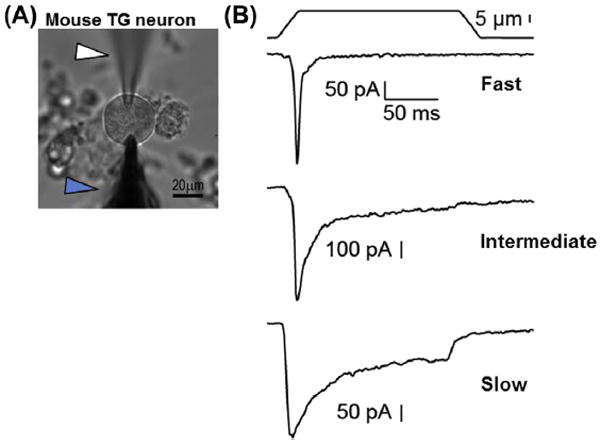
Figure 2. Mechanoactivated currents in mouse trigeminal neurons
(A) An image of a mouse trigeminal (TG) neuron with an electrode (white arrowhead) and blunt probe (blue arrowhead) in the working position to record MA current. (B) Representative whole cell currents from mouse trigeminal neurons showing exemplar fast, intermediate, and slow MA currents based on the rate of exponential current decay (τ). Currents were obtained from a holding potential of −60 mV, using a probe moving at 800 μm/s velocity. (For experimental details, see Schneider et al., 2014).
Figure 3
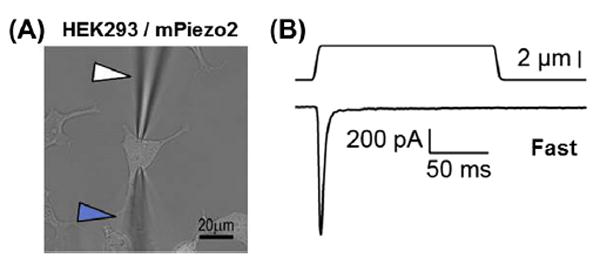
Figure 3. Mouse Piezo2 generates fast inactivating MA current in HEK293 cells
(A) An image of an HEK293 cell expressing mouse Piezo2 during voltage clamp recording to obtain MA current in response to mechanical stimulation with a glass probe. White arrowhead: electrode; blue arrowhead: mechanical probe. (B) Representative fast MA current (τ < 10 ms) trace from mPiezo2 in HEK293 cell obtained in the whole cell configuration from a holding potential of −60 mV. Currents were obtained from a holding potential of −80 mV, using a probe moving at 800 μm/s velocity. Solutions used (mM): bath, 140 NaCl, 5 KCl, 2.5 CaCl2, 1 MgCl2, 10 glucose, 10 HEPES/NaOH pH 7.4; pipette: 133CsCl, 5 EGTA, 1 CaCl2, 1 MgCl2, 4 MgATP, 0.4 Na2GTP, 10 HEPES/CsOH pH 7.3.
Figure 4
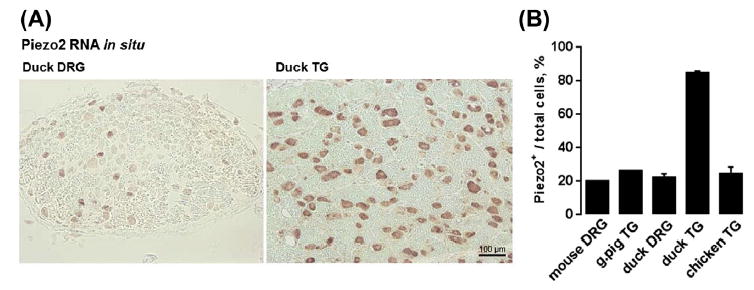
Figure 4. Piezo2 expression in trigeminal ganglia (TG) and dorsal root ganglia (DRG) of rodents and birds
(A) Representative RNA in situ hybridization images from duck TG and DRG using Piezo2 antisense probe. (B) Quantification of Piezo2 mRNA-expressing neurons from TG and DRG of mice (Coste et al., 2010), guinea pig (Bron et al., 2014) and birds (Schneider et al., 2014).

References

    1. Akopian AN, Sivilotti L, Wood JN. A tetrodotoxin-resistant voltage-gated sodium channel expressed by sensory neurons. Nature. 1996;379:257–262. - PubMed
    1. Alamri A, Bron R, Brock JA, Ivanusic JJ. Transient receptor potential cation channel subfamily V member 1 expressing corneal sensory neurons can be subdivided into at least three subpopulations. Frontiers in Neuroanatomy. 2015;9:71. - PMC - PubMed
    1. Arber S, Ladle DR, Lin JH, Frank E, Jessell TM. ETS gene Er81 controls the formation of functional connections between group Ia sensory afferents and motor neurons. Cell. 2000;101:485–498. - PubMed
    1. Arends JJ, Dubbeldam JL. The subnuclei and primary afferents of the descending trigeminal system in the mallard (Anas platyrhynchos L.) Neuroscience. 1984;13:781–795. - PubMed
    1. Bagriantsev SN, Gracheva EO, Gallagher PG. Piezo proteins: Regulators of mechanosensation and other cellular processes. Journal of Biological Chemistry. 2014;289:31673–31681. - PMC - PubMed

Publication types