Clinical Trial
. 2018 Feb;141(2):718-729.e7.
doi: 10.1016/j.jaci.2017.06.022. Epub 2017 Jul 18.

Airway microbiota signals anabolic and catabolic remodeling in the transplanted lung

Collaborators, Affiliations
Clinical Trial

Airway microbiota signals anabolic and catabolic remodeling in the transplanted lung

Stéphane Mouraux et al. J Allergy Clin Immunol. 2018 Feb.

Abstract

Background: Homeostatic turnover of the extracellular matrix conditions the structure and function of the healthy lung. In lung transplantation, long-term management remains limited by chronic lung allograft dysfunction, an umbrella term used for a heterogeneous entity ultimately associated with pathological airway and/or parenchyma remodeling.

Objective: This study assessed whether the local cross-talk between the pulmonary microbiota and host cells is a key determinant in the control of lower airway remodeling posttransplantation.

Methods: Microbiota DNA and host total RNA were isolated from 189 bronchoalveolar lavages obtained from 116 patients post lung transplantation. Expression of a set of 11 genes encoding either matrix components or factors involved in matrix synthesis or degradation (anabolic and catabolic remodeling, respectively) was quantified by real-time quantitative PCR. Microbiota composition was characterized using 16S ribosomal RNA gene sequencing and culture.

Results: We identified 4 host gene expression profiles, among which catabolic remodeling, associated with high expression of metallopeptidase-7, -9, and -12, diverged from anabolic remodeling linked to maximal thrombospondin and platelet-derived growth factor D expression. While catabolic remodeling aligned with a microbiota dominated by proinflammatory bacteria (eg, Staphylococcus, Pseudomonas, and Corynebacterium), anabolic remodeling was linked to typical members of the healthy steady state (eg, Prevotella, Streptococcus, and Veillonella). Mechanistic assays provided direct evidence that these bacteria can impact host macrophage-fibroblast activation and matrix deposition.

Conclusions: Host-microbes interplay potentially determines remodeling activities in the transplanted lung, highlighting new therapeutic opportunities to ultimately improve long-term lung transplant outcome.

Keywords: Airway remodeling; fibroblasts; macrophages; matrix; microbiota.


Figures

None
Graphical abstract
Fig 1
Fig 1
Identification of a set of remodeling genes. A, Schematic outline of experimental approach. B, GO criteria used in candidate gene selection process. C, Principal component (PC) analysis, and associated eigenvectors, based on quantitative PCR determination of expression of the restricted list of 11 remodeling genes (see Table II for details) in the initial subset of 9 BAL samples (dots).
Fig 2
Fig 2
Identification of 4 remodeling gene expression profiles in posttransplantation BAL samples. PC analysis (A) and hierarchical clustering (B) based on qPCR determination of gene expression (C). Medians and IQRs are indicated. *P < .05, **P < .01, ***P < .001, and ****P < .0001. Transversal (D) and intraindividual (E) posttransplantation variations in remodeling gene expression profile. E, Data show the frequency of sample pairs that displayed acquisition of a new remodeling profile. F, Schematic diagram of intraindividual remodeling profile transitions with indicated occurrences.
Fig 3
Fig 3
Associations between the pulmonary microbiota and host remodeling gene expression. Microbiota status (A), the 10 most abundant microbial genera (B), Shannon diversity index with medians and IQRs, *P < .05 (C) and culture outcome (D) as per remodeling profile. E, Kinetics of microbiota status posttransplantation. F, Bray-Curtis principal coordinate (PCo) analysis of inferred metagenomic content. G, Differential abundance analysis focused on KOs related to bacteria-matrix interaction or proteolysis, on a catabolic versus anabolic remodeling gene expression background.
Fig 4
Fig 4
Associations among host remodeling, inflammation, and infection. Relationship among host remodeling and BAL cell differential (A), expression of inflammatory genes COX2 and TNF-α (B), prevalence of suspected clinical infection (C), and bacteria isolated by culture and/or driving dysbiosis (D). In panels A and B, medians and IQRs are indicated. *P < .05, **P < .01, ***P < .001, and ****P < .0001.
Fig 5
Fig 5
Impact of bacterial stimulation on remodeling gene expression in macrophage-fibroblast cocultures. A, Gene expression-based PC analysis. Dots represent the mean coordinates obtained from duplicates in 3 independent experiments. B, Quantitative PCR-based gene expression analysis. Immunostaining (C) and quantification (D) of deposited matrix proteins. Scale bar represents 100 μm. B-D, Data were from 6 independent experiments. Values represented as mean with SEM are expressed as fold-change over baseline. *P < .05, **P < .01, and ***P < .001.
Fig E1
Fig E1
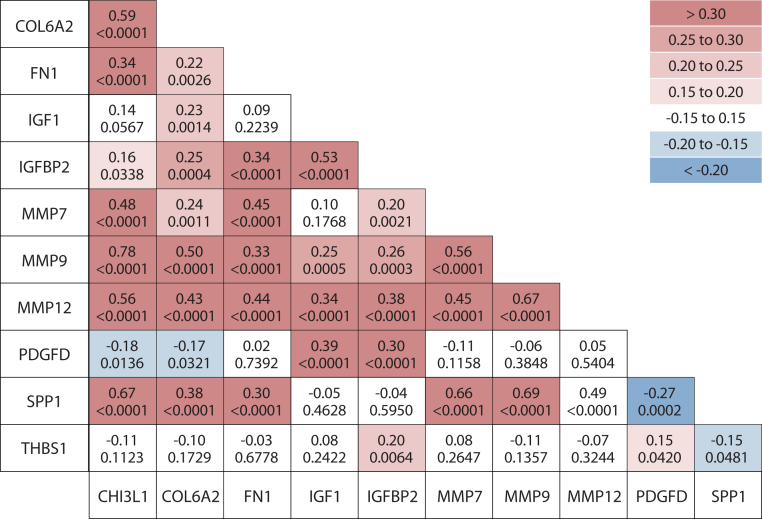
Spearman correlation coefficient matrix based on expression levels of the selected 11 remodeling genes. Gene names are listed in Table II. Data are presented as Spearman ρ with P value, obtained by analyzing by quantitative PCR expression of the 11 selected genes in the total set of 187 BAL samples.
Fig E2
Fig E2
Cell viability determined in fibroblast-THP-DM cocultures, either in the absence (no bacteria) or presence of bacterial mixtures, as indicated. Data were pooled from 3 independent experiments with duplicates. Values (mean ± SEM) were normalized to viability levels in the absence of bacteria. Statistical significance was determined using Friedman test and Dunn post hoc analysis.

References

    1. Yusen R.D., Edwards L.B., Kucheryavaya A.Y., Benden C., Dipchand A.I., Goldfarb S.B. The Registry of the International Society for Heart and Lung Transplantation: Thirty-second Official Adult Lung and Heart-Lung Transplantation Report–2015; Focus Theme: Early Graft Failure. J Heart Lung Transplant. 2015;34:1264–1277. - PubMed
    1. Suwara M.I., Vanaudenaerde B.M., Verleden S.E., Vos R., Green N.J., Ward C. Mechanistic differences between phenotypes of chronic lung allograft dysfunction after lung transplantation. Transpl Int. 2014;27:857–867. - PMC - PubMed
    1. Charlson E.S., Diamond J.M., Bittinger K., Fitzgerald A.S., Yadav A., Haas A.R. Lung-enriched organisms and aberrant bacterial and fungal respiratory microbiota after lung transplant. Am J Respir Crit Care Med. 2012;186:536–545. - PMC - PubMed
    1. Hilty M., Burke C., Pedro H., Cardenas P., Bush A., Bossley C. Disordered microbial communities in asthmatic airways. PLoS One. 2010;5:e8578. - PMC - PubMed
    1. Huang Y.J., Sethi S., Murphy T., Nariya S., Boushey H.A., Lynch S.V. Airway microbiome dynamics in exacerbations of chronic obstructive pulmonary disease. J Clin Microbiol. 2014;52:2813–2823. - PMC - PubMed

Publication types

MeSH terms