


Response to Comments on "The [4Fe4S] cluster of human DNA primase functions as a redox switch using DNA charge transport"
- PMID: 28729485
- PMCID: PMC5935490
- DOI: 10.1126/science.aan2762
Response to Comments on "The [4Fe4S] cluster of human DNA primase functions as a redox switch using DNA charge transport"
Abstract
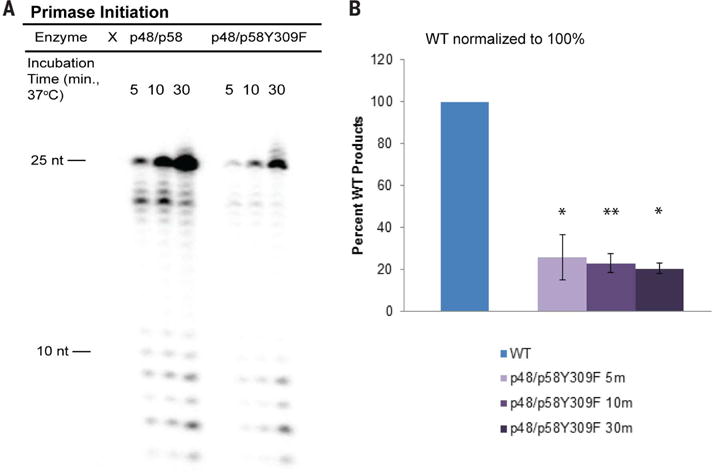
Baranovskiy et al and Pellegrini argue that, based on structural data, the path for charge transfer through the [4Fe4S] domain of primase is not feasible. Our manuscript presents electrochemical data directly showing charge transport through DNA to the [4Fe4S] cluster of a primase p58C construct and a reversible switch in the DNA-bound signal with oxidation/reduction, which is inhibited by mutation of three tyrosine residues. Although the dispositions of tyrosines differ in different constructs, all are within range for microsecond electron transfer.
Copyright © 2017 The Authors, some rights reserved; exclusive licensee American Association for the Advancement of Science. No claim to original U.S. Government Works.
Figures
Comment on
-
Comment on "The [4Fe4S] cluster of human DNA primase functions as a redox switch using DNA charge transport".Science. 2017 Jul 21;357(6348):eaan2396. doi: 10.1126/science.aan2396. Science. 2017. PMID: 28729484 Free PMC article.
-
Comment on "The [4Fe4S] cluster of human DNA primase functions as a redox switch using DNA charge transport".Science. 2017 Jul 21;357(6348):eaan2954. doi: 10.1126/science.aan2954. Science. 2017. PMID: 28729486
References
-
- O’Brien E, et al. Science. 2017;355:eaag1789.
-
- Baranovskiy AG, et al. Science. 2017;357:eaan2396.
-
- Pellegrini L. Science. 2017;357:eaan2954. - PubMed
Publication types
MeSH terms
Substances
Grants and funding
LinkOut - more resources
Full Text Sources
Other Literature Sources
