


Radiation-induced liver disease: current understanding and future perspectives
- PMID: 28729640
- PMCID: PMC5565955
- DOI: 10.1038/emm.2017.85
Radiation-induced liver disease: current understanding and future perspectives
Abstract
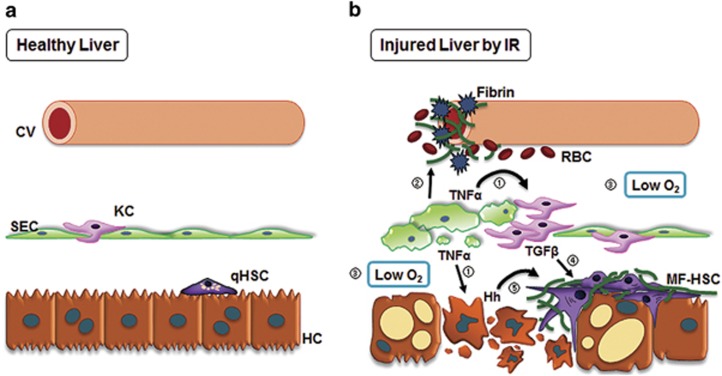
Although radiotherapy (RT) is used for the treatment of cancers, including liver cancer, radiation-induced liver disease (RILD) has emerged as a major limitation of RT. Radiation-induced toxicities in nontumorous liver tissues are associated with the development of numerous symptoms that may limit the course of therapy or have serious chronic side effects, including late fibrosis. Although the clinical characteristics of RILD patients have been relatively well described, the understanding of RILD pathogenesis has been hampered by a lack of reliable animal models for RILD. Despite efforts to develop suitable experimental animal models for RILD, current animal models rarely present hepatic veno-occlusive disease, the pathological hallmark of human RILD patients, resulting in highly variable results in RILD-related studies. Therefore, we introduce the concept and clinical characteristics of RILD and propose a feasible explanation for RILD pathogenesis. In addition, currently available animal models of RILD are reviewed, focusing on similarities with human RILD and clues to understanding the mechanisms of RILD progression. Based on these findings from RILD research, we present potential therapeutic strategies for RILD and prospects for future RILD studies. Therefore, this review helps broaden our understanding for developing effective treatment strategies for RILD.
Conflict of interest statement
The authors declare no conflict of interest.
Figures
References
-
- Feng M, Ben-Josef E. Radiation therapy for hepatocellular carcinoma. Semin Radiat Oncol 2011; 21: 271–277. - PubMed
-
- Torre LA, Bray F, Siegel RL, Ferlay J, Lortet-Tieulent J, Jemal A. Global cancer statistics, 2012. CA Cancer J Clin 2015; 65: 87–108. - PubMed
-
- Villanueva A, Hernandez-Gea V, Llovet JM. Medical therapies for hepatocellular carcinoma: a critical view of the evidence. Nat Rev Gastroenterol Hepatol 2013; 10: 34–42. - PubMed
-
- Hawkins MA, Dawson LA. Radiation therapy for hepatocellular carcinoma: from palliation to cure. Cancer 2006; 106: 1653–1663. - PubMed
Publication types
MeSH terms
LinkOut - more resources
Full Text Sources
Other Literature Sources
Medical
