


Changing Trends in Stomach Cancer Throughout the World
- PMID: 28730504
- PMCID: PMC6918953
- DOI: 10.1007/s11894-017-0575-8
Changing Trends in Stomach Cancer Throughout the World
Abstract
Purpose of review: The paper aims to discuss the global trends in gastric cancer incidence in relation to important factors involved in the pathogenesis of gastric cancer.
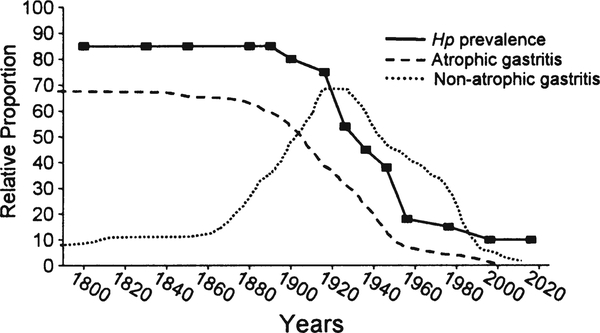
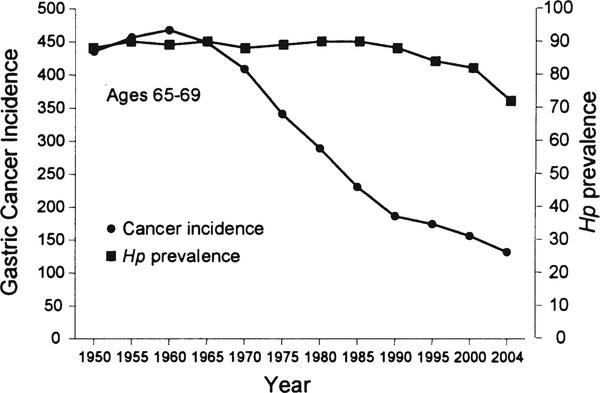
Recent findings: Despite a significant worldwide decline, gastric cancer remains a common cause of cancer death. The decline has been multifactorial and preceded the fall in Helicobacter pylori prevalence. The initial decline was associated with changes in food preservation and availability, especially of fresh fruits and vegetables, followed by a decline in the primary etiologic factor, H. pylori. Gastric cancer incidence remains high in East Asia, intermediate in Latin America, and low in developed countries. Significant racial/ethnic variability exists. The rapid decline in incidence in East Asia will continue as primary and secondary prevention strategies are implemented. The incidence in Latin America is unlikely to decline significantly over the next few decades given high H. pylori prevalence in the young. Ultimately, global H. pylori eradication will be needed to largely eliminate gastric cancer.
Keywords: Disparities; Epidemiology; Gastric cancer; Helicobacter pylori; Natural history; Risk factors.
Conflict of interest statement
Figures
References
-
-
Graham DY. Helicobacter pylori update: gastric cancer, reliable therapy, and possible benefits. Gastroenterology. 2015;148(4):719–31.e3. doi: 10.1053/j.gastro.2015.01.040.
Excellent review that discusses the effects of H. pylori infection and challenges, benefits, and potential downsides of its eradication.
-
-
-
Sugano K, Tack J, Kuipers EJ, Graham DY, El-Omar EM, Miura S, et al. Kyoto global consensus report on Helicobacter pylori gastritis. Gut. 2015;64(9):1353–67. doi: 10.1136/gutjnl-2015-309252.
Global consensus on gastritis which discusses classification of chronic gastritis and duodenitis and defines H. pylori infection as an infectious disease that should be cured whenever encountered.
-
-
-
Asaka M, Kato M, Sakamoto N. Roadmap to eliminate gastric cancer with Helicobacter pylori eradication and consecutive surveillance in Japan. Journal of gastroenterology. 2014;49(1):1–8. doi: 10.1007/s00535-013-0897-8.
Excellent review of the Japanese experience in H. pylori eradication as an approach to reducing gastric cancer deaths.
-
-
- Feldman M. Sleisenger & Fordtran’s gastrointestinal and liver disease: pathophysiology, diagnosis, management. 9th ed 2014 Philadelphia, PA: Saunders Elsevier; 2010. p. 887–906.
Publication types
MeSH terms
Grants and funding
LinkOut - more resources
Full Text Sources
Other Literature Sources
Medical
