


The Relationship of Brain Amyloid Load and APOE Status to Regional Cortical Thinning and Cognition in the ADNI Cohort
- PMID: 28731444
- PMCID: PMC6310151
- DOI: 10.3233/JAD-170286
The Relationship of Brain Amyloid Load and APOE Status to Regional Cortical Thinning and Cognition in the ADNI Cohort
Abstract
Background: Both amyloid (Aβ) load and APOE4 allele are associated with neurodegenerative changes in Alzheimer's disease (AD) prone regions and with risk for cognitive impairment.
Objective: To evaluate the unique and independent contribution of APOE4 allele status (E4+∖E4-), Aβ status (Amy+∖Amy-), and combined APOE4 and Aβ status on regional cortical thickness (CoTh) and cognition among participants diagnosed as cognitively normal (CN, n = 251), early mild cognitive impairment (EMCI, n = 207), late mild cognitive impairment (LMCI, n = 196), and mild AD (n = 162) from the ADNI.
Methods: A series of two-way ANCOVAs with post-hoc Tukey HSD tests, controlling independently for Aβ and APOE4 status and age were examined.
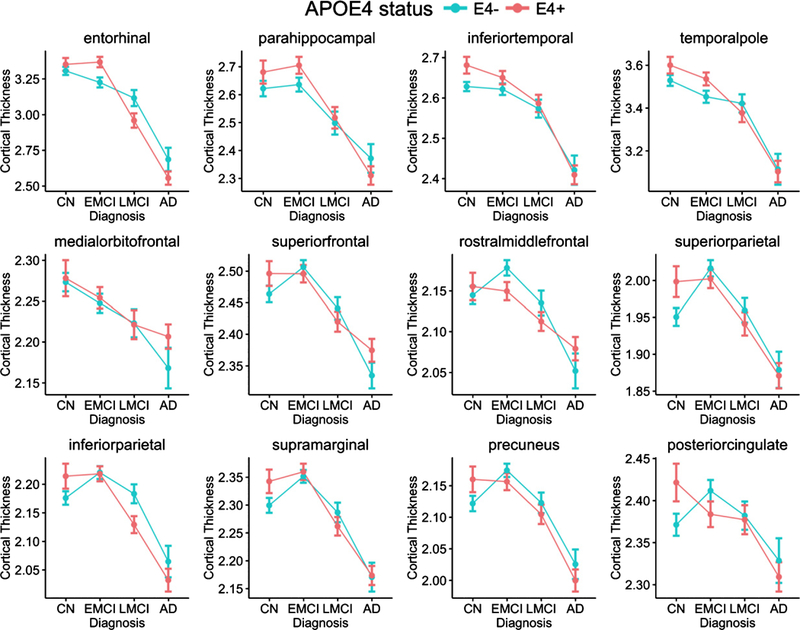
Results: Among LMCI and AD participants, cortical thinning was widespread in association with Amy+ status, whereas in association with E4+ status only in the inferior temporal and medial orbito-frontal regions. Among CN and EMCI participants, E4+ status, but not Amy+ status, was independently associated with increased CoTh, especially in limbic regions [e.g., in the entorhinal cortex, CoTh was 0.123 mm greater (p = 0.002) among E4+ than E4-participants]. Among CN and EMCI, both E4+ and Amy+ status were independently associated with cognitive impairment, which was greatest among those with combined E4 + and Amy+ status.
Conclusion: Decreased CoTh is independently associated with Amy+ status in many brain regions, but with E4+ status in very restricted number of brain regions. Among CN and EMCI participants, E4 + status is associated with increased CoTh, in medial and inferior temporal regions, although cognitive impairment at this state is independently associated with Amy+ and E4 + status. These findings imply a unique pathophysiological mechanism for E4 + status in AD and its progression.
Keywords: ADNI; APOE; Alzheimer’s disease; amyloid; cortical thinning; memory; mild cognitive impairment.
Figures



References
-
- Selkoe DJ (1991) The molecular pathology of Alzheimer’s disease. Neuron 6, 487–498. - PubMed
-
- Hyman BT, Phelps CH, Beach TG, Bigio EH, Cairns NJ, Carrillo MC, Dickson DW, Duyckaerts C, Frosch MP, Masliah E, Mirra SS, Nelson PT, Schneider JA, Thal DR, Thies B, Trojanowski JQ, Vinters HV, Montine TJ (2012) National Institute on Aging-Alzheimer’s Association guidelines for the neuropathologic assessment of Alzheimer’s disease. Alzheimers Dement 8, 1–13. - PMC - PubMed
-
- Murphy KR, Landau SM, Choudhury KR, Hostage CA, Shpanskaya KS, Sair HI, Petrella JR, Wong TZ, Doraiswamy PM, Alzheimer’s Disease Neuroimaging Initiative (2013) Mapping the effects of ApoE4, age and cognitive status on 18F-florbetapir PET measured regional cortical patterns of beta-amyloid density and growth. Neuroimage 78, 474–480. - PMC - PubMed
-
- Drzezga A, Grimmer T, Henriksen G, Muhlau M, Perneczky R, Miederer I, Praus C, Sorg C, Wohlschlager A, Riemenschneider M, Wester HJ, Foerstl H, Schwaiger M, Kurz A (2009) Effect of APOE genotype on amyloid plaque load and gray matter volume in Alzheimer disease. Neurology 72, 1487–1494. - PubMed
-
- Fleisher AS, Chen K, Liu X, Ayutyanont N, Roontiva A, Thiyyagura P, Protas H, Joshi AD, Sabbagh M, Sadowsky CH, Sperling RA, Clark CM, Mintun MA, Pontecorvo MJ, Coleman RE, Doraiswamy PM, Johnson KA, Carpenter AP, Skovronsky DM, Reiman EM (2013) Apolipoprotein E epsilon4 and age effects on florbetapir positron emission tomography in healthy aging and Alzheimer disease. Neurobiol Aging 34, 1–12. - PubMed
MeSH terms
Substances
Grants and funding
LinkOut - more resources
Full Text Sources
Other Literature Sources
Medical
Miscellaneous
