


Uncultivated microbes in need of their own taxonomy
- PMID: 28731467
- PMCID: PMC5649169
- DOI: 10.1038/ismej.2017.113
Uncultivated microbes in need of their own taxonomy
Abstract
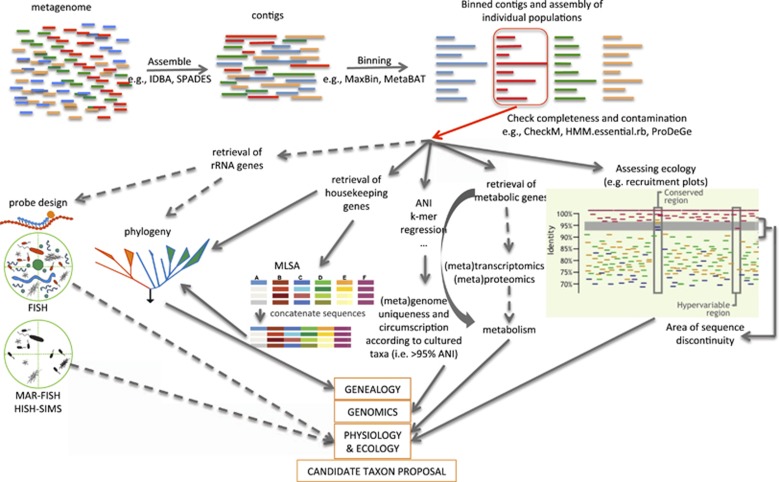
The great majority of microbial species remains uncultured, severely limiting their taxonomic characterization and thus communication among scientists. Although Candidatus was devised as a provisional category to classify uncultured taxa, it has not been widely accepted owing to technical limitations and lack of priority of Candidatus names in the official nomenclature. High-throughput sequencing provides the potential for data-rich taxonomic descriptions of uncultivated microbes, comparable in quality to those of cultured organisms. In order to fully realize this potential, standards and guidelines on how to perform these descriptions are needed. Here we aimed to outline these standards and draw the roadmap for a new genome-based taxonomy that, at least initially, would be parallel but highly convergent to the one in existence for isolates. In particular, we recommend the use of DNA genome sequences, recovered by population binning or single-cell techniques, as the basis for (i) identification and phylogenetic placement, (ii) bioinformatics-based functional and thus phenotypic predictions, as well as (iii) type material. We also recommend the implementation of an independent nomenclatural system for uncultivated taxa, following the same nomenclature rules as those for cultured Bacteria and Archaea but with its own list of validly published names. If widely adopted, this system will not only facilitate a comprehensive characterization of the 'uncultivated majority', but also provide a unified catalogue of validly published names, thereby avoiding synonyms and confusion. We also suggest that a committee of experts, supported by an international microbiological society, should be formed to govern the new classification system.
Conflict of interest statement
The authors declare no conflict of interest.
Figures
Comment in
-
Uncultivated microbes-in need of their own nomenclature?ISME J. 2018 Feb;12(2):309-311. doi: 10.1038/ismej.2017.188. Epub 2017 Oct 20. ISME J. 2018. PMID: 29053144 Free PMC article. No abstract available.
-
Reply to the commentary "Uncultivated microbes-in need of their own nomenclature?".ISME J. 2018 Mar;12(3):653-654. doi: 10.1038/s41396-017-0011-y. Epub 2018 Jan 15. ISME J. 2018. PMID: 29335639 Free PMC article. No abstract available.
References
-
- Abreu F, Martins JL, Silveira TS, Keim CN, de Barros HG, Filho FJ et al. (2007). 'Candidatus Magnetoglobus multicellularis', a multicellular, magnetotactic prokaryote from a hypersaline environment. Int J Syst Evol Microbiol 57: 1318–1322. - PubMed
-
- Albertsen M, Hugenholtz P, Skarshewski A, Nielsen KL, Tyson GW, Nielsen PH. (2013). Genome sequences of rare, uncultured bacteria obtained by differential coverage binning of multiple metagenomes. Nat Biotechnol 31: 533–538. - PubMed
-
- Caro-Quintero A, Konstantinidis KT. (2012). Bacterial species may exist, metagenomics reveal. Environ Microbiol 14: 347–355. - PubMed
MeSH terms
LinkOut - more resources
Full Text Sources
Other Literature Sources
