Review
. 2017 Sep 8:71:731-751.
doi: 10.1146/annurev-micro-090816-093913. Epub 2017 Jul 21.

The Colorful World of Extracellular Electron Shuttles

Affiliations
Review

The Colorful World of Extracellular Electron Shuttles

Nathaniel R Glasser et al. Annu Rev Microbiol. .

Abstract

Descriptions of the changeable, striking colors associated with secreted natural products date back well over a century. These molecules can serve as extracellular electron shuttles (EESs) that permit microbes to access substrates at a distance. In this review, we argue that the colorful world of EESs has been too long neglected. Rather than simply serving as a diagnostic attribute of a particular microbial strain, redox-active natural products likely play fundamental, underappreciated roles in the biology of their producers, particularly those that inhabit biofilms. Here, we describe the chemical diversity and potential distribution of EES producers and users, discuss the costs associated with their biosynthesis, and critically evaluate strategies for their economical usage. We hope this review will inspire efforts to identify and explore the importance of EES cycling by a wide range of microorganisms so that their contributions to shaping microbial communities can be better assessed and exploited.

Keywords: extracellular electron shuttle; metabolism; microbial diversity; public goods; redox chemistry.


Figures
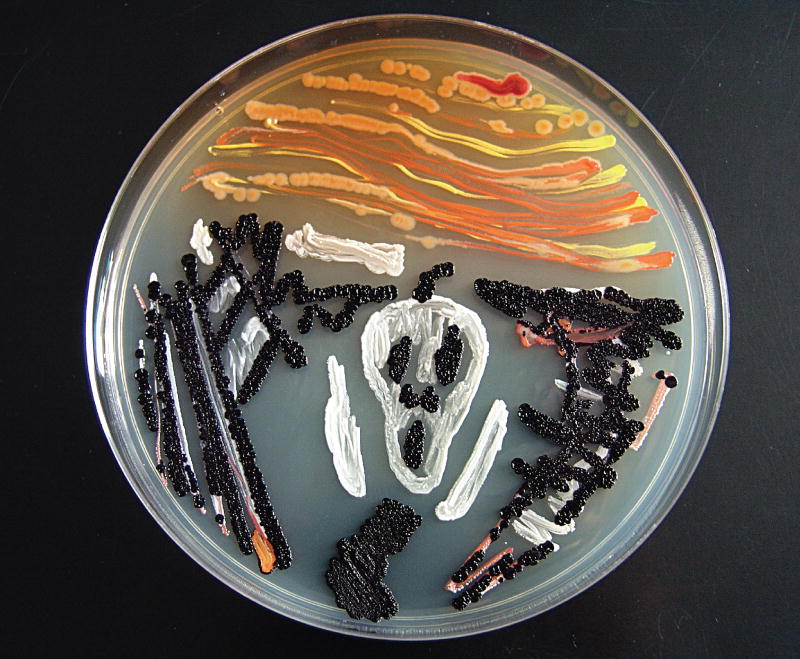
Figure 1
Figure 1
The colorful microbial world: The Scream rendered in bacteria. Black bacteria are Chromobacterium violaceum, and white bacteria are Staphylococcus epidermidis. Others are a mix of Micrococcus luteus (yellow) and unidentified pink and orange strains from different environmental samples. Reproduced courtesy of Tomislav Ivankovic, University of Zagreb, Croatia.
Figure 2
Figure 2
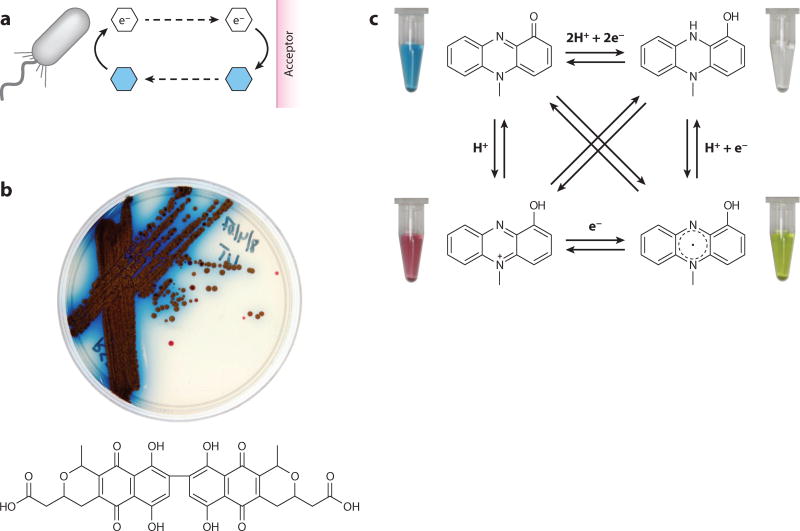
General concept and structures of representative extracellular electron shuttles (EESs). (a) Action at a distance. Cells can transfer electrons to small molecules, which then transfer these electrons to distant extracellular acceptors. (b) Redox-active pigment production by Streptomyces coelicolor, including actinorhodin, whose structure is shown below. (c) One molecule, four colors. The color of pyocyanin depends on both pH and reduction potential. The tubes pictured each contain approximately 200-µM pyocyanin in water. The radical and fully reduced forms can be prepared by titrating pyocyanin with sodium dithionite, producing an immediate and stunning color change. Note that “e” represents a single- or multiple-electron transfer reaction, depending on the particular EES.
Figure 3
Figure 3
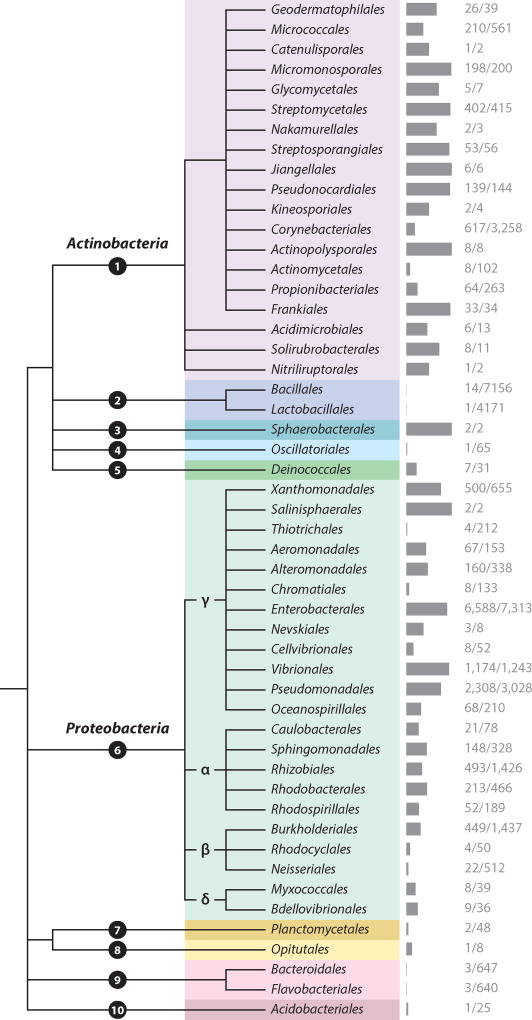
Phylogenetic distribution of SoxR, a transcription factor that senses redox-active metabolites. The phylogenetic tree shows all bacterial orders containing at least one genome with a SoxR homolog in the Integrated Microbial Genomes database [SoxR TIGRfam 01950 (14)]. The gray bars represent the percentage of genomes from each order that contain SoxR, with the number of SoxR-containing genomes over the total listed on the right. The tree was generated using the National Center for Biotechnology Information taxonomic classification with the Phylogenetic Tree Generator and Interactive Tree of Life (37, 69). Phyla: ❶ Actinobacteria, ❷ Firmicutes, ❸ Chloroflexi, ❹ Cyanobacteria, ❺ Deinococcus, ❻ Proteobacteria, ❼ Planctomycetes, ❽ Verrucomicrobia, ❾ Bacteroidetes, ❿ Acidobacteria.
Figure 4
Figure 4
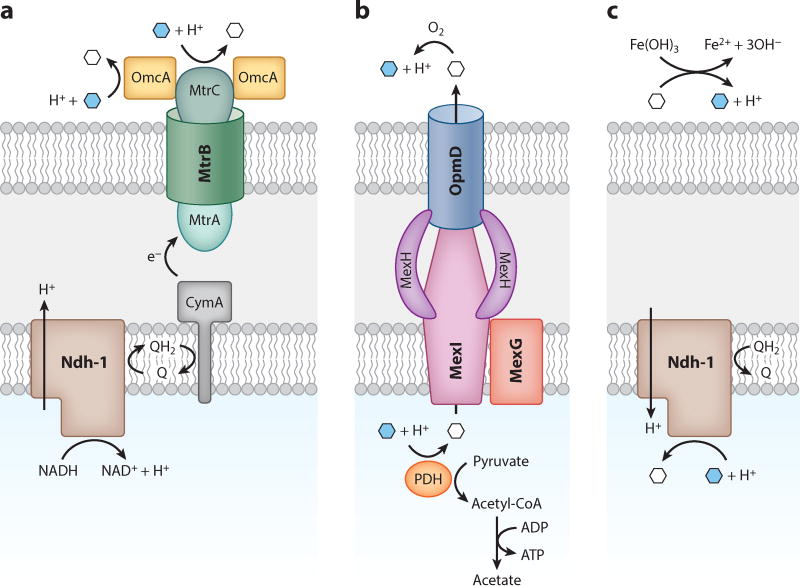
The topology of electron shuttle reduction (white hexagons) and oxidation (blue hexagons). For simplicity, we show only single electrons and protons without considering the stoichiometry of individual reactions. (a) The Mtr system in Shewanella oneidensis MR-1. Shuttles are reduced extracellularly and do not need to reenter the cell. (b) A model of phenazine reduction in Pseudomonas aeruginosa that allows for energy conservation by electron shuttling. By substituting for NAD+ in the pyruvate dehydrogenase complex (PDH), phenazines enable the synthesis of acetyl-CoA, which can drive ATP synthesis through the enzymes phosphate transacetylase and acetate kinase (45, 46). Efflux of reduced phenazines by MexGHI-OpmD (100) may be coupled to proton translocation. (c) A condition where electron shuttling is costly. Operating the NADH dehydrogenase in reverse can consume the proton motive force to drive paraquat reduction (18). Extracellular reduction of some minerals, such as Fe(OH)3, can alkalize the medium, possibly depleting the proton motive force further and causing pH stress for the cell.
Figure 5
Figure 5
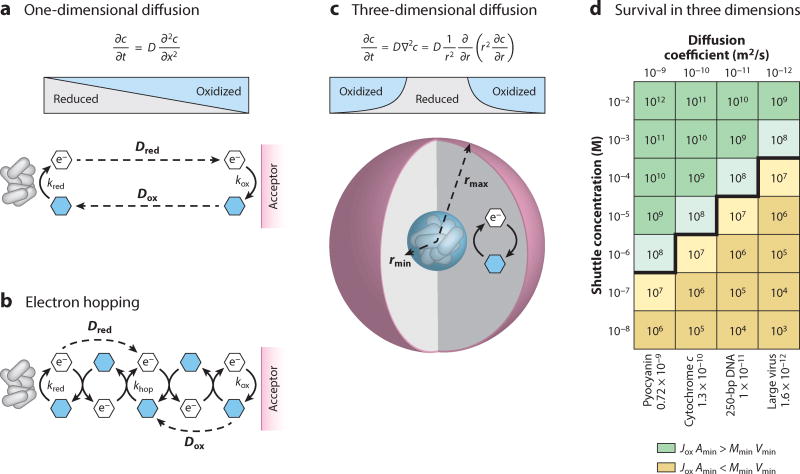
Mechanisms of electron transfer by extracellular electron shuttles (EESs). (a) Diffusion only. The reduced EES can diffuse down its concentration gradient to an electron acceptor, whereas the oxidized form simultaneously returns along its own concentration gradient. At steady state (∂c/∂t = 0), the concentration gradients are linear in this closed, one-dimensional system. (b) The self-exchange rate (khop) allows electrons to hop between oxidized and reduced EESs. If khop is significantly faster than the rate of diffusion, electron hopping will accelerate the apparent diffusion of electrons. EES diffusion can also co-occur. (c) In three dimensions, with an inner sphere of cells and an outer sphere of electron acceptor, the concentration gradient at steady state is nonlinear. The gradient is steeper near the inner sphere, allowing for higher flux than in the one-dimensional case. (d) Results of a closed, steady-state model of EES diffusion in three dimensions, with different EES concentrations and diffusion coefficients. The results were obtained by solving for the concentration profile at steady state (∂c/∂t = 0) and applying Fick’s first law [J = −D (∂c/∂r)] to obtain J=3 DN4πr2(1rmin1rmax)1(rmax3rmin3)1. The number in each box corresponds to the modeled flux of oxidized EES (J evaluated at r = rmin) through the surface area (Amin) of the inner sphere, in units of molecules per second. Green indicates regions where diffusion can account for the minimum flux needed for cells to survive, and tan indicates regions where diffusion is too slow. The number of molecules per second needed to support the inner sphere with volume Vmin was calculated to be 1.5 × 10⁷ based on published parameters for Mmin, the minimum energy required for survival in Pseudomonas aeruginosa (64). The inner sphere radius was rmin = 10 µm, and the outer sphere radius was rmax = 100 µm. For simplicity, we have taken the diffusion constants of the oxidized and reduced EES (Dred and Dox) to be equivalent, and the rates of EES reduction and oxidation (kred and kox) to be instant. Representative aqueous diffusion coefficients spanning a range of biomolecular structures, pyocyanin, cytochrome c, 250-bp DNA, and a large virus are listed below the plot for comparison (29, 73, 77, 79).

References

    1. Chemnetbase. Dictionary of Natural Products 25.2. Taylor and Francis; Oxford, UK: 2017. [accessed February, 2017]. http://dnp.chemnetbase.com/
    1. Alberty RA. Thermodynamics of the nitrogenase reactions. J. Biol. Chem. 1994;269:7099–102. - PubMed
    1. Amthor JS. The McCree–de Wit–Penning de Vries–Thornley respiration paradigms: 30 years later. Ann. Bot. 2000;86:1–20.
    1. Assary RS, Brushett FR, Curtiss LA. Reduction potential predictions of some aromatic nitrogen-containing molecules. RSC Adv. 2014;4:57442–51.
    1. Bacher A, Eberhardt S, Fischer M, Kis K, Richter G. Biosynthesis of vitamin B2 (riboflavin) Annu. Rev. Nutr. 2000;20:153–67. - PubMed

Publication types

MeSH terms

Substances