


The KP1_4563 gene is regulated by the cAMP receptor protein and controls type 3 fimbrial function in Klebsiella pneumoniae NTUH-K2044
- PMID: 28732013
- PMCID: PMC5521740
- DOI: 10.1371/journal.pone.0180666
The KP1_4563 gene is regulated by the cAMP receptor protein and controls type 3 fimbrial function in Klebsiella pneumoniae NTUH-K2044
Abstract
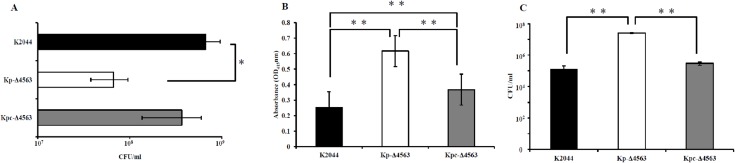
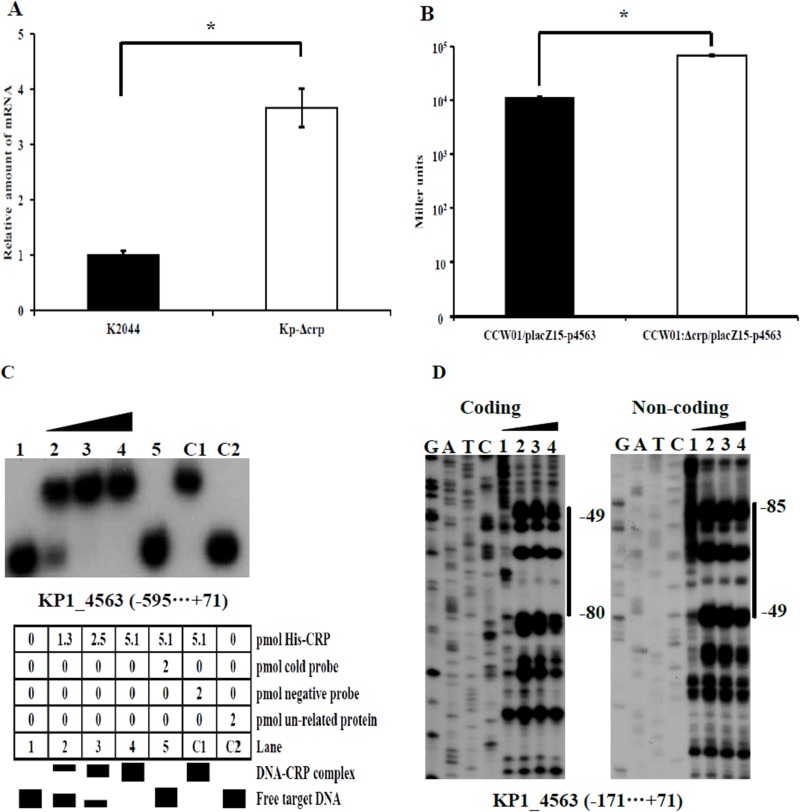
Klebsiella pneumoniae (K. pneumoniae) is an opportunistic pathogen that can adhere to host cells or extracellular matrix via type 1 and type 3 fimbriae. KP1_4563 is a gene encoding a hypothetical protein in K. pneumoniae NTUH-K2044. KP1_4563 is located between the type 1 and type 3 fimbrial gene clusters and is likely associated with fimbrial function given its putative conserved domains of unknown function (DUF1471). Cyclic AMP receptor protein (CRP) regulates virulence-related gene expression and is a crucial transcriptional regulator in many bacteria. The predicted DNA recognition motif of CRP is present in the KP1_4563 promoter region. This study aimed to investigate the function of KP1_4563 in fimbriae and its transcriptional regulation mechanism by CRP. We generated Kp-Δ4563 mutant and complementation strains. We utilized phenotype and adhesion assays to evaluate the role of KP1_4563 in fimbriae. We conducted quantitative RT-PCR (qRT-PCR), LacZ fusion, electrophoretic mobility shift, and DNase I footprinting assays to study the transcriptional regulation of KP1_4563 gene by CRP. We found that KP1_4563 negatively regulates the function of type 3 fimbriae. Compared with NTUH-K2044, the absence of KP1_4563 enhanced the ability of Kp-Δ4563 to adhere to A549 cells. CRP negatively regulates KP1_4563 by directly binding to its promoter region. KP1_4563 plays an important role in type 3 fimbrial function. This novel insight will assist in the development of strategies for preventing K. pneumoniae infection.
Conflict of interest statement
Figures
References
-
- Barbadoro P, Labricciosa FM, Recanatini C, Gori G, Tirabassi F, Martini E, et al. Catheter-associated urinary tract infection: Role of the setting of catheter insertion. AM J INFECT CONTROL. 2015; 43(7): 707–10. doi: 10.1016/j.ajic.2015.02.011 - DOI - PubMed
-
- Ko WC, Paterson DL, Sagnimeni AJ, Hansen DS, Von Gottberg A, Mohapatra S, et al. Community-acquired Klebsiella pneumoniae bacteremia: global differences in clinical patterns. EMERG INFECT DIS. 2002; 8(2): 160–6. doi: 10.3201/eid0802.010025 - DOI - PMC - PubMed
-
- Chang CC, Lu CH, Huang CR, Chuang YC, Tsai NW, Chen SF, et al. Culture-proven bacterial meningitis in elderly patients in southern Taiwan: clinical characteristics and prognostic factors. Acta Neurol Taiwan. 2006; 15(2): 84–91. - PubMed
-
- Luo M, Yang XX, Tan B, Zhou XP, Xia HM, Xue J, et al. Distribution of common pathogens in patients with pyogenic liver abscess in China: a meta-analysis. Eur J Clin Microbiol Infect Dis. 2016; 35(10): 1557–1565. doi: 10.1007/s10096-016-2712-y - DOI - PMC - PubMed
-
- Yadav KK, Awasthi S. The current status of community-acquired pneumonia management and prevention in children under 5 years of age in India: a review. Ther Adv Infect Dis. 2016; 3(3–4): 83–97. doi: 10.1177/2049936116652326 - DOI - PMC - PubMed
MeSH terms
Substances
LinkOut - more resources
Full Text Sources
Other Literature Sources
Molecular Biology Databases
Research Materials
Miscellaneous
