


Habitual versus goal-driven attention
- PMID: 28734549
- PMCID: PMC5754262
- DOI: 10.1016/j.cortex.2017.06.018
Habitual versus goal-driven attention
Abstract
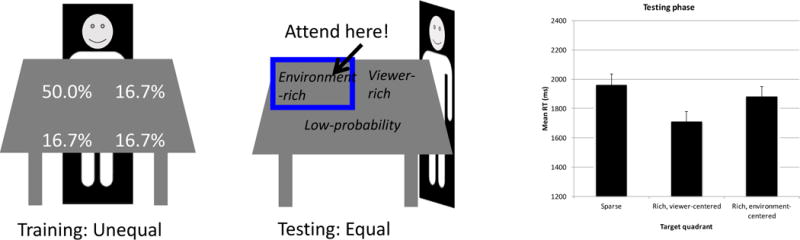
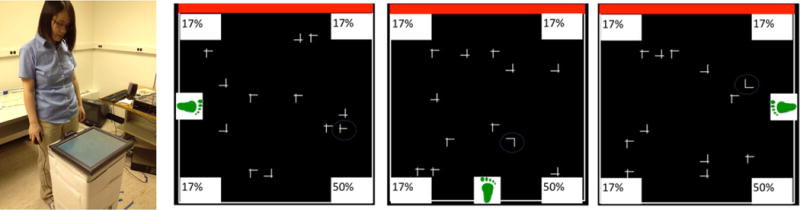
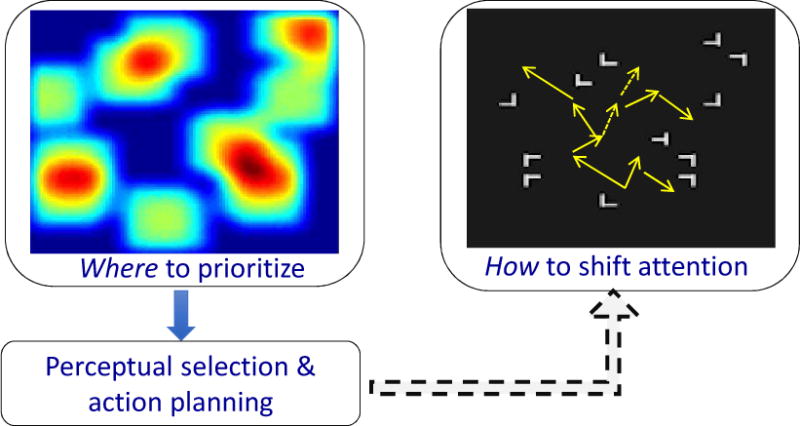
Recent research has expanded the list of factors that control spatial attention. Beside current goals and perceptual salience, statistical learning, reward, motivation and emotion also affect attention. But do these various factors influence spatial attention in the same manner, as suggested by the integrated framework of attention, or do they target different aspects of spatial attention? Here I present evidence that the control of attention may be implemented in two ways. Whereas current goals typically modulate where in space attention is prioritized, search habits affect how one moves attention in space. Using the location probability learning paradigm, I show that a search habit forms when people frequently find a visual search target in one region of space. Attentional cuing by probability learning differs from that by current goals. Probability cuing is implicit and persists long after the probability cue is no longer valid. Whereas explicit goal-driven attention codes space in an environment-centered reference frame, probability cuing is viewer-centered and is insensitive to secondary working memory load and aging. I propose a multi-level framework that separates the source of attentional control from its implementation. Similar to the integrated framework, the multi-level framework considers current goals, perceptual salience, and selection history as major sources of attentional control. However, these factors are implemented in two ways, controlling where spatial attention is allocated and how one shifts attention in space.
Keywords: Implicit learning; Search habit; Spatial attention; Spatial reference frame.
Copyright © 2017 Elsevier Ltd. All rights reserved.
Figures

References
-
- Allport A. Foundations of cognitive science. Cambridge, MA, US: The MIT Press; 1989. Visual attention; pp. 631–682.
-
- Anderson BA, Kuwabara H, Wong DF, Gean EG, Rahmim A, Braŝić JR, Yantis S. The Role of Dopamine in Value-Based Attentional Orienting. Current Biology: CB. 2016;26(4):550–555. https://doi.org/10.1016/j.cub.2015.12.062. - DOI - PMC - PubMed
-
- Awh E, Jonides J. Overlapping mechanisms of attention and spatial working memory. Trends in Cognitive Sciences. 2001;5(3):119–126. - PubMed
-
- Awh Edward, Belopolsky AV, Theeuwes J. Top-down versus bottom-up attentional control: a failed theoretical dichotomy. Trends in Cognitive Sciences. 2012;16(8):437–443. https://doi.org/10.1016/j.tics.2012.06.010. - DOI - PMC - PubMed
Publication types
MeSH terms
Grants and funding
LinkOut - more resources
Full Text Sources
Other Literature Sources
