


Conjunctival Autograft Versus Amniotic Membrane Transplantation for Treatment of Pterygium: Findings From a Cochrane Systematic Review
- PMID: 28734814
- PMCID: PMC5610642
- DOI: 10.1016/j.ajo.2017.07.004
Conjunctival Autograft Versus Amniotic Membrane Transplantation for Treatment of Pterygium: Findings From a Cochrane Systematic Review
Abstract
Purpose: To summarize key findings from a systematic review of the effectiveness and risks of conjunctival autograft (CAG) compared with amniotic membrane transplant (AMT) for pterygium.
Design: Cochrane systematic review.
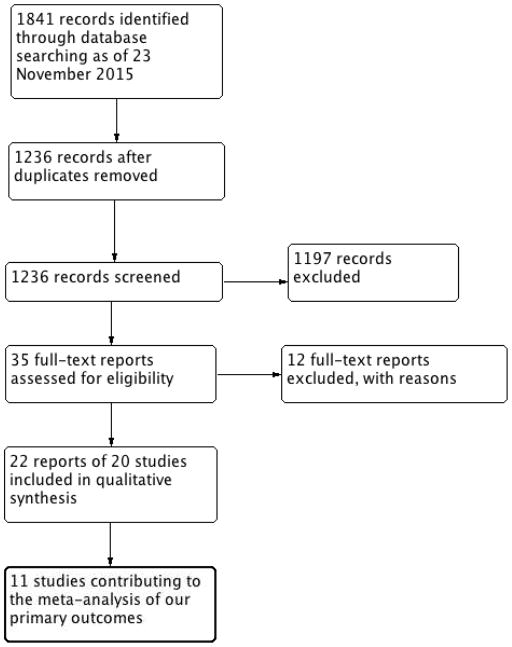
Methods: We included only randomized controlled trials (RCTs) in which CAG and AMT had been compared for primary or recurrent pterygia. The primary outcome was recurrence of pterygium ≥1 mm onto the cornea by 3 and 6 months post surgery. We adhered to Cochrane methods for trial selection, data extraction, risk of bias evaluation, and data synthesis.
Results: Twenty RCTs with 1866 participants (1947 eyes) were included. Pterygium recurrence 6 months after surgery ranged from 3.3% to 16.7% in the CAG group and 6.4% to 42.3% in the AMT group based on data from 1021 eyes in 10 RCTs. Estimated risk ratios from meta-analysis indicated that CAG-treated eyes had a 47% lower risk of recurrence 6 months after surgery compared with the AMT group (RR, 0.53, 95% confidence interval [CI], 0.33-0.85). For 96 eyes with recurrent pterygium, the risk of recurrence 6 months after CAG was reduced by 55% compared with AMT (risk ratio [RR], 0.45, 95% CI, 0.21-0.99). Three-month recurrence rates were similar for CAG and AMT based on data from 538 eyes (6 RCTs).
Conclusions: CAG was more effective than AMT to prevent pterygium recurrence by 6 months post surgery, especially in recurrent pterygia. CAG-treated eyes had half the recurrence rates of AMT-treated eyes. Future RCTs should assess changes in patient-reported outcomes (symptoms, cosmesis) and visual acuity, and evaluate effects of surgical variations.
Copyright © 2017 Elsevier Inc. All rights reserved.
Figures


References
-
- Droutsas K, Sekundo W. Epidemiology of pterygium. A review. Ophthalmologe. 2010;107(6):511–2. 514–516. - PubMed
-
- Hirst LW. Recurrent pterygium surgery using pterygium extended removal followed by extended conjunctival transplant: recurrence rate and cosmesis. Ophthalmology. 2009;116(7):1278–1286. - PubMed
-
- Dusenbery KE, Alul IH, Holland EJ, Khan FM, Levitt SH. β Irradiation of recurrent ptergia: results and complications. International Journal of Radiation Oncology* Biology* Physics. 1992;24(2):315–320. - PubMed
-
- Al Fayez MF. Limbal versus conjunctival autograft transplantation for advanced and recurrent pterygium. Ophthalmology. 2002;109(9):1752–1755. - PubMed
Publication types
MeSH terms
Grants and funding
LinkOut - more resources
Full Text Sources
Other Literature Sources
