


Self-harm and violent criminality among young people who experienced trauma-related hospital admission during childhood: a Danish national cohort study
- PMID: 28736760
- PMCID: PMC5500314
- DOI: 10.1016/S2468-2667(17)30094-4
Self-harm and violent criminality among young people who experienced trauma-related hospital admission during childhood: a Danish national cohort study
Abstract
Background: Development of a better understanding of subsequent pathways for individuals who experienced trauma during childhood might usefully inform clinicians and public health professionals regarding the causes of self-harm and interpersonal violence. We aimed to examine these risks during late adolescence and early adulthood among people admitted to hospital following injuries or poisonings during their childhood.
Methods: This national cohort study included Danish people born between Jan 1, 1977, and Dec 31, 1997, and was linked to the National Patient Register and Psychiatric Central Research Register to identify all people exposed to hospital admissions for injuries or poisonings due to self-harm, interpersonal violence, or accidents before their 15th birthday. Linkage to these two registers and to the National Crime Register enabled ascertainment of self-harm and violent offending, respectively, as adverse outcomes at ages 15-35 years. Sex-specific incidence rate ratios (IRRs; relative risks) and cumulative incidence percentage values (absolute risks) were estimated. The confounding influence of parental socioeconomic status was also explored.
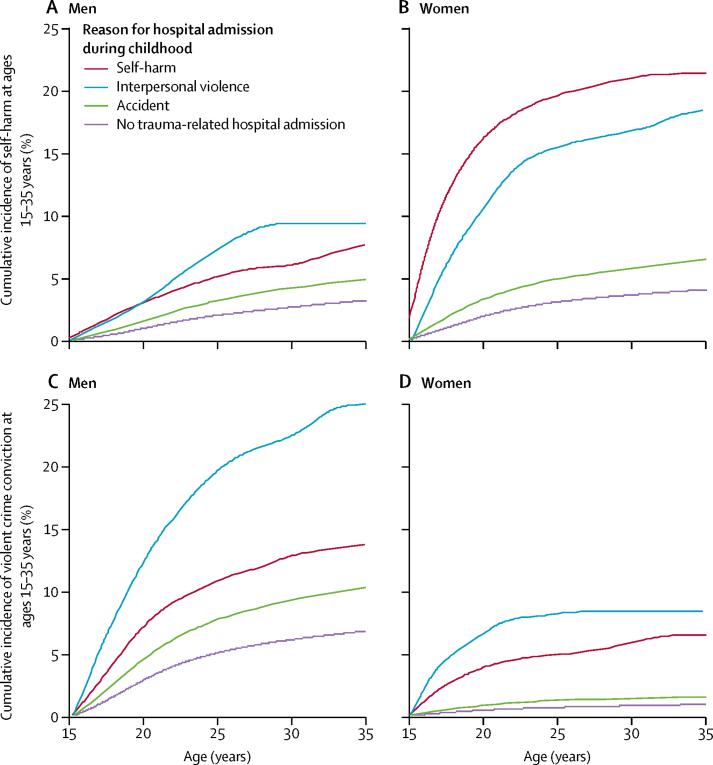
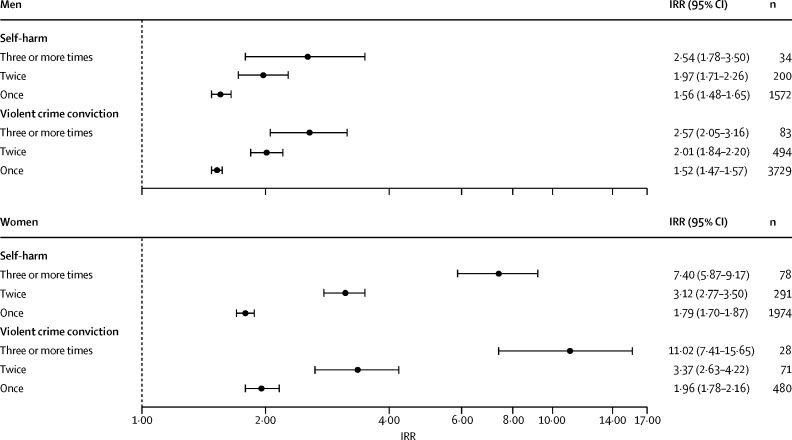
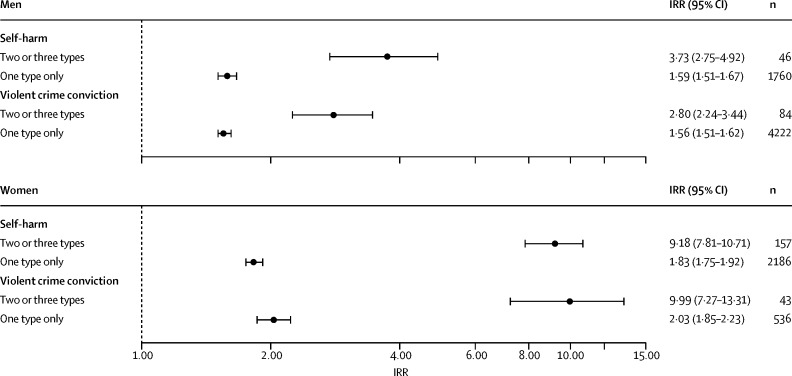
Findings: 1 087 672 Danish people were included in this study. The prevalence of any trauma-related hospital admission was 10% (105 753 per 1 087 672; males: 64 454 [11%]; females: 44 299 [8%]) and for both sexes, accident was by far the most prevalent of the categories assessed (males: 59 011 [11%]; females: 40 756 [8%]). Similar patterns of increased risk for self-harm and violent criminality were observed in both sexes, although the IRRs were consistently and significantly larger in women (self-harm: IRR 1·94 [95% CI 1·85-2·02]; violent criminality: 2·16 [1·97-2·36]) than in men (self-harm: 1·61 [1·53-1·69]; violent criminality: 1·58 [1·53-1·63]). Confounding by parental socioeconomic status explained little of the increased risks observed. For young adult men, the highest absolute risk observed was for violent offending among individuals admitted to hospital for interpersonal violence injury during childhood (cumulative incidence 25·0% [95% CI 21·2-28·9]). For young adult women, absolute risk was highest for repeat self-harm among those admitted to hospital following self-harm during childhood (cumulative incidence 21·4% [95% CI 19·8-23·1]). More frequent trauma-related hospital admissions in childhood, and being admitted multiple times for more than one reason, conferred substantial risk increases among young people, with especially steep gradients of this nature observed among women.
Interpretation: Trauma-related hospital admission early in life could be a useful marker for childhood distress that subsequently predicts internalised and externalised destructive behaviours among youths and young adults and might provide a timely opportunity for initiating family-oriented interventions.
Funding: European Research Council.
Figures
Comment in
-
Childhood trauma: psychiatry's greatest public health challenge?Lancet Public Health. 2017 Jul;2(7):e300-e301. doi: 10.1016/S2468-2667(17)30104-4. Epub 2017 Jun 1. Lancet Public Health. 2017. PMID: 29253454 No abstract available.
References
-
- Finkelstein Y, Macdonald EM, Hollands S. Long-term outcomes following self-poisoning in adolescents: a population-based cohort study. Lancet Psychiatry. 2015;2:532–539. - PubMed
-
- Johansson L, Stenlund H, Bylund PO, Eriksson A. ER visits predict premature death among teenagers. Accid Anal Prev. 2012;48:397–400. - PubMed
-
- Johnson SB, Bradshaw CP, Wright JL, Haynie DL, Simons-Morton BG, Cheng TL. Characterizing the teachable moment: is an emergency department visit a teachable moment for intervention among assault-injured youth and their parents? Pediatr Emerg Care. 2007;23:553–559. - PubMed
LinkOut - more resources
Full Text Sources
Other Literature Sources
Research Materials
