


Breast-feeding and Infant Hospitalization for Infections: Large Cohort and Sibling Analysis
- PMID: 28737571
- PMCID: PMC5527760
- DOI: 10.1097/MPG.0000000000001539
Breast-feeding and Infant Hospitalization for Infections: Large Cohort and Sibling Analysis
Abstract
Objectives: Breast-feeding may protect against infections, but its optimal duration remains controversial. We aimed to study the association of the duration of full and any breast-feeding with infections the first 18 months of life.
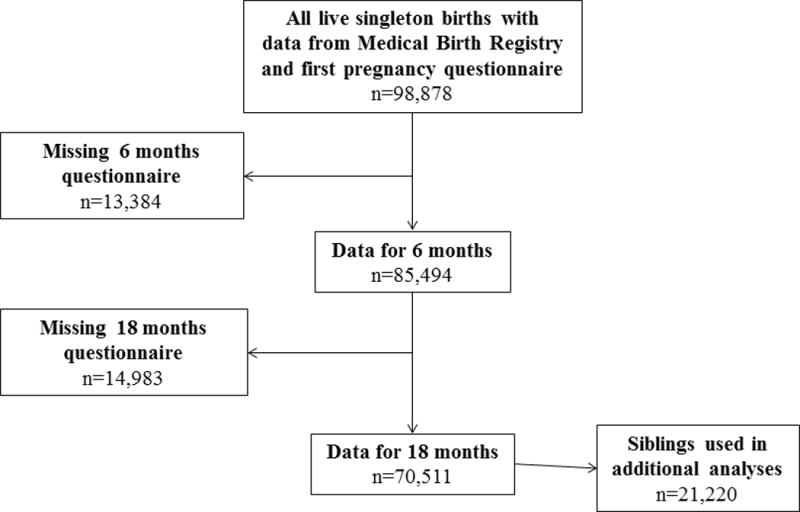
Methods: The Norwegian Mother and Child study (MoBa) is a prospective birth cohort which recruited expecting mothers giving birth from 2000 to 2009. We analyzed data from the full cohort (n = 70,511) and sibling sets (n = 21,220) with parental report of breast-feeding and infections. The main outcome measures were the relative risks (RRs) for hospitalization for infections from 0 to 18 months by age at introduction of complementary foods and duration of any breast-feeding.
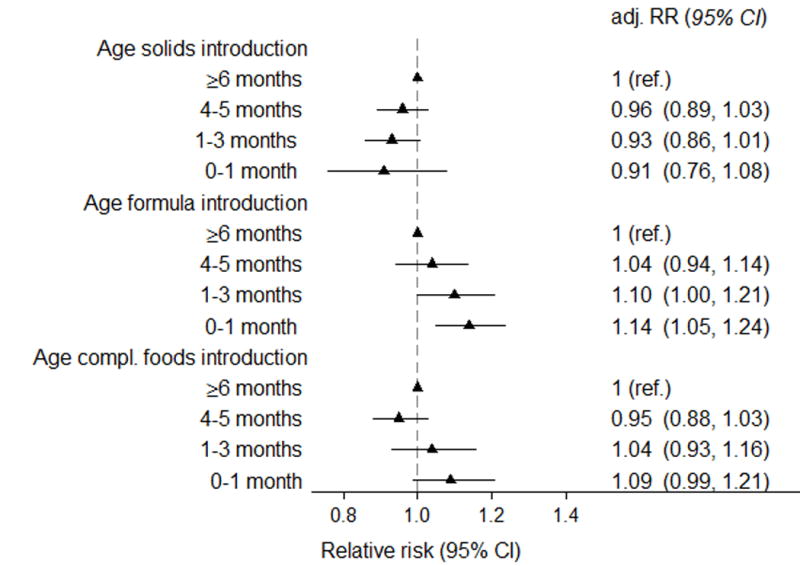
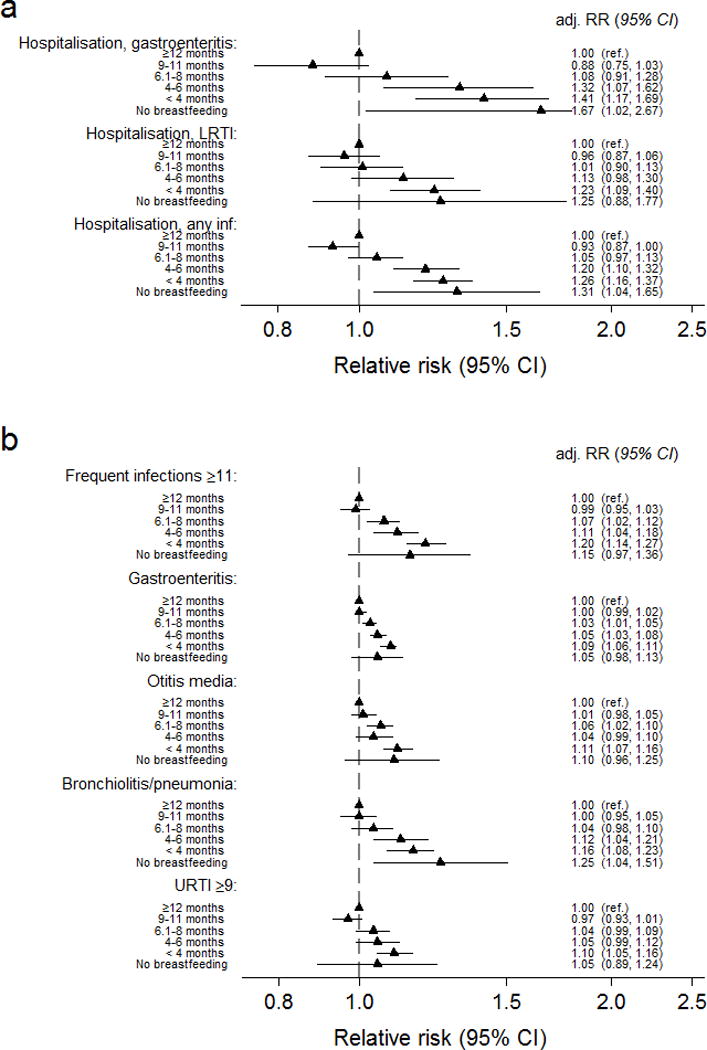
Results: Although we found some evidence for an overall association between longer duration of full breast-feeding and lower risk of hospitalizations for infections, 7.3% of breast-fed children who received complementary foods at 4 to 6 months of age compared to 7.7% of those receiving complementary foods after 6 months were hospitalized (adjusted RR 0.95, 95% confidence interval 0.88-1.03). Higher risk of hospitalization was observed in those breast-fed 6 months or less (10.0%) compared to ≥12 months (7.6%, adjusted RR 1.22, 95% confidence interval 1.14-1.31), but with similar risks for 6 to 11 months versus ≥12 months. Matched sibling analyses, minimizing the confounding from shared maternal factors, showed nonsignificant associations and were generally weaker compared with the cohort analyses.
Conclusions: Our results support the recommendation to fully breast-feed for 4 months and to continue breast-feeding beyond 6 months, and suggest that protection against infections is limited to the first 12 months.
Conflict of interest statement
Figures
References
-
- Fewtrell M, Wilson DC, Booth I, et al. Six months of exclusive breast feeding: how good is the evidence? BMJ. 2010;342:c5955. - PubMed
-
- van’t Hof MA, Haschke F. The Euro-Growth Study: why, who, and how. J Pediatr Gastroenterol Nutr. 2000;31(Suppl 1):S3–13. - PubMed
-
- Organization WH. Infant and young child nutrition. http://apps.who.int/gb/archive/pdf_files/WHA55/ewha5525.pdf.
-
- Breastfeeding and the use of human milk. Pediatrics. 2012;129:e827–e41. - PubMed
Publication types
MeSH terms
Grants and funding
LinkOut - more resources
Full Text Sources
Other Literature Sources
Medical
