Observational Study
. 2017 Oct;18(10):e446-e454.
doi: 10.1097/PCC.0000000000001280.

Identifying Risk for Acute Kidney Injury in Infants and Children Following Cardiac Arrest

Affiliations
Observational Study

Identifying Risk for Acute Kidney Injury in Infants and Children Following Cardiac Arrest

Tara M Neumayr et al. Pediatr Crit Care Med. 2017 Oct.

Abstract

Objectives: Our goal was to identify risk factors for acute kidney injury in children surviving cardiac arrest.

Design: Retrospective analysis of a public access dataset.

Setting: Fifteen children's hospitals associated with the Pediatric Emergency Care Applied Research Network.

Patients: Two hundred ninety-six subjects between 1 day and 18 years old who experienced in-hospital or out-of-hospital cardiac arrest between July 1, 2003, and December 31, 2004.

Interventions: None.

Measurements and main results: Our primary outcome was development of acute kidney injury as defined by the Acute Kidney Injury Network criteria. An ordinal probit model was developed. We found six critical explanatory variables, including total number of epinephrine doses, postcardiac arrest blood pressure, arrest location, presence of a chronic lung condition, pH, and presence of an abnormal baseline creatinine. Total number of epinephrine doses received as well as rate of epinephrine dosing impacted acute kidney injury risk and severity of acute kidney injury.

Conclusions: This study is the first to identify risk factors for acute kidney injury in children after cardiac arrest. Our findings regarding the impact of epinephrine dosing are of particular interest and suggest potential for epinephrine toxicity with regard to acute kidney injury. The ability to identify and potentially modify risk factors for acute kidney injury after cardiac arrest may lead to improved morbidity and mortality in this population.


Figures
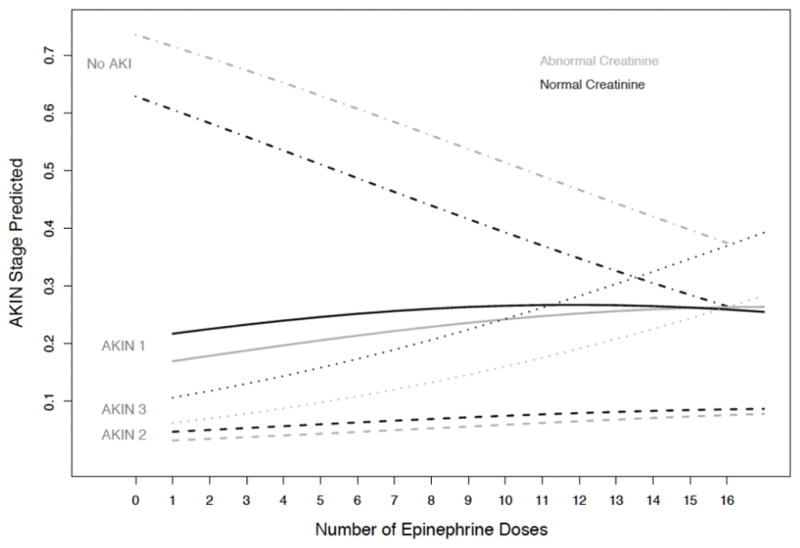
Figure 1
Figure 1
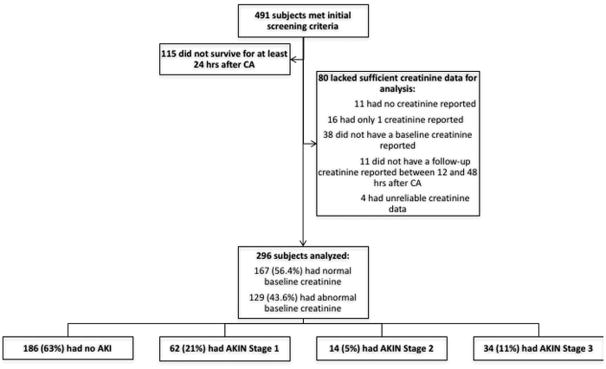
Study subject identification and AKIN classification.
Figure 2
Figure 2
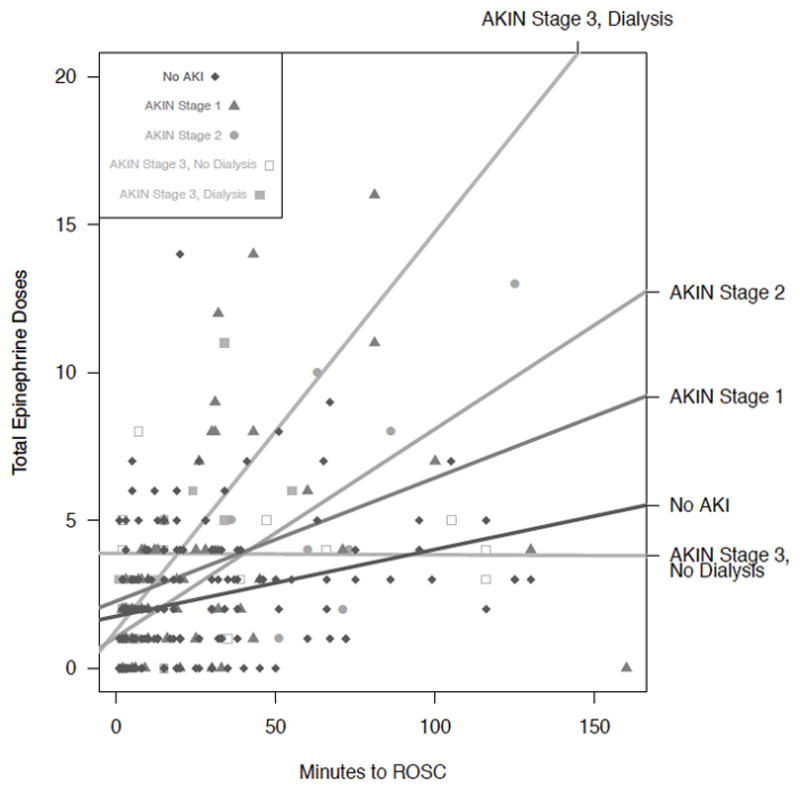
Increasing number of epinephrine doses per minutes to ROSC increases the likelihood of AKIN Stage 3 with dialysis but not for AKIN Stage 3 without dialysis, suggesting an important difference in these two categories of severe AKI that requires further exploration. As demonstrated here, we observed that, when epinephrine dosing rate is low, the likelihood of developing severe AKI – AKIN Stage 2 and Stage 3 with dialysis – is correspondingly low, and either No AKI or AKIN Stage 1 is more likely after CA. The situation is reversed when epinephrine dosing rates are high, favoring development of more severe AKI.
Figure 3
Figure 3
Expected AKIN stage in relation to number of epinephrine doses received for subjects with and without abnormal baseline creatinine. The likelihood of No AKI decreases while likelihood of AKIN Stages 1–3 increases with increasing number of epinephrine doses. This effect is reliably influenced by baseline creatinine, favoring more AKI when baseline creatinine is abnormal. Expected AKIN Stage 3 accelerates in likelihood after 8–9 epinephrine doses. The effect of having an abnormal versus normal baseline creatinine on likelihood of AKIN Stages 1 and 2 appears attenuated after 8–9 epinephrine doses.
Figure 4
Figure 4
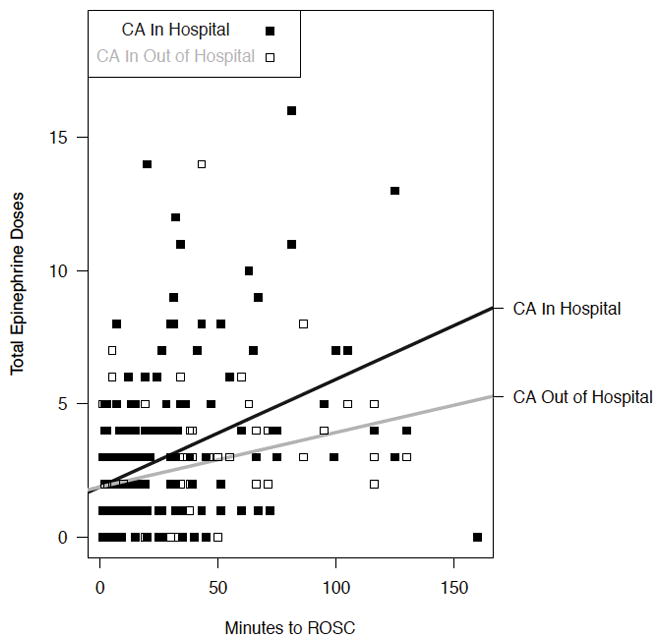
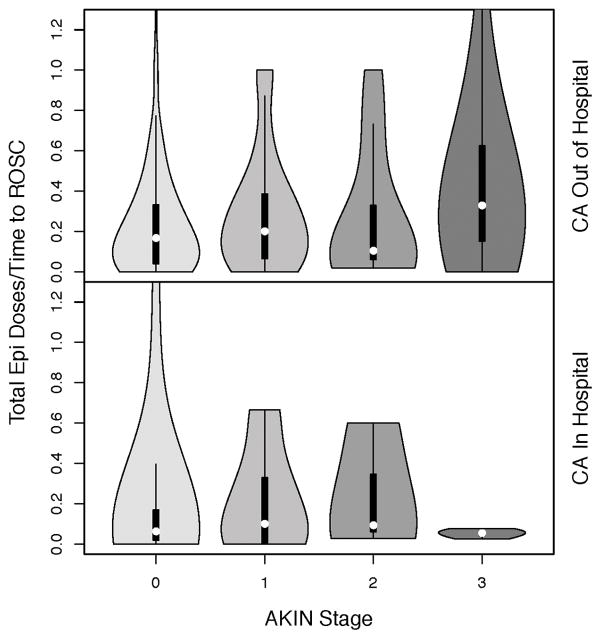
Figure 4a. The rate at which epinephrine was administered differed by arrest location in the cohort. We observed a higher predicted AKIN Stage for children with IHCA than those with OHCA. Figure 4b. Violin plot demonstrating the relationships among epinephrine dosing rate, CA location, and AKIN Stage. Violin plots are similar to box plots but, by combining box plots with kernel density plots, are able to demonstrate the full distribution of the data rather than summary statistics alone. In our cohort, subjects experiencing IHCA and receiving a greater total epinephrine dose per time to ROSC reached AKIN Stage 3 AKI at a higher rate. For subjects experiencing OHCA, epinephrine dose per time to ROSC was slightly higher for those subjects who developed AKI of any stage.
Figure 4
Figure 4
Figure 4a. The rate at which epinephrine was administered differed by arrest location in the cohort. We observed a higher predicted AKIN Stage for children with IHCA than those with OHCA. Figure 4b. Violin plot demonstrating the relationships among epinephrine dosing rate, CA location, and AKIN Stage. Violin plots are similar to box plots but, by combining box plots with kernel density plots, are able to demonstrate the full distribution of the data rather than summary statistics alone. In our cohort, subjects experiencing IHCA and receiving a greater total epinephrine dose per time to ROSC reached AKIN Stage 3 AKI at a higher rate. For subjects experiencing OHCA, epinephrine dose per time to ROSC was slightly higher for those subjects who developed AKI of any stage.

Comment in

References

    1. Topjian AA, French B, Sutton RM, et al. Early postresuscitation hypotension is associated with increased mortality following pediatric cardiac arrest. Pediatr Crit Care Med. 2014;42(6):1518–1523. - PMC - PubMed
    1. Atkins DL, Everson-Stewart S, Sears GK, et al. Epidemiology and outcomes from out-of-hospital cardiac arrest in children: the Resuscitation Outcomes Consortium Epistry - Cardiac Arrest. Circulation. 2009;119:1484–1491. - PMC - PubMed
    1. Girotra S, Spertus JA, Li Y, et al. Survival trends in pediatric in-hospital cardiac arrests: an analysis from Get WIth The Guidelines-Resuscitation. Circ Cardiovasc Qual Outcomes. 2013;6(1):42–49. - PMC - PubMed
    1. Kaddourah A, Basu RK, Bagshaw SM, et al. Epidemiology of Acute Kidney Injury in Critically Ill Children and Young Adults. NEJM. 2017;376(1):11–20. - PMC - PubMed
    1. Clermont G, Acker CG, Angus DC, et al. Renal failure in the ICU: comparison of the impact of acute renal failure and end-stage renal disease on ICU outcomes. Kidney International. 2002;62:986–996. - PubMed

Publication types