


Age-Related Loss of Cohesion: Causes and Effects
- PMID: 28737671
- PMCID: PMC5536066
- DOI: 10.3390/ijms18071578
Age-Related Loss of Cohesion: Causes and Effects
Abstract
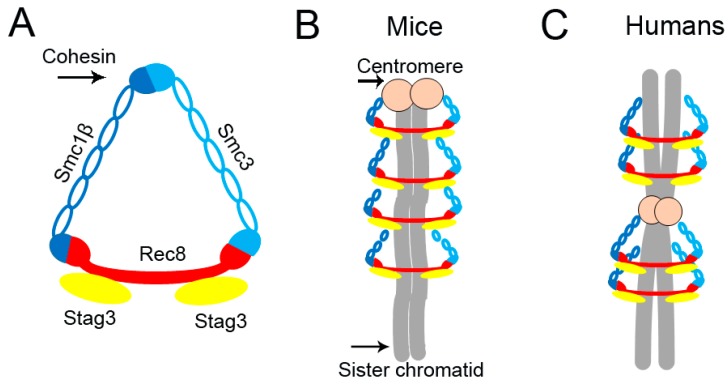
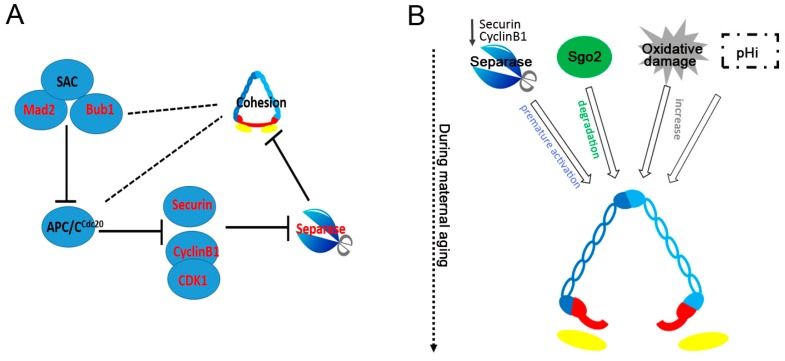
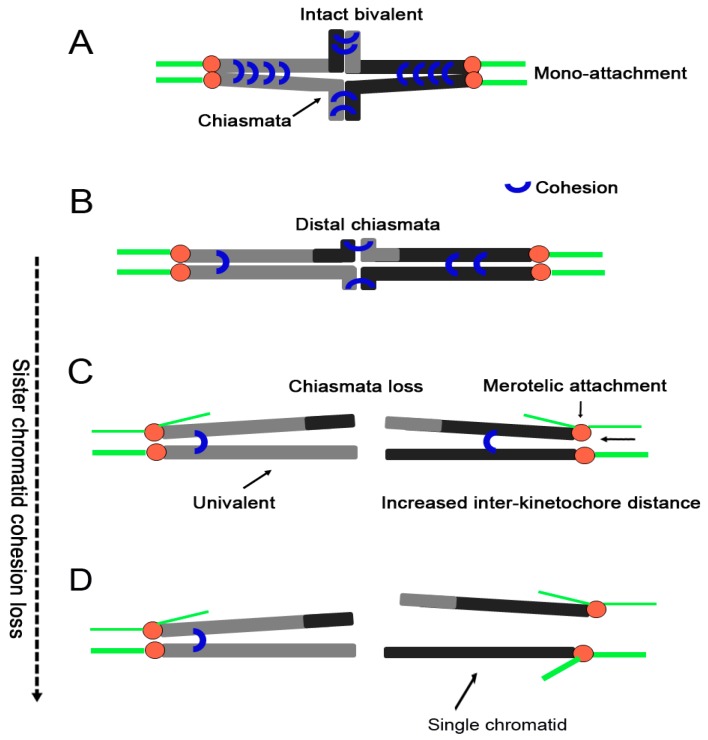
Aneuploidy is a leading genetic cause of birth defects and lower implantation rates in humans. Most errors in chromosome number originate from oocytes. Aneuploidy in oocytes increases with advanced maternal age. Recent studies support the hypothesis that cohesion deterioration with advanced maternal age represents a leading cause of age-related aneuploidy. Cohesin generates cohesion, and is established only during the premeiotic S phase of fetal development without any replenishment throughout a female's period of fertility. Cohesion holds sister chromatids together until meiosis resumes at puberty, and then chromosome segregation requires the release of sister chromatid cohesion from chromosome arms and centromeres at anaphase I and anaphase II, respectively. The time of cohesion cleavage plays an important role in correct chromosome segregation. This review focuses specifically on the causes and effects of age-related cohesion deterioration in female meiosis.
Keywords: age; aneuploidy; cohesion; oocytes.
Conflict of interest statement
The authors declare no conflict of interest.
Figures
References
-
- Anifandis G., Markandona O., Dafopoulos K., Messini C., Tsezou A., Dimitraki M., Georgoulias P., Daponte A., Messinis I. Embryological Results of Couples Undergoing ICSI-ET Treatments with Males Carrying the Single Nucleotide Polymorphism rs175080 of the MLH3 Gene. Int. J. Mol. Sci. 2017;18:314. doi: 10.3390/ijms18020314. - DOI - PMC - PubMed
-
- Cheng J.M., Li J., Tang J.X., Cheng S.R., Deng S.L., Jin C., Zhang Y., Wang X.X., Zhou C.X., Liu Y.X. Elevated intracellular pH appears in aged oocytes and causes oocyte aneuploidy associated with the loss of cohesion in mice. Cell Cycle. 2016;18:2454–2463. doi: 10.1080/15384101.2016.1201255. - DOI - PMC - PubMed
-
- Merriman J.A., Jennings P.C., McLaughlin E.A., Jones K.T. Effect of aging on superovulation efficiency, aneuploidy rates, and sister chromatid cohesion in mice aged up to 15 months. Biol. Reprod. 2011;49:1–6. - PubMed
-
- Camlin N.J., McLaughlin E.A., Holt J.E. The use of C57Bl/6 × CBA F1 hybrid cross as a model for human age-related oocyte aneuploidy. Mol. Reprod. Dev. 2017;84:6–7. - PubMed
Publication types
MeSH terms
LinkOut - more resources
Full Text Sources
Other Literature Sources
Medical
