


Parenting and Cortisol in Infancy Interactively Predict Conduct Problems and Callous-Unemotional Behaviors in Childhood
- PMID: 28737836
- PMCID: PMC5783800
- DOI: 10.1111/cdev.12900
Parenting and Cortisol in Infancy Interactively Predict Conduct Problems and Callous-Unemotional Behaviors in Childhood
Abstract
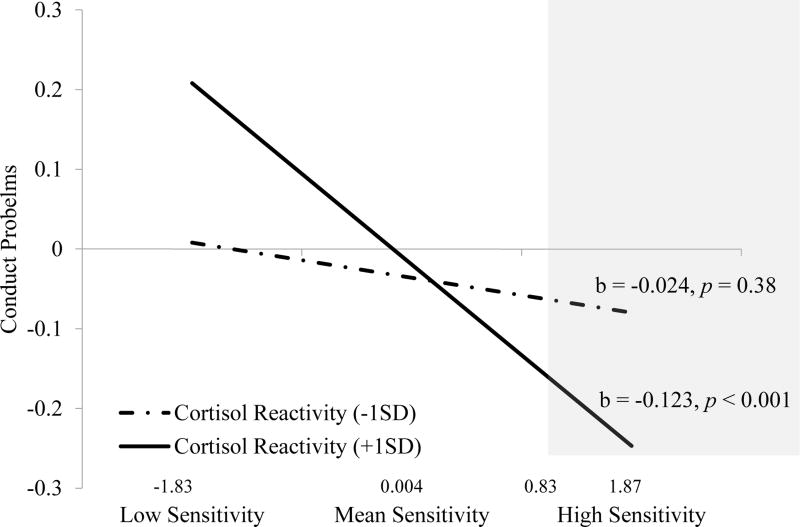
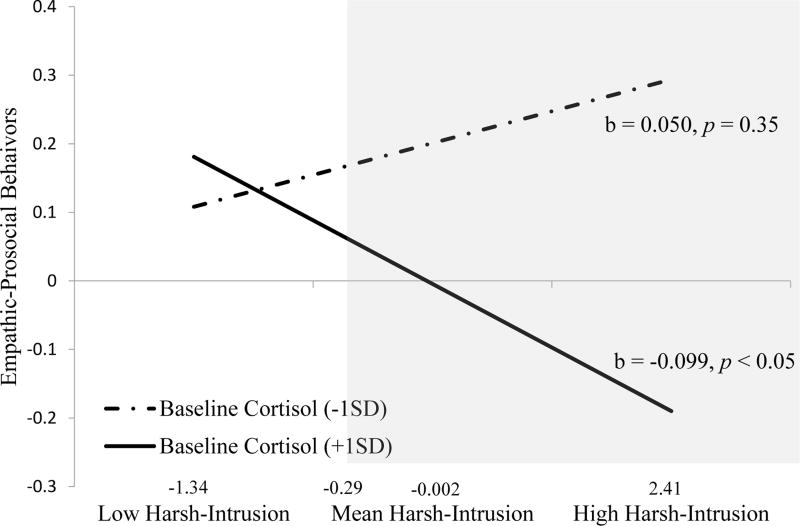
This study examines observed maternal sensitivity, harsh-intrusion, and mental-state talk in infancy as predictors of conduct problems (CP) and callous-unemotional (CU) behaviors in middle childhood, as well as the extent to which infants' resting cortisol and cortisol reactivity moderate these associations. Using data from the Family Life Project (n = 1,292), results indicate that maternal sensitivity at 6 months predicts fewer CP at first grade, but only for infants who demonstrate high levels of cortisol reactivity. Maternal harsh intrusion predicts fewer empathic-prosocial behaviors, a component of CU behaviors, but only for infants who demonstrate high resting cortisol. Findings are discussed in the context of diathesis-stress and differential susceptibility models.
© 2017 The Authors. Child Development © 2017 Society for Research in Child Development, Inc.
Figures
References
-
- Alink LRa, van IJzendoorn MH, Bakermans-Kranenburg MJ, Mesman J, Juffer F, Koot HM. Cortisol and externalizing behavior in children and adolescents: Mixed meta-analytic evidence for the inverse relation of basal cortisol and cortisol reactivity with externalizing behavior. Developmental Psychobiology. 2008;50:427–450. - PubMed
-
- Belsky J, Bakermans-Kranenburg MJ, van IJzendoorn MH. For better and for worse: Differential susceptibility to environmental influences. Current Directions in Psychological Science. 2007;16:300–304.
Publication types
MeSH terms
Substances
Grants and funding
LinkOut - more resources
Full Text Sources
Other Literature Sources
Medical
Miscellaneous
