Werner syndrome: a model for sarcopenia due to accelerated aging
- PMID: 28738022
- PMCID: PMC5559172
- DOI: 10.18632/aging.101265
Werner syndrome: a model for sarcopenia due to accelerated aging
Abstract
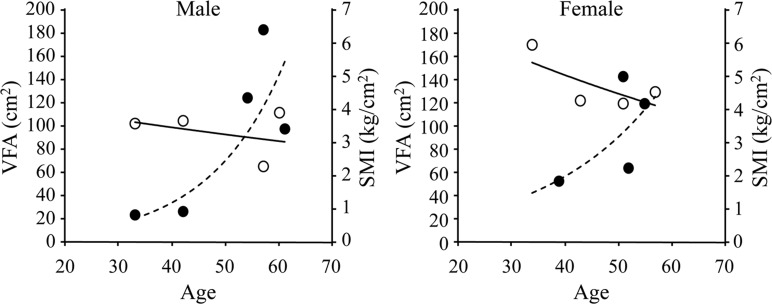
Werner syndrome (WS) is a rare inheritable progeroid syndrome caused by a mutation in the WRN gene. Although WS has been described as a characteristic appearance of very slender extremities with a stocky trunk, few studies have investigated the loss of muscle mass, fat mass distribution (body composition), and mobility according to age and sex. Therefore, the aim of this study was to precisely describe the body composition in WS. Nine Japanese patients with WS (four males and five females; mean age 48±8.8 years) were recruited. Body composition was examined by dual-energy X-ray absorptiometry and computed tomography (CT). The hand grip strength and mobility were evaluated using the two-step test, stand-up test and 25-question geriatric locomotive function scale (GLFS). The mean skeletal muscle index (SMI) was 4.0±0.6 kg/m2. SMI of all patients met the criteria of sarcopenia, even though some patients were aged < 40 years. All patients also showed deceased mobility. In conclusion, these results indicate that all patients with WS, even those aged < 40 years, had already lost muscle mass to the level of sarcopenia. Continued research on sarcopenia in WS might facilitate the discovery of novel mechanisms and development of new treatment strategies for sarcopenia.
Keywords: Werner syndrome; progeria; sarcopenia.
Conflict of interest statement
All authors have no conflict of interests.
Figures
References
-
- Epstein CJ, Martin GM, Schultz AL, Motulsky AG. Werner's syndrome a review of its symptomatology, natural history, pathologic features, genetics and relationship to the natural aging process. Medicine (Baltimore) 1966;45:177–221. https://doi.org/10.1097/00005792-196605000-00001 - DOI - PubMed
-
- Matsumoto T, Imamura O, Yamabe Y, Kuromitsu J, Tokutake Y, Shimamoto A, Suzuki N, Satoh M, Kitao S, Ichikawa K, Kataoka H, Sugawara K, Thomas W, et al. Mutation and haplotype analyses of the Werner's syndrome gene based on its genomic structure: genetic epidemiology in the Japanese population. Hum Genet. 1997;100:123–30. https://doi.org/10.1007/s004390050477 - DOI - PubMed
-
- Yokote K, Hara K, Mori S, Kadowaki T, Saito Y, Goto M. Dysadipocytokinemia in werner syndrome and its recovery by treatment with pioglitazone. Diabetes Care. 2004;27:2562–63. https://doi.org/10.2337/diacare.27.10.2562 - DOI - PubMed
-
- Yokote K, Honjo S, Kobayashi K, Fujimoto M, Kawamura H, Mori S, Saito Y. Metabolic improvement and abdominal fat redistribution in Werner syndrome by pioglitazone. J Am Geriatr Soc. 2004;52:1582–83. https://doi.org/10.1111/j.1532-5415.2004.52430_4.x - DOI - PubMed
-
- Okabe E, Takemoto M, Onishi S, Ishikawa T, Ishibashi R, He P, Kobayashi K, Fujimoto M, Kawamura H, Yokote K. Incidence and characteristics of metabolic disorders and vascular complications in individuals with Werner syndrome in Japan. J Am Geriatr Soc. 2012;60:997–8. https://doi.org/10.1111/j.1532-5415.2012.03944.x - DOI - PubMed
Publication types
MeSH terms
LinkOut - more resources
Full Text Sources
Other Literature Sources
Miscellaneous