


A Bayesian spatio-temporal model for forecasting Anaplasma species seroprevalence in domestic dogs within the contiguous United States
- PMID: 28738085
- PMCID: PMC5524335
- DOI: 10.1371/journal.pone.0182028
A Bayesian spatio-temporal model for forecasting Anaplasma species seroprevalence in domestic dogs within the contiguous United States
Abstract
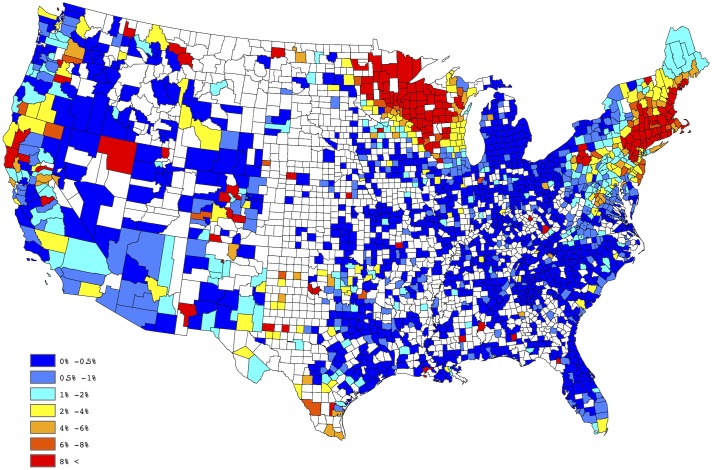
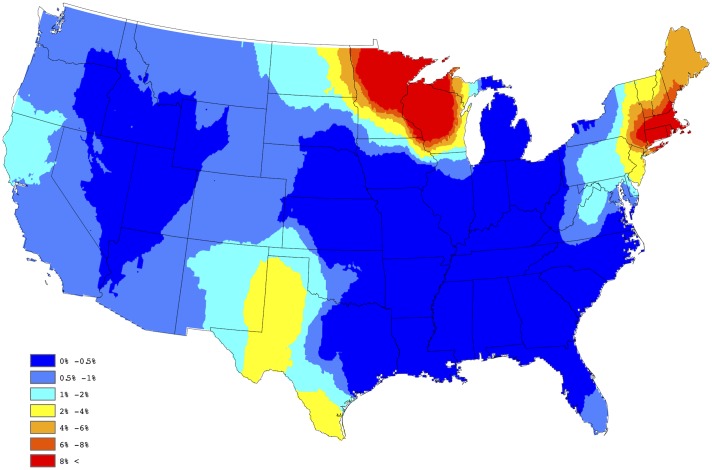
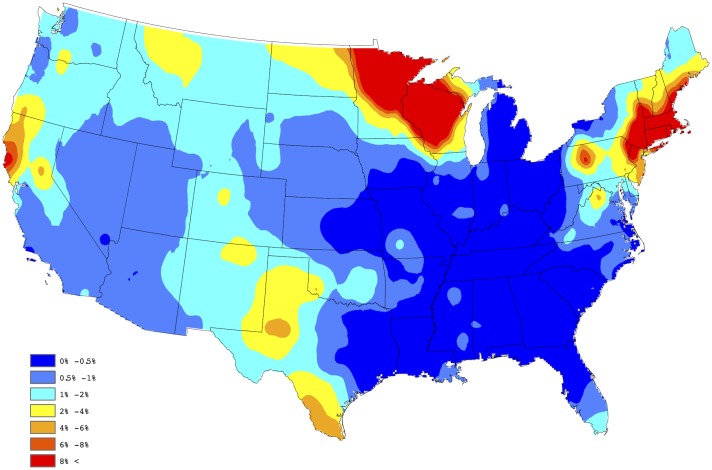
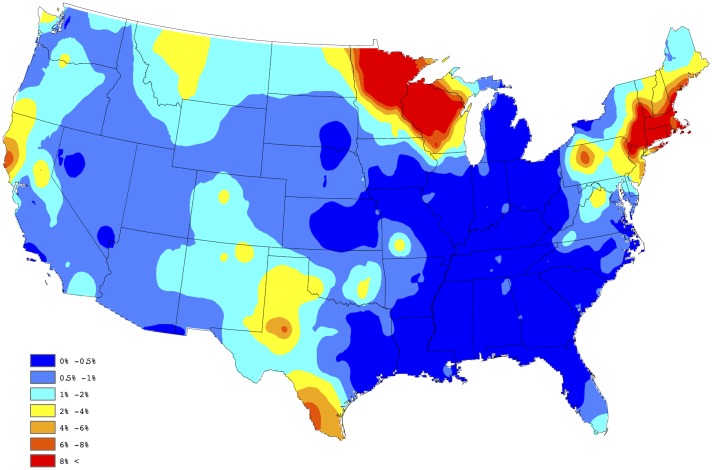
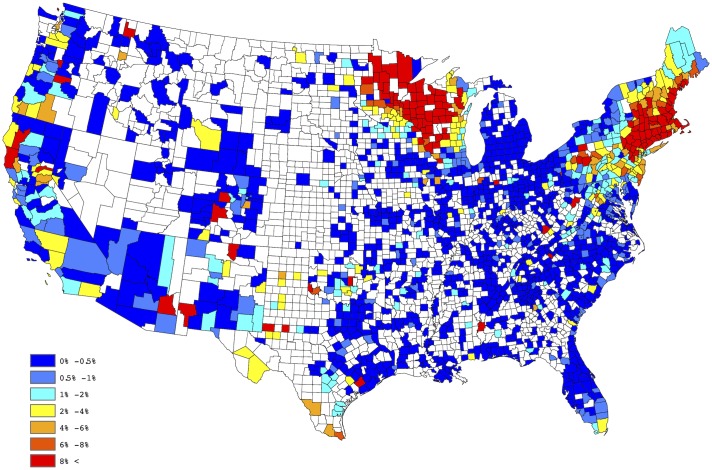
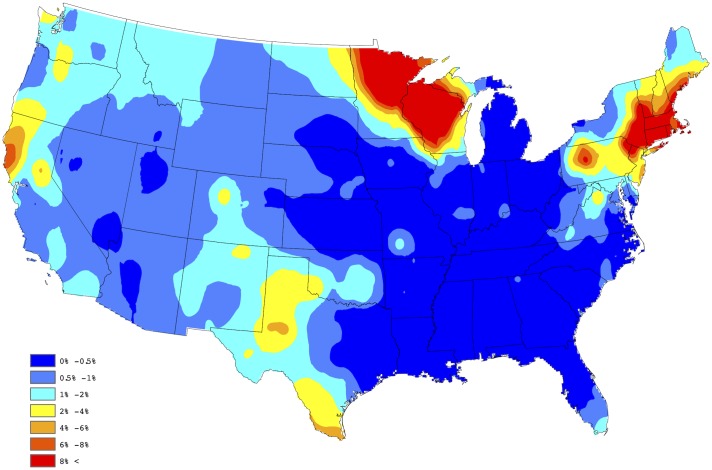
This paper forecasts the 2016 canine Anaplasma spp. seroprevalence in the United States from eight climate, geographic and societal factors. The forecast's construction and an assessment of its performance are described. The forecast is based on a spatial-temporal conditional autoregressive model fitted to over 11 million Anaplasma spp. seroprevalence test results for dogs conducted in the 48 contiguous United States during 2011-2015. The forecast uses county-level data on eight predictive factors, including annual temperature, precipitation, relative humidity, county elevation, forestation coverage, surface water coverage, population density and median household income. Non-static factors are extrapolated into the forthcoming year with various statistical methods. The fitted model and factor extrapolations are used to estimate next year's regional prevalence. The correlation between the observed and model-estimated county-by-county Anaplasma spp. seroprevalence for the five-year period 2011-2015 is 0.902, demonstrating reasonable model accuracy. The weighted correlation (accounting for different sample sizes) between 2015 observed and forecasted county-by-county Anaplasma spp. seroprevalence is 0.987, exhibiting that the proposed approach can be used to accurately forecast Anaplasma spp. seroprevalence. The forecast presented herein can a priori alert veterinarians to areas expected to see Anaplasma spp. seroprevalence beyond the accepted endemic range. The proposed methods may prove useful for forecasting other diseases.
Conflict of interest statement
Figures
References
-
- Dumler JS, Barbet AF, Bekker CP, Dasch GA, Palmer GH, Ray SC, et al. Reorganization of genera in the families Rickettsiaceae and Anaplasmataceae in the order Rickettsiales: unification of some species of Ehrlichia with Anaplasma, Cowdria with Ehrlichia and Ehrlichia with Neorickettsia, descriptions of six new species combinations and designation of Ehrlichia equi and ‘HGE agent’ as subjective synonyms of Ehrlichia phagocytophila. Int J Syst Evol Microbiol. 2001;51(6):2145–2165. - PubMed
-
- Qurollo BA, Chandrashekar R, Hegarty BC, Beall MJ, Stillman BA, Liu J, et al. A serological survey of tick-borne pathogens in dogs in North America and the Caribbean as assessed by Anaplasma phagocytophilum, A. platys, Ehrlichia canis, E. chaffeensis, E. ewingii, and Borrelia burgdorferi species-specific peptides. Infect Ecol Epidemiol. 2014;4 10.3402/iee.v4.24699 - DOI - PMC - PubMed
-
- Drouin EE, Glickstein LJ, Steere AC. Molecular characterization of the OspA(161-175) T cell epitope associated with treatment-resistant Lyme arthritis: differences among the three pathogenic species of Borrelia burgdorferi sensu lato. J Autoimmun. 2004;23(3):281–292. 10.1016/j.jaut.2004.06.005 - DOI - PubMed
-
- O’Connor TP, Hanscom JL, Hegarty BC, Groat RG, Breitschwerdt EB. Comparison of an indirect immunofluorescence assay, western blot analysis, and a commercially available ELISA for detection of Ehrlichia canis antibodies in canine sera. Am J Vet Res. 2006;67(2):206–210. 10.2460/ajvr.67.2.206 - DOI - PubMed
MeSH terms
Substances
Grants and funding
LinkOut - more resources
Full Text Sources
Other Literature Sources
Miscellaneous
