


Presymptomatic atrophy in autosomal dominant Alzheimer's disease: A serial magnetic resonance imaging study
- PMID: 28738187
- PMCID: PMC5751893
- DOI: 10.1016/j.jalz.2017.06.2268
Presymptomatic atrophy in autosomal dominant Alzheimer's disease: A serial magnetic resonance imaging study
Abstract
Introduction: Identifying at what point atrophy rates first change in Alzheimer's disease is important for informing design of presymptomatic trials.
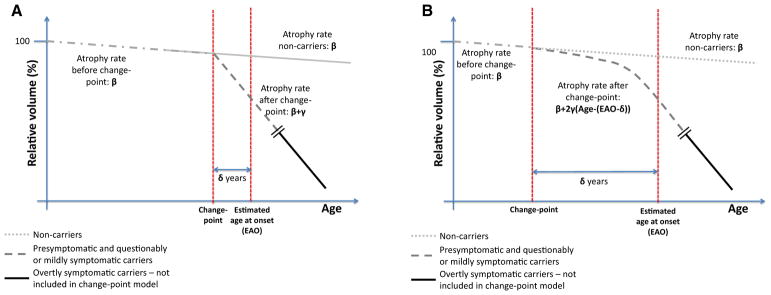
Methods: Serial T1-weighted magnetic resonance imaging scans of 94 participants (28 noncarriers, 66 carriers) from the Dominantly Inherited Alzheimer Network were used to measure brain, ventricular, and hippocampal atrophy rates. For each structure, nonlinear mixed-effects models estimated the change-points when atrophy rates deviate from normal and the rates of change before and after this point.
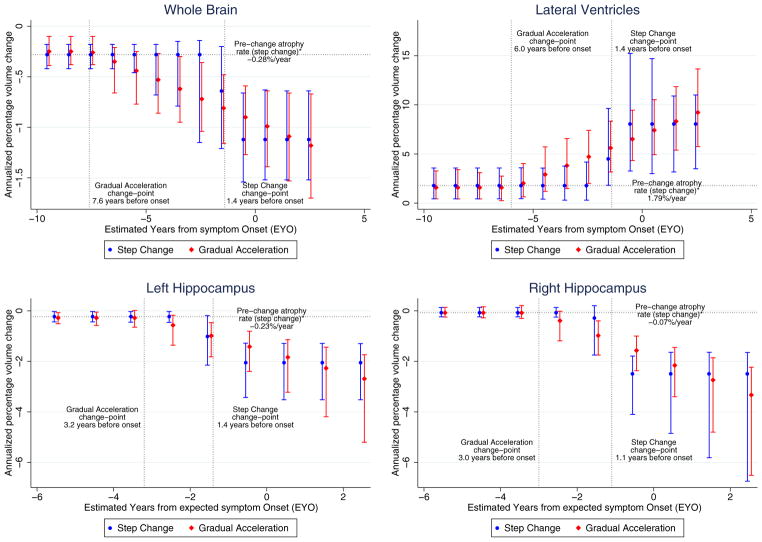
Results: Atrophy increased after the change-point, which occurred 1-1.5 years (assuming a single step change in atrophy rate) or 3-8 years (assuming gradual acceleration of atrophy) before expected symptom onset. At expected symptom onset, estimated atrophy rates were at least 3.6 times than those before the change-point.
Discussion: Atrophy rates are pathologically increased up to seven years before "expected onset". During this period, atrophy rates may be useful for inclusion and tracking of disease progression.
Keywords: Alzheimer's disease; Atrophy; Autosomal dominant; Boundary Shift Integral; Change-point; Dementia; Longitudinal; MRI; Neuroimaging; Nonlinear modeling.
Copyright © 2017 the Alzheimer's Association. Published by Elsevier Inc. All rights reserved.
Figures
References
Publication types
MeSH terms
Substances
Grants and funding
- R01 AG034189/AG/NIA NIH HHS/United States
- U01 AG032984/AG/NIA NIH HHS/United States
- R01 NS065667/NS/NINDS NIH HHS/United States
- P01 AG026276/AG/NIA NIH HHS/United States
- R01 LM011360/LM/NLM NIH HHS/United States
- MR/J01107X/1/MRC_/Medical Research Council/United Kingdom
- R01 CA129769/CA/NCI NIH HHS/United States
- UF1 AG032438/AG/NIA NIH HHS/United States
- MR/L023784/2/MRC_/Medical Research Council/United Kingdom
- P30 AG066514/AG/NIA NIH HHS/United States
- UL1 TR002345/TR/NCATS NIH HHS/United States
- U19 AG032438/AG/NIA NIH HHS/United States
- MR/M009106/1/MRC_/Medical Research Council/United Kingdom
- R01 AG019771/AG/NIA NIH HHS/United States
- RF1 AG041915/AG/NIA NIH HHS/United States
- R01 AG036469/AG/NIA NIH HHS/United States
- R01 AG016495/AG/NIA NIH HHS/United States
- R21 AG043337/AG/NIA NIH HHS/United States
- P30 AG010133/AG/NIA NIH HHS/United States
- U24 AG021886/AG/NIA NIH HHS/United States
- R44 AG049540/AG/NIA NIH HHS/United States
- R56 AG034189/AG/NIA NIH HHS/United States
- P01 AG003991/AG/NIA NIH HHS/United States
- P50 AG005681/AG/NIA NIH HHS/United States
- K23 AG030946/AG/NIA NIH HHS/United States
- MR/L023784/1/MRC_/Medical Research Council/United Kingdom
- P50 AG005138/AG/NIA NIH HHS/United States
- R01 AG037212/AG/NIA NIH HHS/United States
- UL1 TR000448/TR/NCATS NIH HHS/United States
LinkOut - more resources
Full Text Sources
Other Literature Sources
Medical
