


Neonatal detection of Aicardi Goutières Syndrome by increased C26:0 lysophosphatidylcholine and interferon signature on newborn screening blood spots
- PMID: 28739201
- PMCID: PMC5722655
- DOI: 10.1016/j.ymgme.2017.07.006
Neonatal detection of Aicardi Goutières Syndrome by increased C26:0 lysophosphatidylcholine and interferon signature on newborn screening blood spots
Erratum in
-
Corrigendum to "Neonatal detection of Aicardi Goutières Syndrome by increased C26:0 lysophosphatidylcholine and interferon signature on newborn screening blood spots" [2017 Nov;122(3):134-139].Mol Genet Metab. 2022 May;136(1):80. doi: 10.1016/j.ymgme.2022.03.006. Epub 2022 Mar 21. Mol Genet Metab. 2022. PMID: 35331633 No abstract available.
Abstract
Background: Aicardi Goutières Syndrome (AGS) is a heritable interferonopathy associated with systemic autoinflammation causing interferon (IFN) elevation, central nervous system calcifications, leukodystrophy and severe neurologic sequelae. An infant with TREX1 mutations was recently found to have abnormal C26:0 lysophosphatidylcholine (C26:0 Lyso-PC) in a newborn screening platform for X-linked adrenoleukodystrophy, prompting analysis of this analyte in retrospectively collected samples from individuals affected by AGS.
Methods: In this study, we explored C26:0 Lyso-PC levels and IFN signatures in newborn blood spots and post-natal blood samples in 19 children with a molecular and clinical diagnosis of AGS and in the blood spots of 22 healthy newborns. We used Nanostring nCounter™ for IFN-induced gene analysis and a high-performance liquid chromatography with tandem mass spectrometry (HPLC MS/MS) newborn screening platform for C26:0 Lyso-PC analysis.
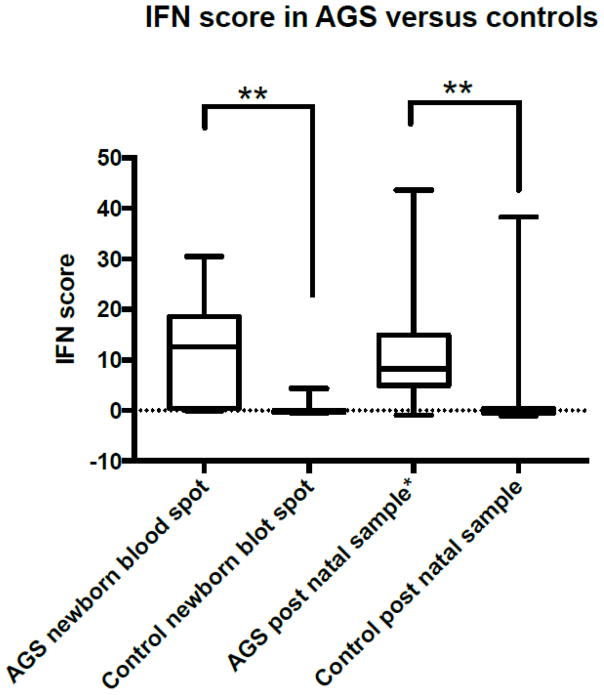
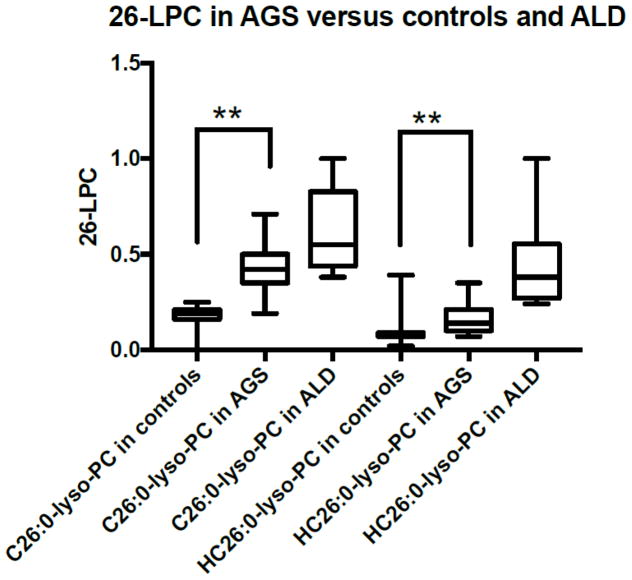
Results: Newborn screening cards from patients across six AGS associated genes were collected, with a median disease presentation of 2months. Thirteen out of 19 (68%) children with AGS had elevations of first tier C26:0 Lyso-PC (>0.4μM), that would have resulted in a second screen being performed in a two tier screening system for X-linked adrenoleukodystrophy (X-ALD). The median (95%CI) of first tier C26:0 Lyso-PC values in AGS individuals (0.43μM [0.37-0.48]) was higher than that seen in controls (0.21μM [0.21-0.21]), but lower than X-ALD individuals (0.72μM [0.59-0.84])(p<0.001). Fourteen of 19 children had elevated expression of IFN signaling on blood cards relative to controls (Sensitivity 73.7%, 95%CI 51-88%, Specificity 95%, 95% CI 78-99%) including an individual with delayed disease presentation (36months of age). All five AGS patients with negative IFN signature at birth had RNASEH2B mutations. Consistency of agreement between IFN signature in neonatal and post-natal samples was high (0.85).
Conclusion: This suggests that inflammatory markers in AGS can be identified in the newborn period, before symptom onset. Additionally, since C26:0 Lyso-PC screening is currently used in X-ALD newborn screening panels, clinicians should be alert to the fact that AGS infants may present as false positives during X-ALD screening.
Copyright © 2017 Elsevier Inc. All rights reserved.
Conflict of interest statement
Figures
References
-
- Crow YJ, Chase DS, Lowenstein Schmidt J, Szynkiewicz M, Forte G, Gornall HL, Oojageer A, Anderson B, Pizzino A, Helman G. Characterization of human disease phenotypes associated with mutations in TREX1, RNASEH2A, RNASEH2B, RNASEH2C, SAMHD1, ADAR, and IFIH1. American Journal of Medical Genetics Part A. 2015;167:296–312. - PMC - PubMed
-
- Crow YJ, Hayward BE, Parmar R, Robins P, Leitch A, Ali M, Black DN, van Bokhoven H, Brunner HG, Hamel BC. Mutations in the gene encoding the 3′–5′ DNA exonuclease TREX1 cause Aicardi-Goutieres syndrome at the AGS1 locus. Nature genetics. 2006;38:917–920. - PubMed
-
- Crow YJ, Leitch A, Hayward BE, Garner A, Parmar R, Griffith E, Ali M, Semple C, Aicardi J, Babul-Hirji R. Mutations in genes encoding ribonuclease H2 subunits cause Aicardi-Goutieres syndrome and mimic congenital viral brain infection. Nature genetics. 2006;38:910–916. - PubMed
Publication types
MeSH terms
Substances
Supplementary concepts
Grants and funding
LinkOut - more resources
Full Text Sources
Other Literature Sources
Medical
