


Distinct Trajectories of Cortisol Response to Prolonged Acute Stress Are Linked to Affective Responses and Hippocampal Gray Matter Volume in Healthy Females
- PMID: 28739584
- PMCID: PMC5559768
- DOI: 10.1523/JNEUROSCI.1175-17.2017
Distinct Trajectories of Cortisol Response to Prolonged Acute Stress Are Linked to Affective Responses and Hippocampal Gray Matter Volume in Healthy Females
Abstract
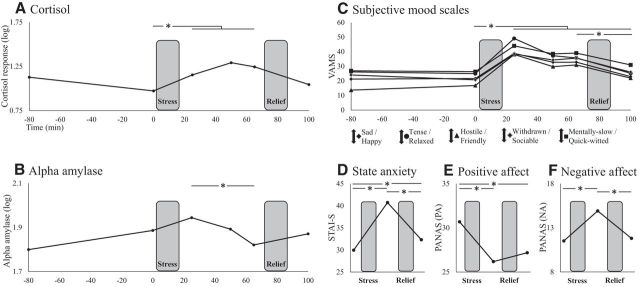
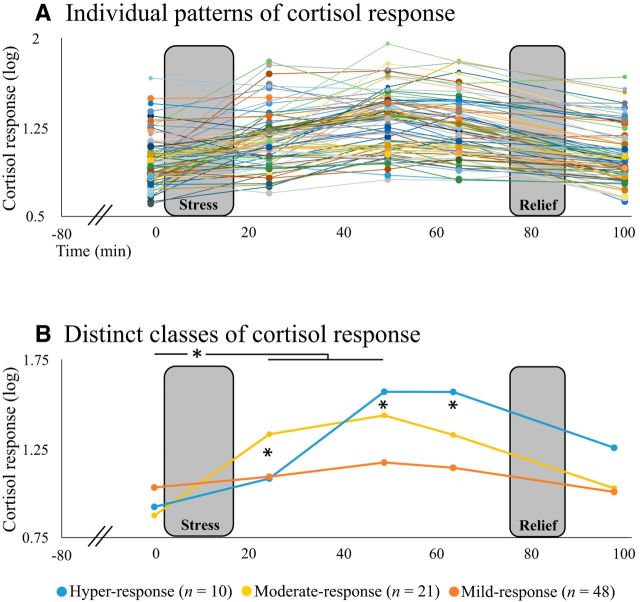
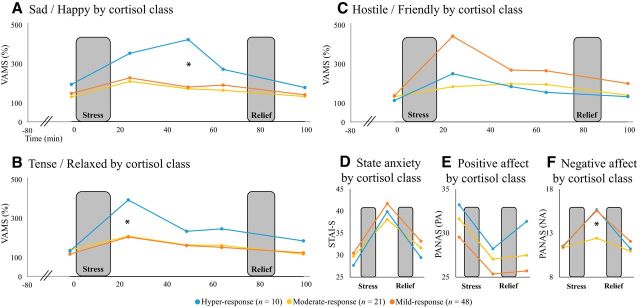
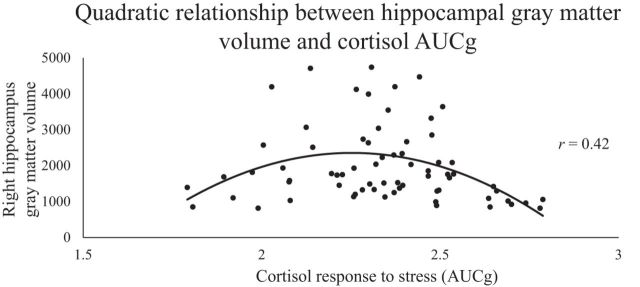
The development of robust laboratory procedures for acute stress induction over the last decades has greatly advanced our understanding of stress responses in humans and their underlying neurobiological mechanisms. Nevertheless, attempts to uncover linear relationships among endocrine, neural, and affective responses to stress have generally yielded inconsistent results. Here, 79 healthy females completed a well established laboratory procedure of acute stress induction that was modified to prolong its effect. Endocrinological and subjective affect assessments revealed stress-induced increases in cortisol release and negative affect that persisted 65 and 100 min after stress onset, respectively, confirming a relatively prolonged acute stress induction. Applying latent class linear mixed modeling on individuals' patterns of cortisol responses identified three distinct trajectories of cortisol response: the hyper-response (n = 10), moderate-response (n = 21), and mild-response (n = 48) groups. Notably, whereas all three groups exhibited a significant stress-induced increase in cortisol release and negative affect, the hyper-response and mild-response groups both reported more negative affect relative to the moderate-response group. Structural MRI revealed no group differences in hippocampal and amygdala volumes, yet a continuous measure of cortisol response (area under the curve) showed that high and low levels of stress-induced cortisol release were associated with less hippocampal gray matter volume compared with moderate cortisol release. Together, these results suggest that distinct trajectories of cortisol response to prolonged acute stress among healthy females may not be captured by conventional linear analyses; instead, quadratic relations may better describe links between cortisol response to stress and affective responses, as well as hippocampal structural variability.SIGNIFICANCE STATEMENT Despite substantial research, it is unclear whether and how individual neuroendocrine stress response patterns are linked to affective responses to stress and structural variability in neuroendocrine regulatory brain regions. By applying latent class linear mixed modeling on individuals' patterns of cortisol responses to a prolonged acute stressor, we identified three distinct trajectories of cortisol response. Relative to the group showing a moderate cortisol response, groups characterized by hyper and mild cortisol response were both associated with more negative affect. Moreover, a continuous measure of cortisol response showed that high and low levels of stress-induced cortisol release correlated with reduced hippocampal gray matter volume. Given that neuroendocrine stress responses are conceptualized as biomarkers of stress susceptibility, these insights may have clinical implications.
Keywords: HPA; cortisol; hippocampus; mood; stress.
Copyright © 2017 the authors 0270-6474/17/377995-09$15.00/0.
Figures

References
-
- Blascovich JJ, Vanman E, Mendes WB, Dickerson S (2011) Social psychophysiology for social and personality psychology. Thousand Oaks, CA: Sage.
-
- Cacciaglia R, Nees F, Grimm O, Ridder S, Pohlack ST, Diener SJ, Liebscher C, Flor H (2017) Trauma exposure relates to heightened stress, altered amygdala morphology and deficient extinction learning: implications for psychopathology. Psychoneuroendocrinology 76:19–28. 10.1016/j.psyneuen.2016.11.012 - DOI - PubMed
Publication types
MeSH terms
Substances
Grants and funding
LinkOut - more resources
Full Text Sources
Other Literature Sources
