


Older, sociable capuchins (Cebus capucinus) invent more social behaviors, but younger monkeys innovate more in other contexts
- PMID: 28739946
- PMCID: PMC5544268
- DOI: 10.1073/pnas.1620739114
Older, sociable capuchins (Cebus capucinus) invent more social behaviors, but younger monkeys innovate more in other contexts
Abstract
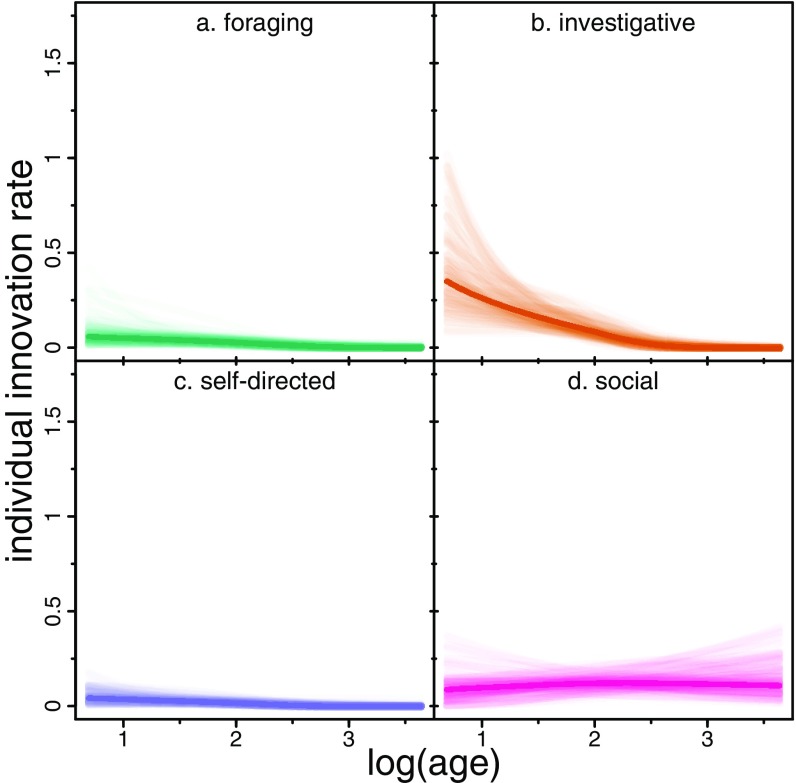
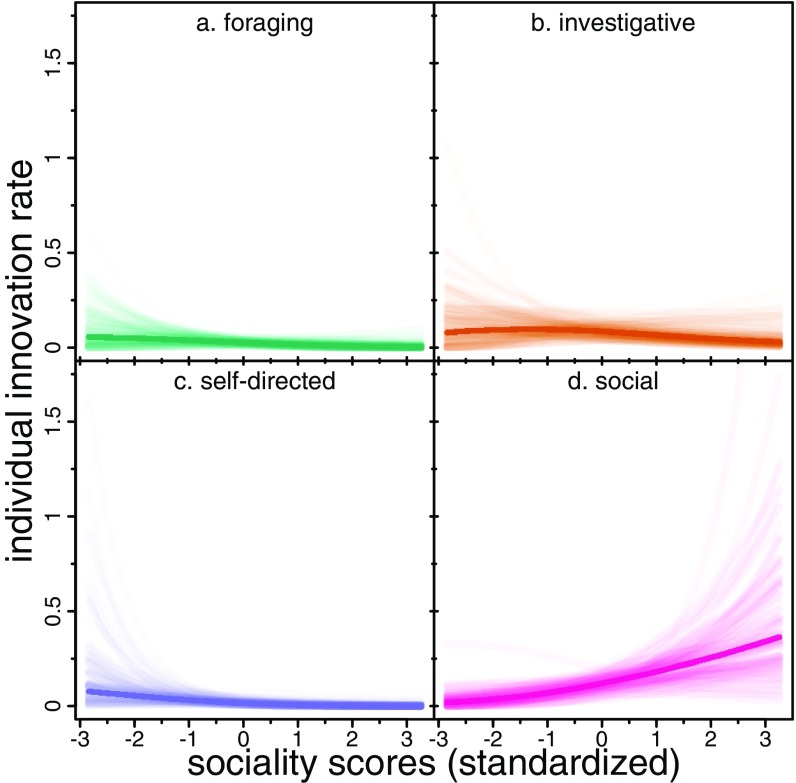
An important extension to our understanding of evolutionary processes has been the discovery of the roles that individual and social learning play in creating recurring phenotypes on which selection can act. Cultural change occurs chiefly through invention of new behavioral variants combined with social transmission of the novel behaviors to new practitioners. Therefore, understanding what makes some individuals more likely to innovate and/or transmit new behaviors is critical for creating realistic models of culture change. The difficulty in identifying what behaviors qualify as new in wild animal populations has inhibited researchers from understanding the characteristics of behavioral innovations and innovators. Here, we present the findings of a long-term, systematic study of innovation (10 y, 10 groups, and 234 individuals) in wild capuchin monkeys (Cebus capucinus) in Lomas Barbudal, Costa Rica. Our methodology explicitly seeks novel behaviors, requiring their absence during the first 5 y of the study to qualify as novel in the second 5 y of the study. Only about 20% of 187 innovations identified were retained in innovators' individual behavioral repertoires, and 22% were subsequently seen in other group members. Older, more social monkeys were more likely to invent new forms of social interaction, whereas younger monkeys were more likely to innovate in other behavioral domains (foraging, investigative, and self-directed behaviors). Sex and rank had little effect on innovative tendencies. Relative to apes, capuchins devote more of their innovations repertoire to investigative behaviors and social bonding behaviors and less to foraging and comfort behaviors.
Keywords: Cebus capucinus; cultural evolution; innovation; learning; phenotypic plasticity.
Conflict of interest statement
The authors declare no conflict of interest.
Figures
References
-
- Imanishi K. Man. Mainichi-Shinbunsha; Tokyo: 1952.
-
- Kummer H. Primate Societies: Group Techniques of Ecological Adaptation. AHM Publ Corp; Arlington Heights, IL: 1971.
-
- West-Eberhard MJ. Developmental Plasticity and Evolution. Oxford Univ Press; Oxford: 2003.
-
- Giraldeau L-A, Caraco Y, Valone T. Social foraging: Individual learning and cultural transmission of innovations. Behav Ecol. 1994;5:35–43.
-
- Sol D. Behavioural flexibility: A neglected issue in the ecological and evolutionary literature? In: Reader SM, Laland KN, editors. Animal Innovation. Oxford Univ Press; Oxford: 2003. pp. 62–82.
LinkOut - more resources
Full Text Sources
Other Literature Sources
