. 2017 Jul 24;7(1):6308.
doi: 10.1038/s41598-017-06587-0.

Neanderthal-Derived Genetic Variation Shapes Modern Human Cranium and Brain

Affiliations

Neanderthal-Derived Genetic Variation Shapes Modern Human Cranium and Brain

Michael D Gregory et al. Sci Rep. .

Abstract

Before their disappearance from the fossil record approximately 40,000 years ago, Neanderthals, the ancient hominin lineage most closely related to modern humans, interbred with ancestors of present-day humans. The legacy of this gene flow persists through Neanderthal-derived variants that survive in modern human DNA; however, the neural implications of this inheritance are uncertain. Here, using MRI in a large cohort of healthy individuals of European-descent, we show that the amount of Neanderthal-originating polymorphism carried in living humans is related to cranial and brain morphology. First, as a validation of our approach, we demonstrate that a greater load of Neanderthal-derived genetic variants (higher "NeanderScore") is associated with skull shapes resembling those of known Neanderthal cranial remains, particularly in occipital and parietal bones. Next, we demonstrate convergent NeanderScore-related findings in the brain (measured by gray- and white-matter volume, sulcal depth, and gyrification index) that localize to the visual cortex and intraparietal sulcus. This work provides insights into ancestral human neurobiology and suggests that Neanderthal-derived genetic variation is neurologically functional in the contemporary population.


Conflict of interest statement

The authors declare that they have no competing interests.

Figures
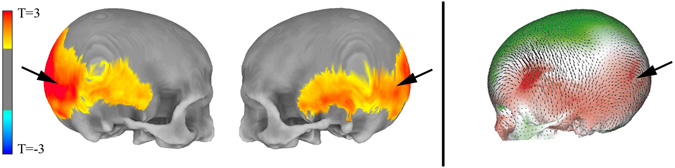
Figure 1
Figure 1
NeanderScore related skull shape changes. Associations between skull morphology and percentage of Neanderthal-derived SNPs (NeanderScore) in modern humans (Left), compared to differences between Neanderthal and modern human skulls (Right). Left panel shows regions with morphological changes, measured in vivo, related to NeanderScore and overlaid on the average skull of all 146 participants. Warm colors represent areas for which NeanderScore correlated with skull expansion (p < 0.05, FWE-corrected). There were no findings in the opposite direction. Right panel depicts previously published shape differences between Neanderthals and modern humans, from archeological samples, overlaid on a modern human skull. Red regions represent skull expansion in Neanderthals relative to modern humans; green represents contraction, adapted by permission from Macmillian Publishers Ltd: Nature, © 2001. Note the convergence of in vivo and archeological data in occipito-parieto-temporal regions (arrows).
Figure 2
Figure 2
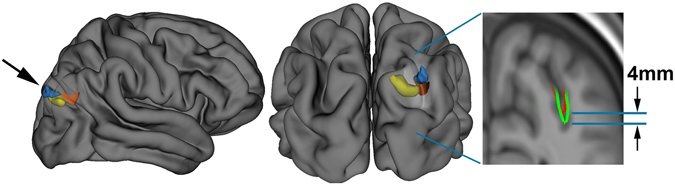
NeanderScore related brain changes in the intraparietal sulcus. Structural variation of the intraparietal sulcus (IPS) related to percentage of Neanderthal-derived SNPs (NeanderScore). Left and middle show lateral and posterior views of the right IPS on the average brain surface, illustrating the anatomical convergence of the associations of NeanderScore with greater sulcal depth (orange; p < 0.05 FWE-corrected), gray matter volume (blue; p < 0.005), and white matter volume (yellow; p < 0.005). Right shows a coronal slice (y = −72 mm) through the IPS where there was a sulcal depth difference of 4 mm between the 30 individuals with highest (blue line) and lowest (red line) NeanderScore. Findings are depicted on the average brain of all 221 individuals included in the study and underlie the maximal skull findings shown in Fig. 1 (arrows).
Figure 3
Figure 3
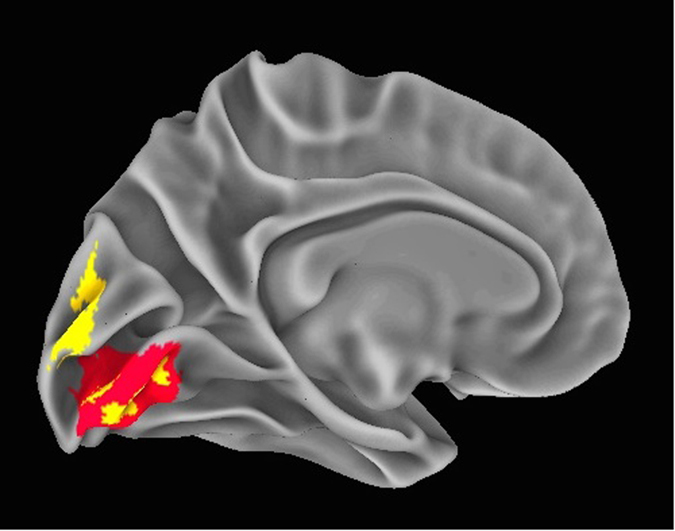
NeanderScore related brain changes in the primary visual cortex. Associations between local gyrification index, gray matter volume, and NeanderScore in visual cortex. Medial view of the primary visual cortex showing areas where NeanderScore was significantly associated with local gyrification index (red; p < 0.05 FWE-corrected) and with gray matter volume (yellow; p < 0.005).
Figure 4
Figure 4
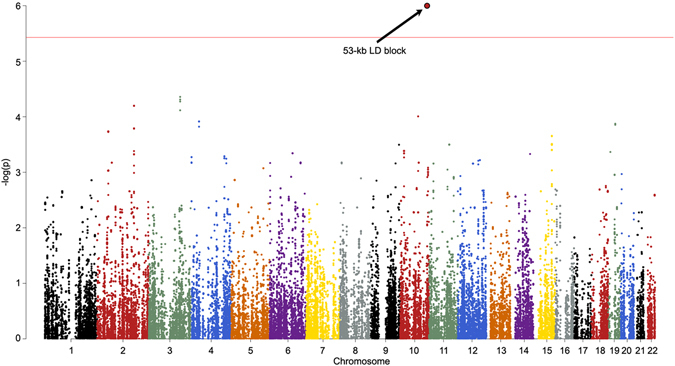
Manhattan plot of the shared variance of NeanderScore associated brain and skull changes. Manhattan plot showing the chromosomal position and significance of association between the shared variance of all Neanderthal-associated brain measures for each Neanderthal-derived SNP. Red line indicates Bonferroni-corrected threshold of p < 0.05 for the effective number of SNPs in the analysis. The arrow points to the significant 53-kb LD block on chromosome 10 containing 18 SNPs. See also Table 2.
Figure 5
Figure 5
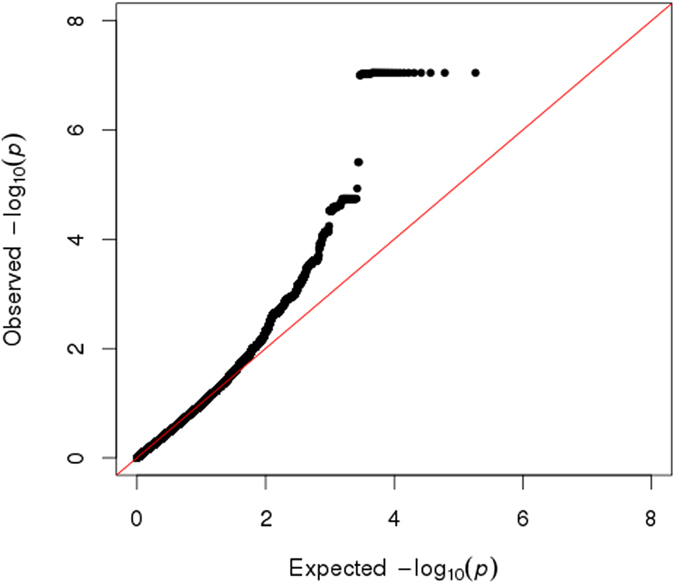
QQ plot showing observed versus expected −log10 (p values) for association at all Neanderthal-derived loci of the shared variance of all Neanderthal-associated brain measures.
Figure 6
Figure 6
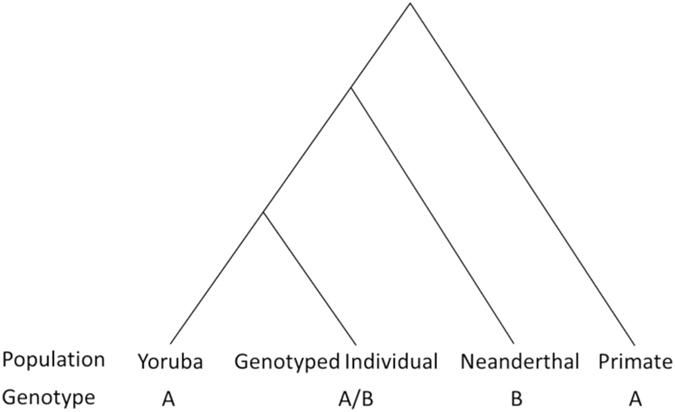
Derivation of NeanderScore. Phylogenic tree showing relationship of Yoruba, a genotyped individual, Neanderthal and Primates. At a given SNP, Yoruba and Primates contain the ancestral allele (A), Neanderthal contains the derived allele (B) and the genotyped individual may have either allele (A,B).
Figure 7
Figure 7
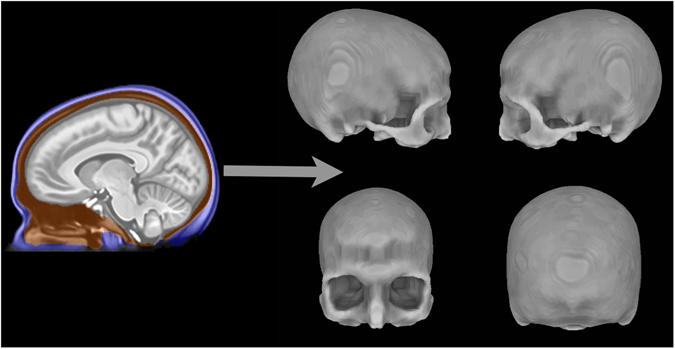
Skull surface creation from the T1-weighted MRI scan of a single participant. Left shows the segmentation procedure performed in the volume where voxels labeled blue represent scalp, orange voxels represent skull, and gray voxels represent the intracranial area. Right shows the 3D skull surface derived from voxels labeled as skull (orange) in the segmentation.

References

    1. Lind J, Lindenfors P, Ghirlanda S, Liden K, Enquist M. Dating human cultural capacity using phylogenetic principles. Sci Rep. 2013;3:1785. doi: 10.1038/srep01785. - DOI - PMC - PubMed
    1. Ponce de Leon MS, Zollikofer CP. Neanderthal cranial ontogeny and its implications for late hominid diversity. Nature. 2001;412:534–538. doi: 10.1038/35087573. - DOI - PubMed
    1. Green RE, et al. A draft sequence of the Neandertal genome. Science. 2010;328:710–722. doi: 10.1126/science.1188021. - DOI - PMC - PubMed
    1. Burbano HA, et al. Targeted investigation of the Neandertal genome by array-based sequence capture. Science. 2010;328:723–725. doi: 10.1126/science.1188046. - DOI - PMC - PubMed
    1. Sankararaman S, et al. The genomic landscape of Neanderthal ancestry in present-day humans. Nature. 2014;507:354–357. doi: 10.1038/nature12961. - DOI - PMC - PubMed

Publication types

LinkOut - more resources