Review
. 2017 Jun;9(Suppl 7):S640-S660.
doi: 10.21037/jtd.2017.06.99.

Multimodality imaging assessment of mitral valve anatomy in planning for mitral valve repair in secondary mitral regurgitation

Affiliations
Review

Multimodality imaging assessment of mitral valve anatomy in planning for mitral valve repair in secondary mitral regurgitation

Romain Capoulade et al. J Thorac Dis. 2017 Jun.

Abstract

Secondary mitral regurgitation (MR) is frequent valvular heart disease and conveys worse prognostic. Therapeutic surgical or percutaneous options are available in the context of severe symptomatic secondary MR, but the best approach to treat these patients remains unclear, given the lack of clear clinical evidence of benefit. A comprehensive evaluation of the mitral valve apparatus and the left ventricle (LV) has the ability to clearly define and characterize the disease, and thus determine the best option for the patient to improve its clinical outcomes, as well as quality of life and symptoms. The current report reviews the mitral valve (MV) anatomy, the underlying mechanisms associated with secondary MR, the related therapeutic options available, and finally the usefulness of a multimodality imaging approach for the planning of surgical or percutaneous mitral valve intervention.

Keywords: Secondary mitral regurgitation; cardiac magnetic resonance (CMR); computed tomography (CT); echocardiography; multimodality imaging; positron emission tomography (PET).


Conflict of interest statement

Conflicts of Interest: N Piriou has served as consultant for Abbott Vascular and has received fees. The other authors have reported no relationship to disclose.

Figures

Figure 1
Figure 1
Mitral valve anatomy. Schematic representation of the mitral valve in the surgeon view. The mitral valve is composed of anterior and posterior leaflets subdivided into three scallops and joined by anterior and posterior commissures. Intervalvular fibrosa is the continuous junction between the mitral and aortic annulus.
Figure 2
Figure 2
Mitral valve apparatus geometry in normal and secondary mitral regurgitation conditions. Schematic representation of the mitral valve apparatus including papillary muscle, chordae tendineae, mitral annulus. In the context of secondary mitral regurgitation, the distortion of the left ventricle (LV) due to ischemic or idiopathic cardiomyopathy results in papillary muscle displacement. This spatial change leads to increased tethering forces exerted by chordae on the mitral leaflets. The tethering of the mitral valve leaflets is associated with apical displacement of the coaptation zone, which in turn results in incomplete leaflet closure and secondary mitral regurgitation (MR). Annular dilation also participates to the process.
Figure 3
Figure 3
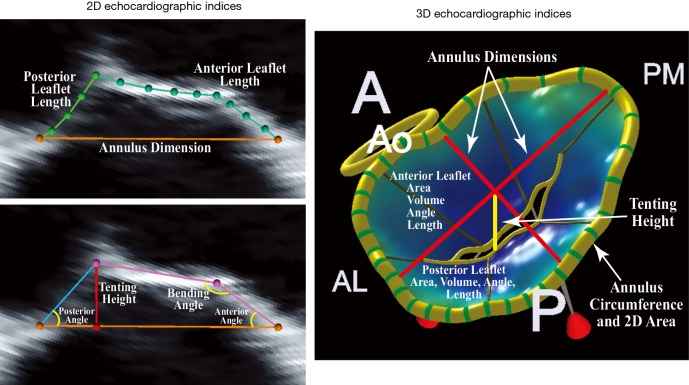
Echocardiographic evaluation of the mitral valve morphology. Standard indices derived from 2D and 3D echocardiography to assess mitral valve morphology. 2D echocardiographic indices are measured on apical 4-chamber (or 3-chamber) and included annulus dimension, anterior and posterior leaflet lengths and angles, bending angle and tenting height. 3D echocardiographic indices are measured from transesophageal echocardiography and included annulus dimensions and circumference, annulus 2D area, anterior and posterior leaflet area/volume/angle/length, and tenting height. A, anterior; AL, anterolateral; Ao, aorta; P, posterior; PM, posteromedial.
Figure 4
Figure 4
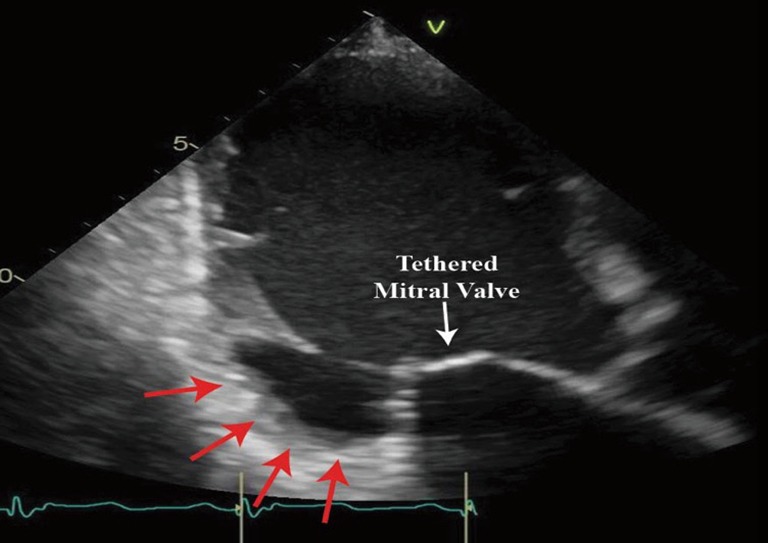
Echocardiographic example of basal left ventricular aneurysm. Basal left ventricular (LV) aneurysm (red arrows) in patients with secondary mitral regurgitation and tethered mitral valve.
Figure 5
Figure 5
Left ventricular to mitral valve ring mismatch concept and clinical implication to treat patients with secondary mitral regurgitation. Proposed algorithm for applying left ventricular-mitral valve (LV-MV) ring mismatch concept to define patients at high risk for recurrence of mitral regurgitation (MR) post restrictive annuloplasty. Reproduced with permission from Capoulade et al., Circulation, 2016 (121).
Figure 6
Figure 6
Mitral valve topography based on 3D echocardiography. Advanced 3D mitral valve (MV) analysis to assess regional degree of MV tethering. Development of the regional tethering map and MV segmentation (A). Example of MV mapping in normal subjects and patients with secondary mitral regurgitation (B).
Figure 7
Figure 7
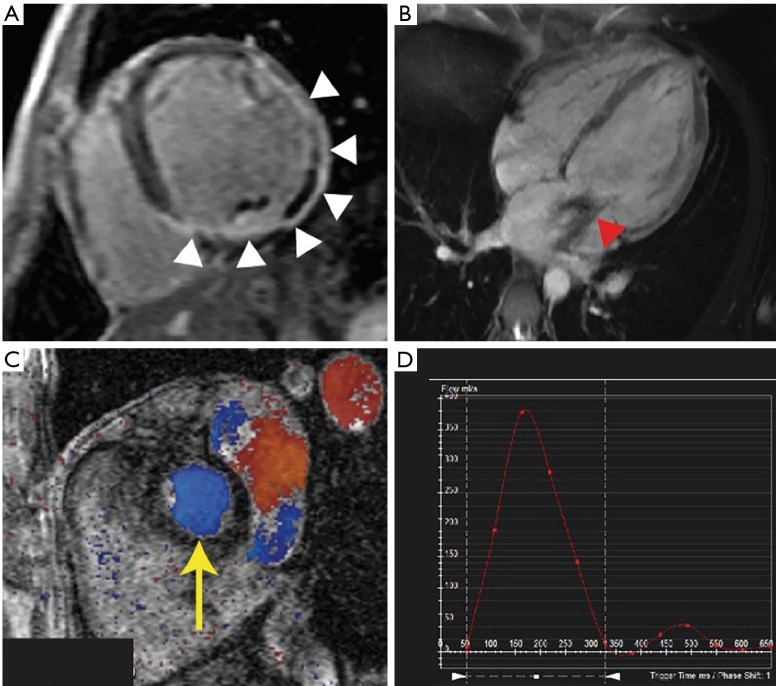
Fibrotic scar and mitral regurgitation evaluation by cardiac magnetic resonance. (A,B) A large non-viable fibrotic scar secondary to myocardial infarction in the lateral and inferior medial and basal segments (A: white arrows head) in patients with secondary mitral regurgitation (B: red arrow head; MR jet). (C,D) Indirect method to quantify mitral regurgitation by cardiac magnetic resonance imaging: in the absence of aortic regurgitation, mitral regurgitation is quantified by the difference between left ventricular flow and aortic flow assessed using phase-contrast sequence (C: yellow arrow) and the analysis of the flow time plot (D).
Figure 8
Figure 8
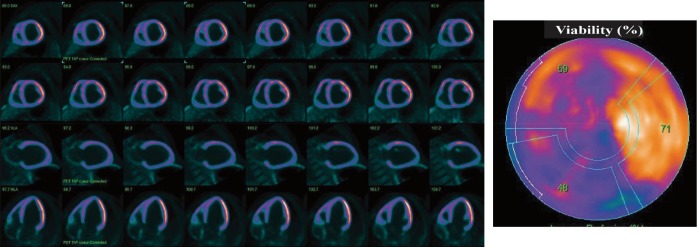
Assessment of myocardial viability by positron emission tomography. 18F-FDG PET scan in a patient with severe LV dysfunction in the context of ischemic cardiomyopathy associated with severe secondary mitral regurgitation and 3-vessel disease. Tomographic and polar plot representations showed significant myocardial viability in the lateral, anterior and antero-septal walls driving the therapeutic strategy to coronary artery bypass graft + MV repair. FDG, 18fluorin-deoxyglucose; PET, positron emission tomography; LV, left ventricular; MV, mitral valve.

References

    1. Nkomo VT, Gardin JM, Skelton TN, et al. Burden of valvular heart diseases: a population-based study. Lancet 2006;368:1005-11. 10.1016/S0140-6736(06)69208-8 - DOI - PubMed
    1. de Marchena E, Badiye A, Robalino G, et al. Respective prevalence of the different carpentier classes of mitral regurgitation: a stepping stone for future therapeutic research and development. J Card Surg 2011;26:385-92. 10.1111/j.1540-8191.2011.01274.x - DOI - PubMed
    1. Lamas GA, Mitchell GF, Flaker GC, et al. Clinical significance of mitral regurgitation after acute myocardial infarction. Survival and Ventricular Enlargement Investigators. Circulation 1997;96:827-33. 10.1161/01.CIR.96.3.827 - DOI - PubMed
    1. Koelling TM, Aaronson KD, Cody RJ, et al. Prognostic significance of mitral regurgitation and tricuspid regurgitation in patients with left ventricular systolic dysfunction. Am Heart J 2002;144:524-9. 10.1067/mhj.2002.123575 - DOI - PubMed
    1. Grigioni F, Enriquez-Sarano M, Zehr KJ, et al. Ischemic mitral regurgitation. Long-term outcome and prognostic implications with quantitative Doppler assessment. Circulation 2001;103:1759-64. 10.1161/01.CIR.103.13.1759 - DOI - PubMed

LinkOut - more resources