


Chemoradiation therapy with docetaxel in elderly patients with stage II/III esophageal cancer: A phase 2 trial
- PMID: 28740892
- PMCID: PMC5514160
- DOI: 10.1016/j.adro.2016.07.002
Chemoradiation therapy with docetaxel in elderly patients with stage II/III esophageal cancer: A phase 2 trial
Abstract
Purpose: The most effective treatments in elderly patients with esophageal cancer remain a subject of debate. This multicenter phase 2 study was designed to evaluate the efficacy and toxicity of chemoradiation therapy (CRT) with docetaxel (DTX) in elderly patients with stage II/III (non-T4) esophageal cancer.
Methods and materials: Patients ≥70 years of age with clinical stage II/III esophageal cancer received DTX at a weekly dose of 10 mg/m2 during 6 consecutive weeks and concurrent radiation therapy (60 Gy in 30 fractions). The primary endpoint was the 2-year survival rate, and the required number of enrolled patients was 37.
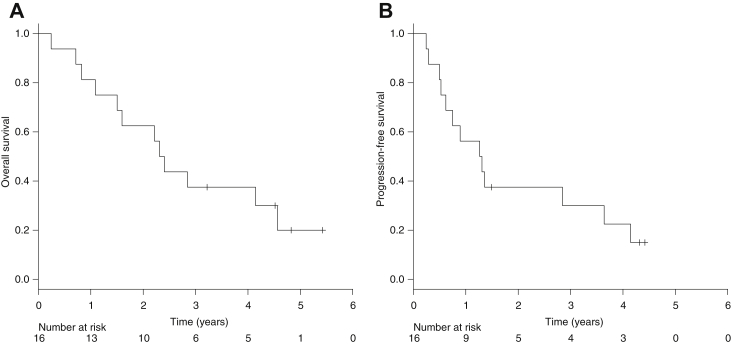
Results: Between July 2008 and January 2011, 16 patients were enrolled. The study was prematurely closed because of slow accrual. Characteristics of the patients were as follows: median age, 77 years (range, 73-81); performance status 0/1, 4/12; and clinical stage IIA/IIB/III, 3/4/9. Of the 16 patients, 14 (87.5%) completed the CRT. The 2-year survival rate was 62.5% (90% confidence interval [CI], 42.5-82.5). The median survival time was 27.7 months (95% CI, 23.3-32.2 months) and the median progression-free survival was 15.2 months (95% CI, 5.4-25.0 months). Seven patients achieved complete response, resulting in a complete response rate of 43.8% (95% CI, 19.8-70.1). Grade 3 or higher acute toxicities included esophagitis (31.3%), anorexia (12.5%), leukopenia (6.3%), neutropenia (6.3%), thrombocytopenia (6.3%), mucositis (6.3%), and infection (6.3%). Grade 3 or higher late toxicities included esophagitis (12.5%), pleural effusion (12.5%), pneumonitis (6.3%), and pericardial effusion (6.3%).
Conclusions: CRT with DTX might be a treatment option for elderly patients with stage II/III esophageal cancer, particularly for patients who are medically unfit for surgery or cisplatin-containing therapy. However, further improvements of this therapy are required to decrease the incidence of esophagitis.
Figures
References
-
- Parkin D.M., Bray F., Ferlay J. Global cancer statistics, 2002. CA Cancer J Clin. 2005;55:74–108. - PubMed
-
- The Editorial Board of the Cancer Statistics in Japan. Cancer Statistics in Japan 2007 Foundation for Promotion of Cancer Research.
-
- Bonavina L., Incarbone R., Saino G. Clinical outcome and survival after esophagectomy for carcinoma in elderly patients. Dis Esophagus. 2003;16:90–93. - PubMed
-
- Steyerberg E.W., Neville B., Weeks J.C. Referral patterns, treatment choices, and outcomes in locoregional esophageal cancer: A population-based analysis of elderly patients. J Clin Oncol. 2007;25:2389–2396. - PubMed
-
- Kinugasa S., Tachibana M., Yoshimura H. Esophageal resection in elderly esophageal carcinoma patients: Improvement in postoperative complications. Ann Thorac Surg. 2001;71:414–418. - PubMed
LinkOut - more resources
Full Text Sources
Other Literature Sources
Research Materials
