. 2017 Aug;54(4):1503-1528.
doi: 10.1007/s13524-017-0594-y.

The Network Survival Method for Estimating Adult Mortality: Evidence From a Survey Experiment in Rwanda

Affiliations

The Network Survival Method for Estimating Adult Mortality: Evidence From a Survey Experiment in Rwanda

Dennis M Feehan et al. Demography. 2017 Aug.

Abstract

Adult death rates are a critical indicator of population health and well-being. Wealthy countries have high-quality vital registration systems, but poor countries lack this infrastructure and must rely on estimates that are often problematic. In this article, we introduce the network survival method, a new approach for estimating adult death rates. We derive the precise conditions under which it produces consistent and unbiased estimates. Further, we develop an analytical framework for sensitivity analysis. To assess the performance of the network survival method in a realistic setting, we conducted a nationally representative survey experiment in Rwanda (n = 4,669). Network survival estimates were similar to estimates from other methods, even though the network survival estimates were made with substantially smaller samples and are based entirely on data from Rwanda, with no need for model life tables or pooling of data from other countries. Our analytic results demonstrate that the network survival method has attractive properties, and our empirical results show that this method can be used in countries where reliable estimates of adult death rates are sorely needed.

Keywords: Adult mortality; Demographic and Health Surveys; Sampling; Social networks; Survey experiment.


Figures
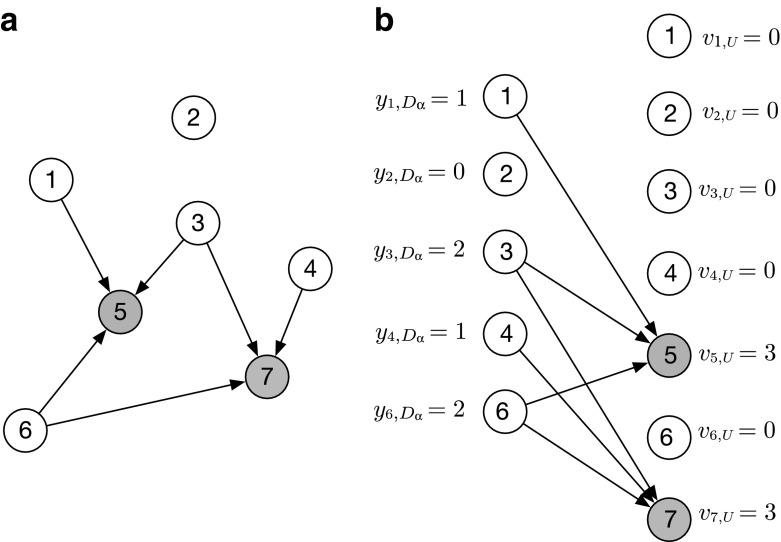
Fig. 1
Fig. 1
Panel a shows a population of seven people, two of whom have died (shown in gray). A directed edge ij indicates that i counts j as having died when answering the question, “How many people do you know who have died in the past 12 months?” Panel b shows the same population but redrawn so that each person now appears twice: as someone who reports (left) and as someone who could be reported about (right). People who have died cannot report (they cannot be interviewed). This figure depicts detailed individual reports ij; but in practice, reports are not typically collected at that level of detail (i.e., we typically would know that person i reports one death, but not that the death was specifically person j). Fortunately, the identity in Eq. (3) requires estimates of aggregate quantities, so this level of detail is not required
Fig. 2
Fig. 2
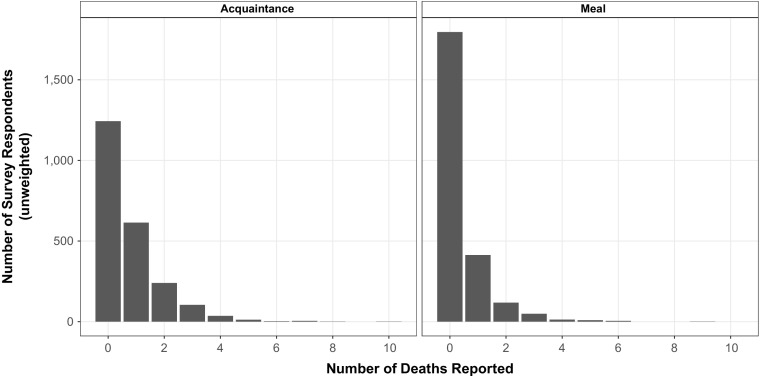
Distribution of the number of adult deaths reported by respondents using the acquaintance network (left panel) and the meal network (right panel)
Fig. 3
Fig. 3
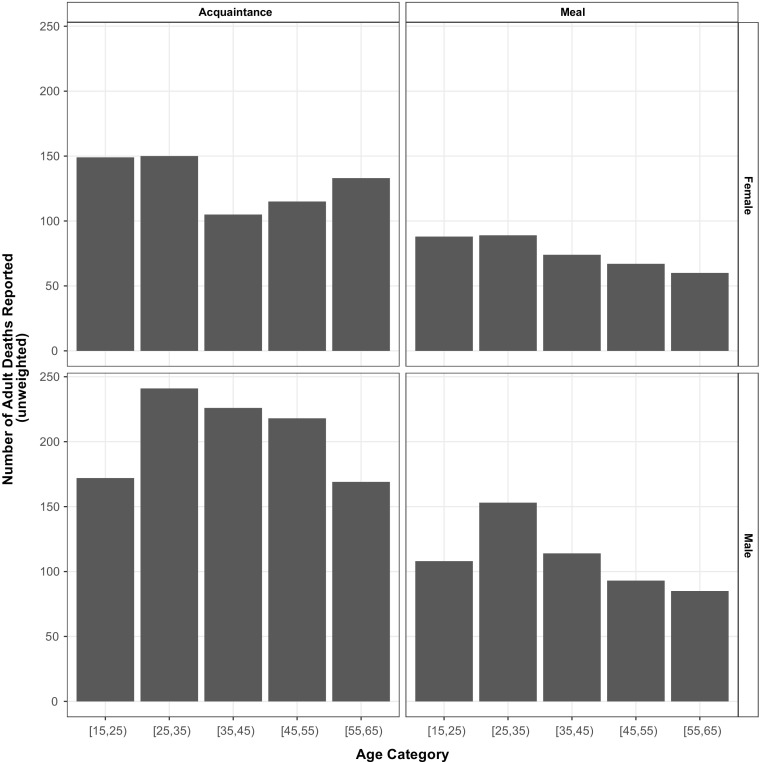
Age and sex distribution of adult deaths reported by respondents using the acquaintance network (left panels) and the meal network (right panels)
Fig. 4
Fig. 4
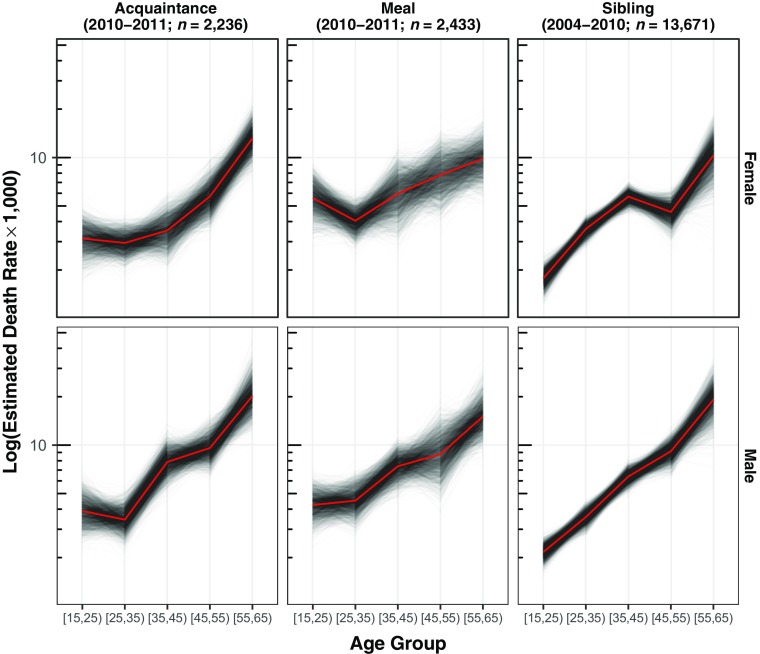
Comparison between network survival death rate estimates for two types of personal network (left column and middle column), and direct sibling survival death rates estimates from the 2010 Rwanda Demographic and Health Survey (right column). The top row has death rates estimated for females, and the bottom row has death rates estimated for males. The network survival estimates are based on reported deaths from the 12 months prior to the interview. The sibling estimates are based on reported deaths in the 84 months prior to the interview because estimates from the 12 months prior were too unstable (see Online Resource 1 (section F)). Each gray line shows the estimate from one bootstrap resample; taken together, the set of lines shows the estimated sampling uncertainty of the death rates. The thicker black lines show the mean of the bootstrap resamples
Fig. 5
Fig. 5
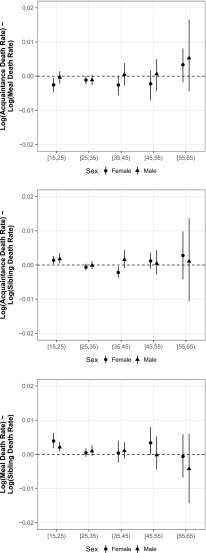
Age-specific differences between the estimated log death rate using (1) the acquaintance network and the meal network (top panel); (2) the acquaintance network and the sibling histories (middle panel); and (3) the meal network and the sibling histories (bottom panel). Above the dotted line, estimated death rates from the meal or acquaintance network are higher. These estimates are presented in tabular form in Online Resource 1 (section D)
Fig. 6
Fig. 6
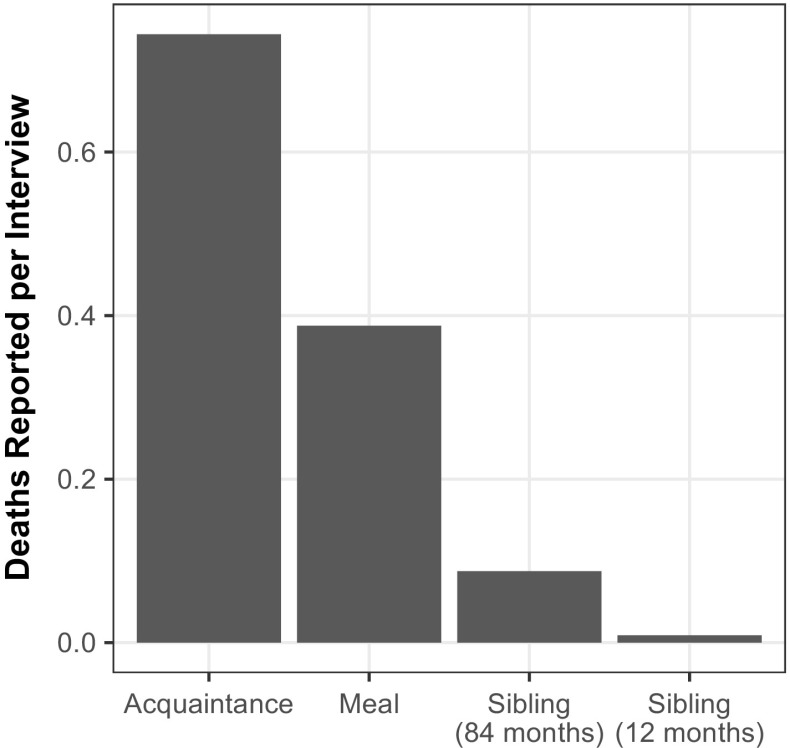
Average number of deaths reported from each interview in Rwanda using the acquaintance and meal tie definitions from the network survival study, and using the sibling history module of the DHS survey. The acquaintance and meal definitions use reported information about deaths in the 12 months prior to the survey. Compared with sibling reports about 84 months before the survey, network survival respondents reported approximately eight times more deaths using the acquaintance tie definition and approximately four times more deaths using the meal tie definition. Compared with the sibling reports about 12 months before the survey, network survival respondents reported approximately 82 times more deaths using the acquaintance tie definition and approximately 43 times more deaths using the meal tie definition
Fig. 7
Fig. 7
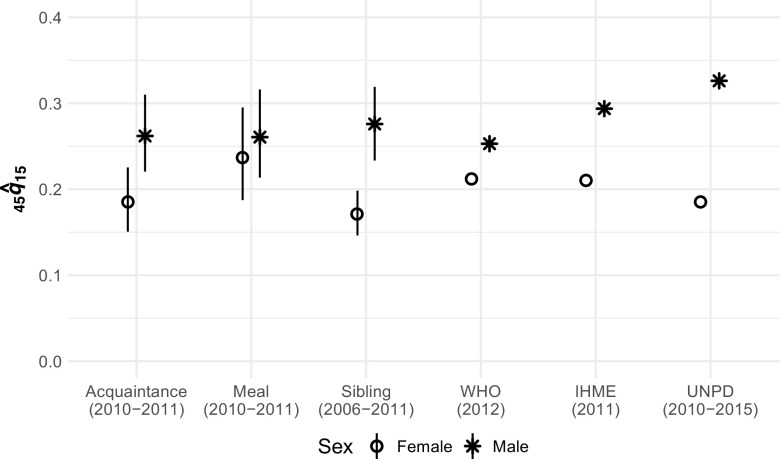
Estimated 45 q 15 for Rwanda from six sources: the acquaintance and meal tie definitions from our network survival method; the direct sibling survival method from the 2010 Rwanda Demographic and Health Survey; the United Nations Population Division (UNPD); the World Health Organization (WHO); and the Institute for Health Metrics and Evaluation (IHME). Error bars indicate 95 % sampling uncertainty intervals for the survey-based estimates, which were computed using the rescaled bootstrap. The estimates are not for exactly the same periods
Fig. 8
Fig. 8
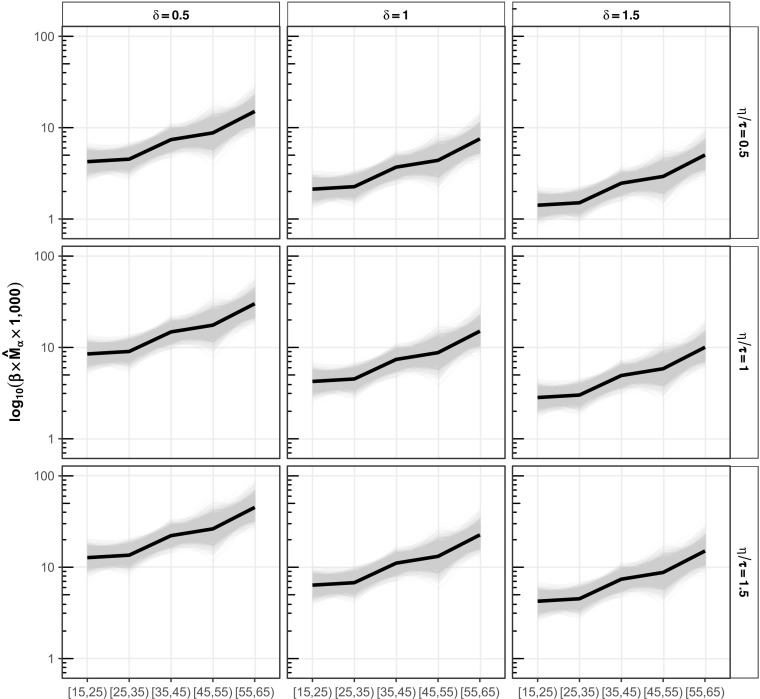
Estimated age-specific death rates for Rwandan males using the meal definition under violations of reporting and network structure conditions. The rows show different types of reporting: in the middle row, the accurate reporting condition holds (ηF , αF , α = 1); in the top row, reporting tends to omit deaths (ηF , αF , α = 0.5); and in the bottom row, reporting tends to erroneously include deaths (ηF , αF , α = 1.5). The columns show different types of personal network structure: in the middle column, the decedent network condition holds (δF , α = 1); in the left column, people who die have smaller personal networks than the average frame population member (δF , α = 0:5); in the right column, people who die have personal networks that are larger than the average frame population member (δF , α = 1.5). Violations of the accurate reporting and decedent network condition can work in opposite directions, balancing each other out (top left and bottom right panels); or, they can work in the same direction, making estimates less accurate (bottom left and top right panels)

References

    1. AbouZahr, C., de Savigny, D., Mikkelsen, L., Setel, P. W., Lozano, R., Nichols, E., . . . Lopez, A. D. (2015). Civil registration and vital statistics: Progress in the data revolution for counting and accountability. Lancet, 385, 1373–1385. - PMC - PubMed
    1. Auguie, B. (2012). gridExtra: Functions in grid graphics [R package version 0.9.1]. Retrieved from http://CRAN.R-project.org/package=gridExtra
    1. Bernard, H. R., Hallett, T., Iovita, A., Johnsen, E. C., Lyerla, R., McCarty, C., . . . Scutelniciuc, O. (2010). Counting hard-to-count populations: The Network scale-up method for public health. Sexually Transmitted Infections, 86(Suppl. 2), ii11–ii15. - PMC - PubMed
    1. Bradshaw, D., & Timaeus, I. M. (2006). Levels and trends of adult mortality. In D. T. Jamison, R. G. Feachem, M. W. Makgoba, E. R. Bos, F. K. Baingana, K. J. Hofman, & K. O. Rogo (Eds.), Disease and mortality in sub-Saharan Africa (pp. 31–42). Washington, DC: World Bank. - PubMed
    1. Checchi F, Roberts L. Documenting mortality in crises: What keeps us from doing better? PLoS Medicine. 2008;5 doi: 10.1371/journal.pmed.0050146. - DOI - PMC - PubMed

Publication types