


doi: 10.1016/j.trecan.2016.01.005.
Epub 2016 Feb 11.
Molecular Discriminators of Racial Disparities in Prostate Cancer
Affiliations
- PMID: 28741531
- PMCID: PMC6485634
- DOI: 10.1016/j.trecan.2016.01.005
Item in Clipboard
Molecular Discriminators of Racial Disparities in Prostate Cancer
Trends Cancer.
2016 Mar.
Abstract
Recent molecular characterization of prostate cancer (PCa) identified novel genetic aberrations and disease subtypes. The frequencies of molecular aberrations show racial disparity. Clinical strategies and targeted therapies embracing these racial differences are required. Here we discuss ethnic differences in genetic alterations and their impact on the susceptibility, progression, and treatment of prostate cancer.
Keywords: 8q24 locus; SPINK1; SPOP; TMPRSS2–ERG; prostate cancer.
Copyright © 2016 Elsevier Inc. All rights reserved.
Figures
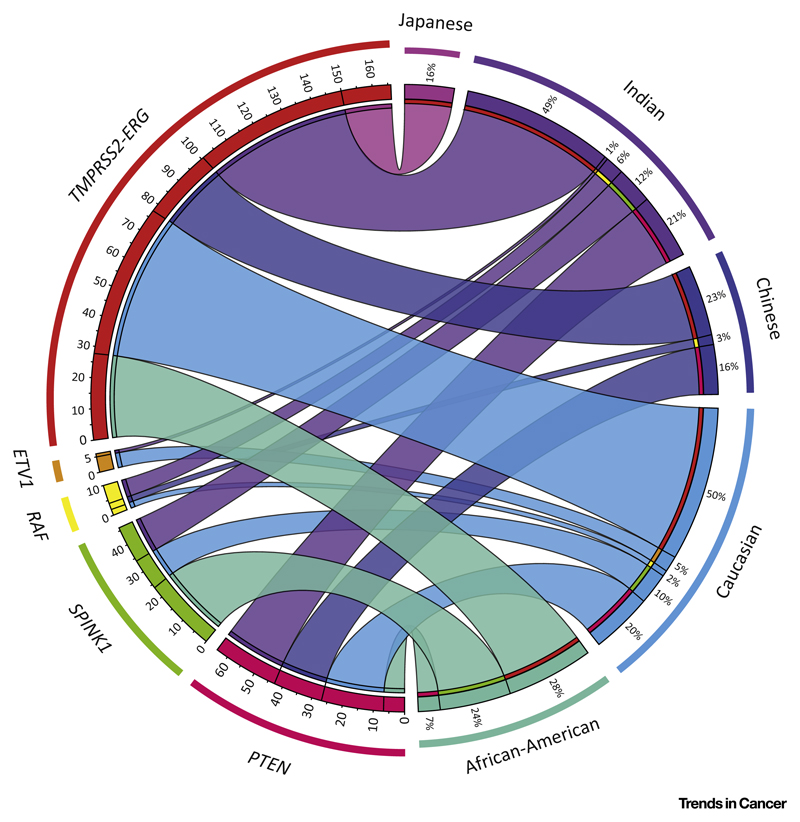
Integrated Circos plot shows the correlation between molecular subtypes of PCa and their prevalence in different ethnic groups. Individual ethnic groups (on the right) are represented in different colors and corresponding colored ribbons connect each ethnic group to various molecular aberrations (on the left). The width of the individual ribbon denotes the prevalence of a molecular subtype in a given ethnic group.
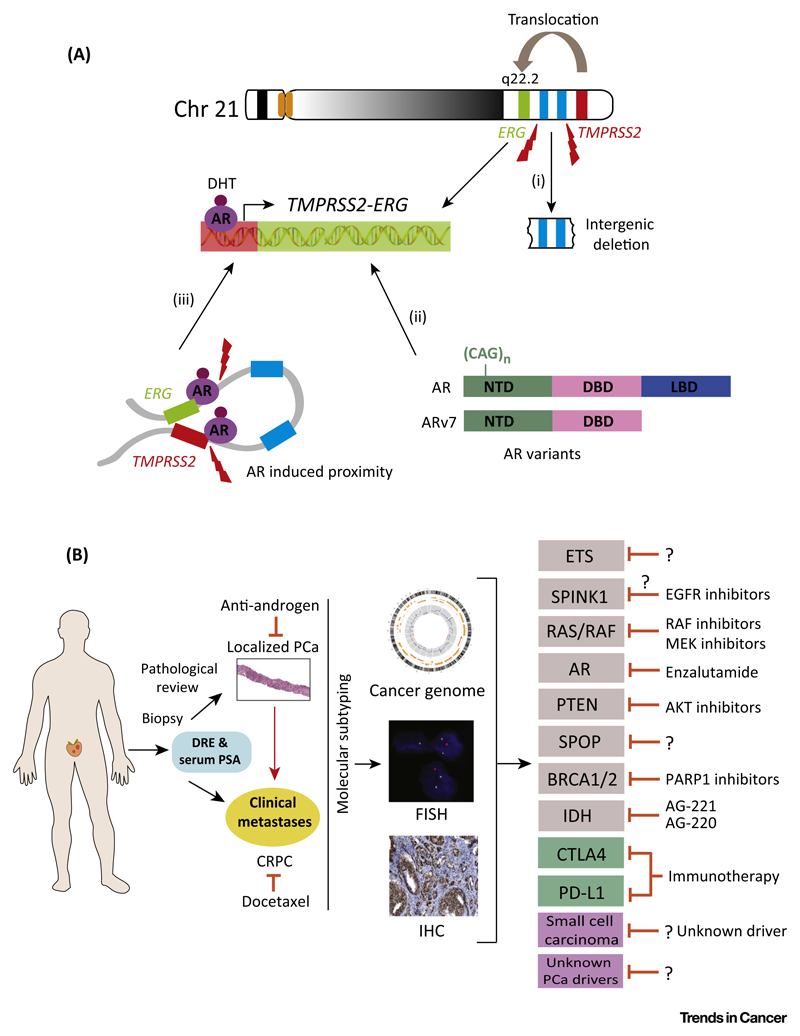
(A) Schematic representation of the genomic organization of TMPRSS2 and ERG on chromosome 21 and possible mechanisms supporting the genesis of TMPRSS2–ERG genetic rearrangement: (i) intergenic deletion or translocation between ERG and TMPRSS2; (ii) androgen-induced proximity between TMPRSS2 and ERG resulting in TMPRSS2–ERG fusion on gamma-irradiation-induced double-strand DNA breaks; (iii) CAG repeats in the N-terminal transactivation domain of the androgen receptor (AR) and a constitutively active AR isoform encoded by splice variant 7 (ARv7) lacking a ligand-binding domain (LBD). (B) Schematic representation of clinical strategies for the treatment and management of localized PCa and castration-resistant prostate cancer (CRPC). Sequential needle core biopsy prompted by an increase in serum prostate-specific antigen (PSA) and digital rectal examination (DRE) is routinely used for initial diagnosis. Molecular subtyping is done by fluorescence in situ hybridization (FISH), biomarker screening [immunohistochemistry (IHC)], and integrative genomic sequencing approaches. In localized PCa, treatment is largely determined by tumor stage and includes first-generation antiandrogens, castration, or watchful waiting. In advanced PCa, first-line treatment options such as antiandrogens or docetaxel may be combined with targeted therapies to improve patient outcome. Some of the evolving targeted therapies matched with respective genomic aberrations for PCa treatment are shown on the right.
References
MeSH terms
Substances
Grants and funding
LinkOut - more resources
Full Text Sources
Other Literature Sources
Medical
