Bacterial communities in the small intestine respond differently to those in the caecum and colon in mice fed low- and high-fat diets
- PMID: 28742010
- PMCID: PMC5775896
- DOI: 10.1099/mic.0.000496
Bacterial communities in the small intestine respond differently to those in the caecum and colon in mice fed low- and high-fat diets
Abstract
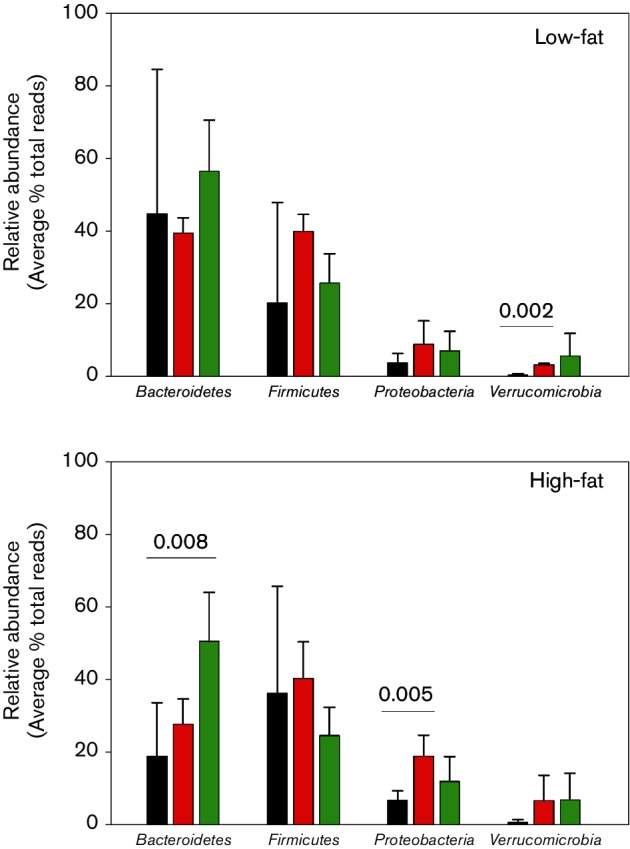
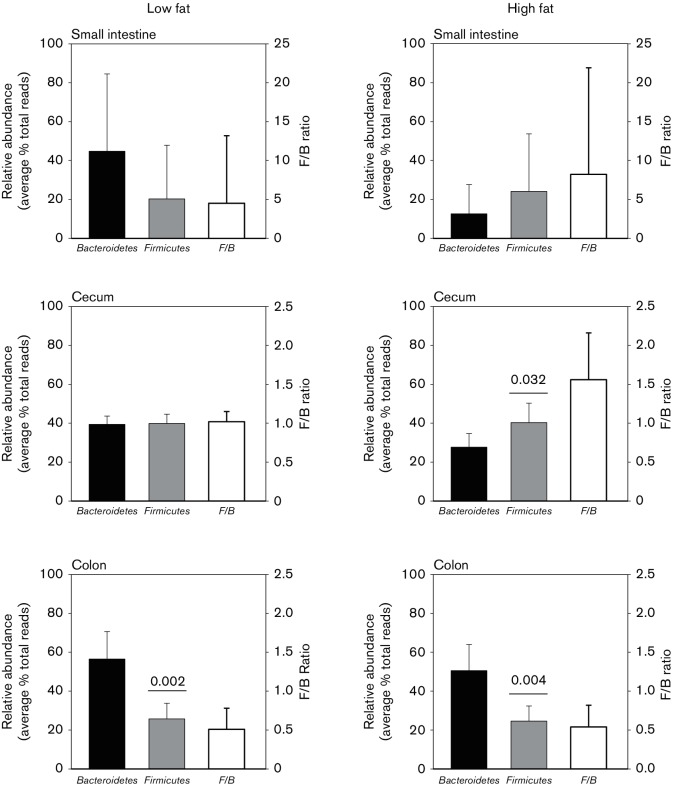
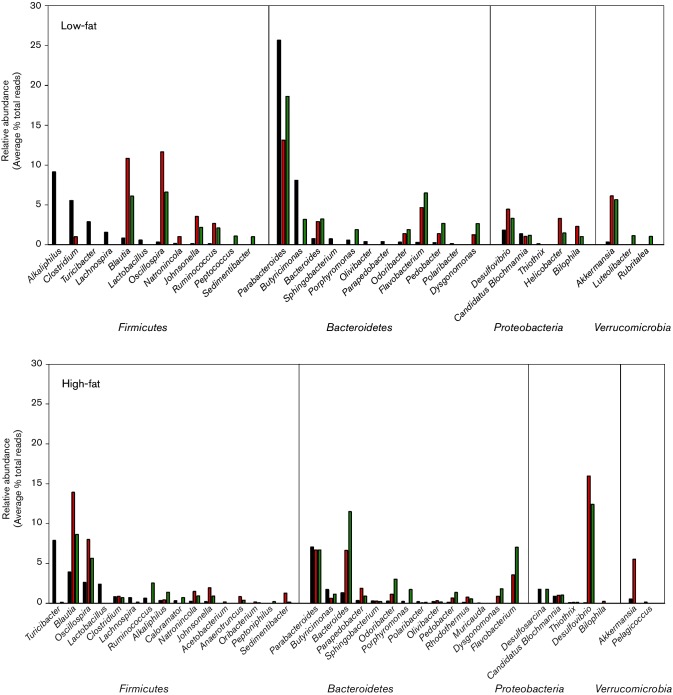
Bacterial communities in the mouse caecum and faeces are known to be altered by changes in dietary fat. The microbiota of the mouse small intestine, by contrast, has not been extensively profiled and it is unclear whether small intestinal bacterial communities shift with dietary fat levels. We compared the microbiota in the small intestine, caecum and colon in mice fed a low-fat (LF) or high-fat (HF) diet using 16S rRNA gene sequencing. The relative abundance of major phyla in the small intestine, Bacteriodetes, Firmicutes and Proteobacteria, was similar to that in the caecum and colon; the relative abundance of Verrucomicrobia was significantly reduced in the small intestine compared to the large intestine. Several genera were uniquely detected in the small intestine and included the aerotolerant anaerobe, Lactobacillus spp. The most abundant genera in the small intestine were accounted for by anaerobic bacteria and were identical to those identified in the large intestine. An HF diet was associated with significant weight gain and adiposity and with changes in the bacterial communities throughout the intestine, with changes in the small intestine differing from those in the caecum and colon. Prominent Gram-negative bacteria including genera of the phylum Bacteroidetes and a genus of Proteobacteria significantly changed in the large intestine. The mechanistic links between these changes and the development of obesity, perhaps involving metabolic endotoxemia, remain to be determined.
Conflict of interest statement
The authors declare that there are no conflicts of interest.
Figures
Similar articles
-
Characterisation of the bacterial community in the gastrointestinal tracts of elk (Cervus canadensis).Antonie Van Leeuwenhoek. 2019 Feb;112(2):225-235. doi: 10.1007/s10482-018-1150-5. Epub 2018 Aug 28. Antonie Van Leeuwenhoek. 2019. PMID: 30155662
-
Short Term High Fat Diet Induces Obesity-Enhancing Changes in Mouse Gut Microbiota That are Partially Reversed by Cessation of the High Fat Diet.Lipids. 2017 Jun;52(6):499-511. doi: 10.1007/s11745-017-4253-2. Epub 2017 Apr 20. Lipids. 2017. PMID: 28429150
-
Dietary fat intake and age modulate the composition of the gut microbiota and colonic inflammation in C57BL/6J mice.BMC Microbiol. 2019 Aug 20;19(1):193. doi: 10.1186/s12866-019-1557-9. BMC Microbiol. 2019. PMID: 31429703 Free PMC article.
-
The gut microbiota drives the impact of bile acids and fat source in diet on mouse metabolism.Microbiome. 2018 Aug 2;6(1):134. doi: 10.1186/s40168-018-0510-8. Microbiome. 2018. PMID: 30071904 Free PMC article.
-
Characterization and comparison of the bacterial microbiota in different gastrointestinal tract compartments of Mongolian horses.Microbiologyopen. 2020 Jun;9(6):1085-1101. doi: 10.1002/mbo3.1020. Epub 2020 Mar 9. Microbiologyopen. 2020. PMID: 32153142 Free PMC article.
Cited by
-
Can Dietary Fatty Acids Affect the COVID-19 Infection Outcome in Vulnerable Populations?mBio. 2020 Jul 23;11(4):e01723-20. doi: 10.1128/mBio.01723-20. mBio. 2020. PMID: 32703911 Free PMC article. Review.
-
Effects of Different Diets on Microbiota in The Small Intestine Mucus and Weight Regulation in Rats.Sci Rep. 2019 Jun 11;9(1):8500. doi: 10.1038/s41598-019-44994-7. Sci Rep. 2019. PMID: 31186491 Free PMC article.
-
Modulation of Gut Microbiome Community Mitigates Multiple Sclerosis in a Mouse Model: The Promising Role of Palmaria palmata Alga as a Prebiotic.Pharmaceuticals (Basel). 2023 Sep 25;16(10):1355. doi: 10.3390/ph16101355. Pharmaceuticals (Basel). 2023. PMID: 37895826 Free PMC article.
-
Old Fashioned vs. Ultra-Processed-Based Current Diets: Possible Implication in the Increased Susceptibility to Type 1 Diabetes and Celiac Disease in Childhood.Foods. 2017 Nov 15;6(11):100. doi: 10.3390/foods6110100. Foods. 2017. PMID: 29140275 Free PMC article. Review.
-
Impact of intestinal parasites on microbiota and cobalamin gene sequences: a pilot study.Parasit Vectors. 2020 Apr 19;13(1):200. doi: 10.1186/s13071-020-04073-7. Parasit Vectors. 2020. PMID: 32306993 Free PMC article.
References
Publication types
MeSH terms
Substances
Grants and funding
LinkOut - more resources
Full Text Sources
Other Literature Sources
Medical
Research Materials
Miscellaneous