


Risk factors associated with posttraumatic stress disorder in US veterans: A cohort study
- PMID: 28742837
- PMCID: PMC5526531
- DOI: 10.1371/journal.pone.0181647
Risk factors associated with posttraumatic stress disorder in US veterans: A cohort study
Abstract
Objective: To assess the association between clinical and exercise test factors and the development of posttraumatic stress disorder (PTSD) in US Veterans.
Patients and methods: Exercise capacity, demographics and clinical variables were assessed in 5826 veterans (mean age 59.4 ± 11.5 years) from the Veterans Affairs Healthcare System in Palo Alto, CA. The study participants underwent routine clinical exercise testing between the years 1987 and 2011. The study end point was the development of PTSD.
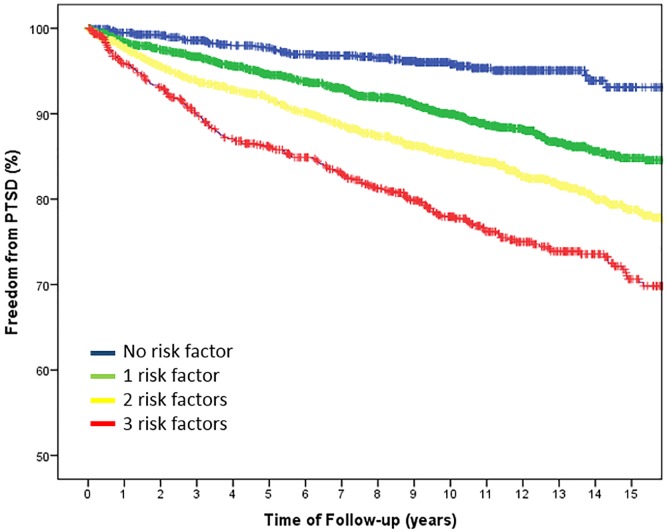
Results: A total of 723 (12.9%) veterans were diagnosed with PTSD after a mean follow-up of 9.6 ± 5.6 years. Drug abuse (HR: 1.98, CI: 1.33-2.92, p = .001), current smoking (HR: 1.57, CI: 1.35-2.24, p <.001), alcohol abuse (HR: 1.58, CI: 1.12-2.24, p = .009), history of chest pain (HR: 1.48, CI: 1.25-1.75, p <.001) and higher exercise capacity (HR: 1.03, CI: 1.01-1.05, p = .003) were strong independent risk factors for PTSD in a univariate model. Physical activity pattern was not associated with PTSD in either the univariate or multivariate models. In the final multivariate model, current smoking (HR: 1.30, CI: 1.10-1.53, p = .002) history of chest pain (HR: 1.37, CI: 1.15-1.63, p <.001) and younger age (HR: 0.97, CI: 0.97-0.98, p <.001) were significantly associated to PTSD.
Conclusions: Onset of PTSD is significantly associated with current smoking, history of chest pain and younger age. Screening veterans with multiple risk factors for symptoms of PTSD should therefore be taken into account.
Conflict of interest statement
Figures
References
-
- Vujanovic AA, Rathnayaka N, Amador CD, Schmitz JM. Distress Tolerance: Associations With Posttraumatic Stress Disorder Symptoms Among Trauma-Exposed, Cocaine-Dependent Adults. Behavior modification. 2016;40(1–2):120–43. doi: 10.1177/0145445515621490 . - DOI - PubMed
-
- Kessler RC, Chiu WT, Demler O, Merikangas KR, Walters EE. Prevalence, severity, and comorbidity of 12-month DSM-IV disorders in the National Comorbidity Survey Replication. Archives of general psychiatry. 2005;62(6):617–27. doi: 10.1001/archpsyc.62.6.617 ; - DOI - PMC - PubMed
-
- de Assis MA, de Mello MF, Scorza FA, Cadrobbi MP, Schooedl AF, Gomes da Silva S, et al. Evaluation of physical activity habits in patients with posttraumatic stress disorder. Clinics (Sao Paulo). 2008;63(4):473–8. doi: 10.1590/S1807-59322008000400010 ; - DOI - PMC - PubMed
-
- Kessler RC, Sonnega A, Bromet E, Hughes M, Nelson CB. Posttraumatic stress disorder in the National Comorbidity Survey. Archives of general psychiatry. 1995;52(12):1048–60. . - PubMed
-
- Green BL, Grace MC, Lindy JD, Gleser GC, Leonard A. Risk factors for PTSD and other diagnoses in a general sample of Vietnam veterans. Am J Psychiatry. 1990;147(6):729–33. doi: 10.1176/ajp.147.6.729 . - DOI - PubMed
MeSH terms
Grants and funding
LinkOut - more resources
Full Text Sources
Other Literature Sources
Medical
Molecular Biology Databases
