


Exploring the Association Between Self-Reported Asthma Impact and Fitbit-Derived Sleep Quality and Physical Activity Measures in Adolescents
- PMID: 28743679
- PMCID: PMC5548986
- DOI: 10.2196/mhealth.7346
Exploring the Association Between Self-Reported Asthma Impact and Fitbit-Derived Sleep Quality and Physical Activity Measures in Adolescents
Abstract
Background: Smart wearables such as the Fitbit wristband provide the opportunity to monitor patients more comprehensively, to track patients in a fashion that more closely follows the contours of their lives, and to derive a more complete dataset that enables precision medicine. However, the utility and efficacy of using wearable devices to monitor adolescent patients' asthma outcomes have not been established.
Objective: The objective of this study was to explore the association between self‑reported sleep data, Fitbit sleep and physical activity data, and pediatric asthma impact (PAI).
Methods: We conducted an 8‑week pilot study with 22 adolescent asthma patients to collect: (1) weekly or biweekly patient‑reported data using the Patient-Reported Outcomes Measurement Information System (PROMIS) measures of PAI, sleep disturbance (SD), and sleep‑related impairment (SRI) and (2) real-time Fitbit (ie, Fitbit Charge HR) data on physical activity (F-AM) and sleep quality (F‑SQ). To explore the relationship among the self-reported and Fitbit measures, we computed weekly Pearson correlations among these variables of interest.
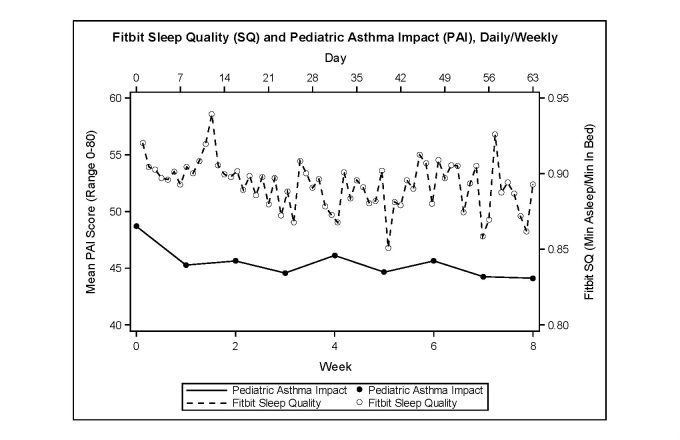
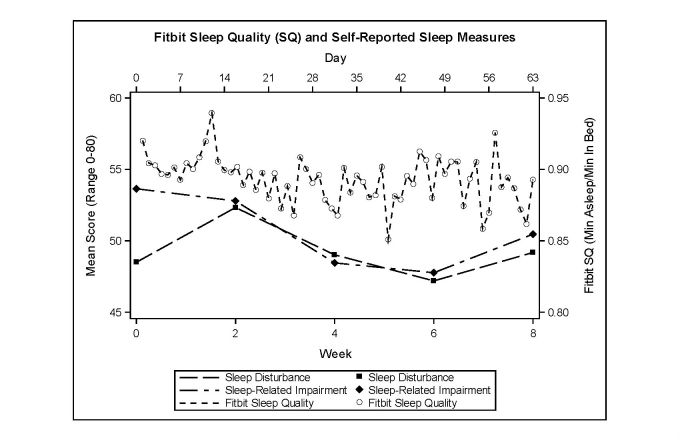
Results: We have shown that the Fitbit-derived sleep quality F-SQ measure has a moderate correlation with the PROMIS SD score (average r=-.31, P=.01) and a weak but significant correlation with the PROMIS PAI score (average r=-.18, P=.02). The Fitbit physical activity measure has a negligible correlation with PAI (average r=.04, P=.62).
Conclusions: Our findings support the potential of using wrist-worn devices to continuously monitor two important factors-physical activity and sleep-associated with patients' asthma outcomes and to develop a personalized asthma management platform.
Keywords: Fitbit; asthma; mHealth; mobile health; physical activity; sleep; sleep quality.
©Jiang Bian, Yi Guo, Mengjun Xie, Alice E Parish, Isaac Wardlaw, Rita Brown, François Modave, Dong Zheng, Tamara T Perry. Originally published in JMIR Mhealth and Uhealth (http://mhealth.jmir.org), 25.07.2017.
Conflict of interest statement
Conflicts of Interest: None declared.
Figures
References
-
- Moorman JE, Rudd RA, Johnson CA, King M, Minor P, Bailey C, Scalia MR, Akinbami LJ, Centers for Disease Control and Prevention (CDC) National surveillance for asthma--United States, 1980-2004. MMWR Surveill Summ. 2007 Oct 19;56(8):1–54. https://www.cdc.gov/mmwr/preview/mmwrhtml/ss5608a1.htm - PubMed
-
- Calmes D, Leake BD, Carlisle DM. Adverse asthma outcomes among children hospitalized with asthma in California. Pediatrics. 1998 May;101(5):845–50. - PubMed
-
- Walker TJ, Reznik M. In-school asthma management and physical activity: children's perspectives. J Asthma. 2014 Oct;51(8):808–13. doi: 10.3109/02770903.2014.920875. http://europepmc.org/abstract/MED/24796650 - DOI - PMC - PubMed
Grants and funding
LinkOut - more resources
Full Text Sources
Other Literature Sources
