. 2017 Sep 1;144(17):3054-3065.
doi: 10.1242/dev.150342. Epub 2017 Jul 25.

Sonic hedgehog from both nerves and epithelium is a key trophic factor for taste bud maintenance

Affiliations

Sonic hedgehog from both nerves and epithelium is a key trophic factor for taste bud maintenance

David Castillo-Azofeifa et al. Development. .

Abstract

The integrity of taste buds is intimately dependent on an intact gustatory innervation, yet the molecular nature of this dependency is unknown. Here, we show that differentiation of new taste bud cells, but not progenitor proliferation, is interrupted in mice treated with a hedgehog (Hh) pathway inhibitor (HPI), and that gustatory nerves are a source of sonic hedgehog (Shh) for taste bud renewal. Additionally, epithelial taste precursor cells express Shh transiently, and provide a local supply of Hh ligand that supports taste cell renewal. Taste buds are minimally affected when Shh is lost from either tissue source. However, when both the epithelial and neural supply of Shh are removed, taste buds largely disappear. We conclude Shh supplied by taste nerves and local taste epithelium act in concert to support continued taste bud differentiation. However, although neurally derived Shh is in part responsible for the dependence of taste cell renewal on gustatory innervation, neurotrophic support of taste buds likely involves a complex set of factors.

Keywords: Cell renewal; Innervation; Lingual epithelium; Shh; Taste receptor cells.


Conflict of interest statement

Competing interestsThe authors declare no competing or financial interests.

Figures
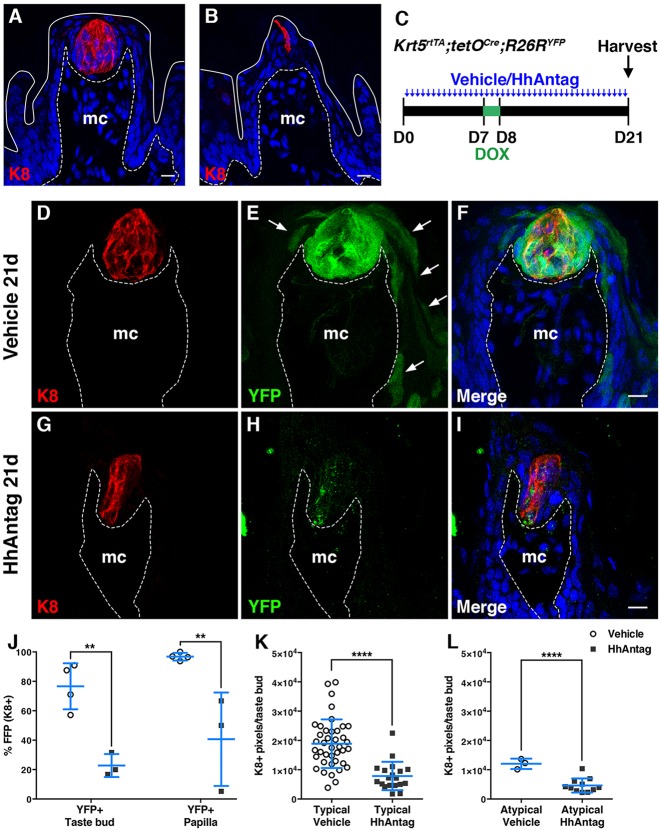
Fig. 1.
Fig. 1.
Mice treated with HhAntag for 21 days have reduced renewal of taste bud and FF papilla epithelium. (C) Krt5rtTA;tetOCre;R26RYFP mice were treated with vehicle or HhAntag twice daily (blue arrows) for 21 days, and fed dox chow overnight on day 7. Typical (A) and atypical (B) FFP with K8+ taste buds (red) are present in controls and mutants. (D-F) Control FFP taste buds have robust levels of K8+ cells (red), and K5-YFP+ progeny are evident (green) in taste buds and FFP epithelium (arrows). (G-I) HhAntag-treated mice have fewer K8+ taste cells (red) and K5-YFP+ lineage-traced cells (green), and distorted morphology. (J) HhAntag treatment results in significantly fewer taste buds and FFP with K5-YFP lineage-traced cells. (K,L) Taste bud size, i.e. the number of K8+ pixels, is reduced in typical (K) and atypical (L) FFP in HhAntag-treated mice. Nuclei are counterstained with Draq5 (blue); white dashed lines indicate basement membrane; solid line indicates tongue surface; mc, mesenchymal core. Images are compressed confocal z-stacks. Scale bars: 10 μm. n=3 or 4 mice per condition. Data are represented as mean±s.d. analyzed using two-way ANOVA (J) or Student's t-test (K,L). **P<0.01, ****P<0.0001.
Fig. 2.
Fig. 2.
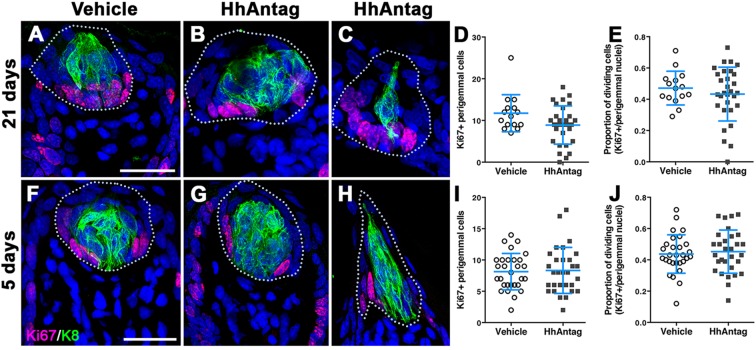
HhAntag does not alter proliferation of perigemmal taste progenitor cells in FFP. (A-C) Proliferating epithelial cells (Ki67+ red) are situated perigemmally around taste buds (K8+, green) in mice treated with vehicle (A) or HhAntag (B,C) for 21 days. (D,E) Although fewer taste buds are present in HhAntag mice at 21 days (see Fig. S1), the number (D) and proportion (E) of Ki67+ perigemmal cells in the remaining FFP with buds do not differ from controls. (F-H) Similarly, Ki67+ perigemmal cells are detected in vehicle (F) and HhAntag-treated mice (G,H) after 5 days. (I,J) Neither the number of Ki67+ perigemmal cells (I) nor proportion of Ki67+ perigemmal cells (J) differs with treatment. Images are compressed confocal z-stacks. Scale bars: 25 µm. n=3-6 mice per condition. Data are mean±s.d. analyzed using Student's t-test with Welch's correction.
Fig. 3.
Fig. 3.
Genetic deletion of Shh in K5+ progenitor cells does not alter taste bud renewal. (A) Krt5rtTA;tetOCre;Shhflox/flox (K5-ShhcKO) mice were fed dox for 14, 21 or 42 days. (B) Deleting Shh in K5 progenitors results in Shhneg taste precursors (marked with crosses). (C-E) Shh-expressing precursor cells are evident in most control taste bud profiles using Nomarksi optics (C) but absent in most mutant profiles (D,E). (F) Shh mRNA expression is reduced in K5-ShhcKO epithelium, although because of high variability in control values, this difference is not significant. Gli1 expression does not differ between mutants and controls. (G,H) The number of K8+ typical (G) and atypical (H) FFP does not differ between control and K5-ShhcKO mice after 14, 21 or 42 days. (I,J) K5-ShhcKO does not affect taste bud size (K8+ pixels) within typical (I) and atypical (J) FFP. Black dashed lines indicate basement membrane; black circles indicate taste buds; mc, mesenchymal core. Scale bars: 25 μm. n=3 or 4 mice per condition. Data are presented as mean±s.d. analyzed using Student's t-test (E) or two-way ANOVA (G-J). ***P<0.001.
Fig. 4.
Fig. 4.
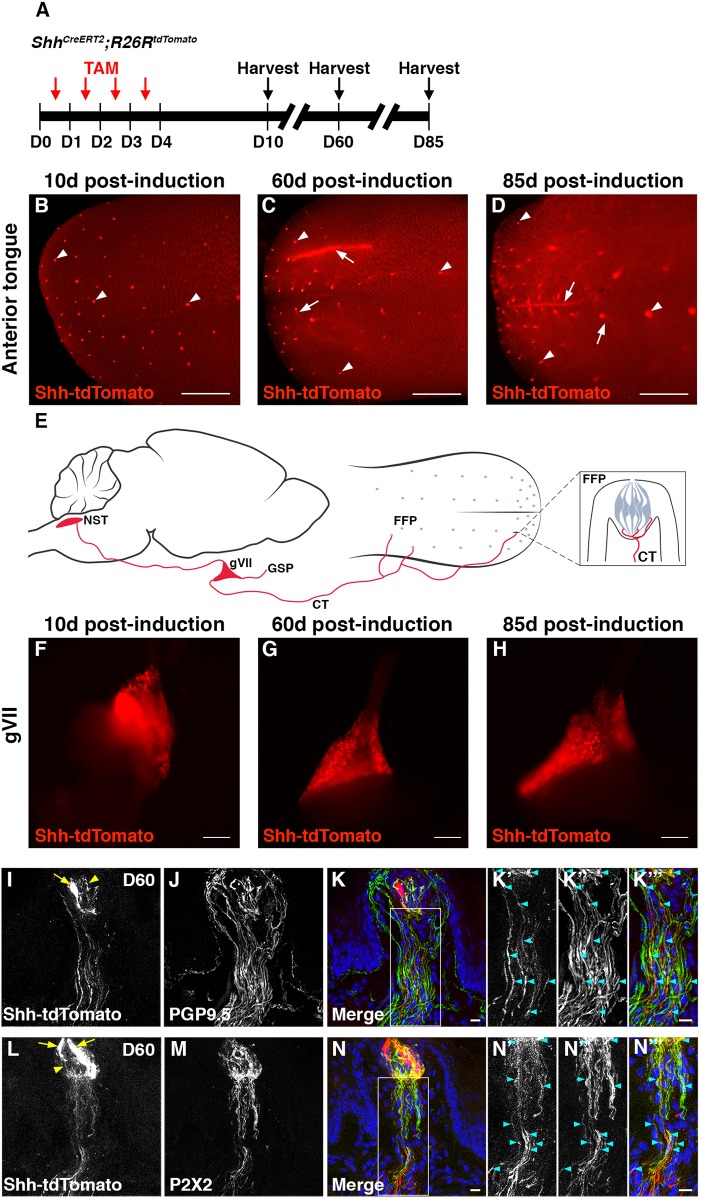
Gustatory ganglion cells that innervate taste buds express Shh-tdTomato. (A) ShhCreERT2;R26RtdTomato (Shh-tdTomato) mice were given tamoxifen daily for 4 days and harvested at 10, 60 or 85 days. (B-D) In Shh-tdTomato+ tongues, punctate signal (red) is evident in FFP at all times (arrowheads); at 60 and 85 days (C,D) gustatory innervation (arrows) associated with FFP (arrowheads) is also labeled. (E) Gustatory neurons in the geniculate ganglion (gVII) innervate FFP via the chorda tympani (CT) nerve, and project to the nucleus of the solitary tract (NST) in the brainstem. The greater superficial petrosal (GSP) nerve innervates soft palate taste buds (not shown). gVII neurons project centrally to the NST. (F-H) Cells in gVII express tdTomato at all time points. (I-K‴) At 60 days, PGP9.5+ nerve fibers (white in J,K″; green in K,K‴) innervate taste buds and adjacent FF epithelium, whereas Shh-tdTomato+ neurites (white in I,K′; red in K,K‴), which are also PGP9.5+, innervate taste buds exclusively (K′-K‴, cyan arrowheads). (L-N‴) P2X2+ taste fibers (white in M,N′; green in N,N‴) express Shh-tdTomato (white in L,N′; red in N,N‴; cyan arrowheads). Boxes in K and N are shown at higher magnification in K′-K‴ and N′-N‴, respectively. Sparse bright lineage-labeled taste cells are detected at later times (I,L, arrows), and are distinguishable from dimmer Shh-tdTomato+ neurites (I,L, arrowheads within taste buds). Nuclei are counterstained with Draq5 (blue). B-D and F-H are images of whole tongue and ganglia. I-N‴ are compressed confocal z-stacks. Scale bars: 1 mm in B-D; 150 μm in F-H; 10 μm in I-N‴.
Fig. 5.
Fig. 5.
Genetic deletion of Shh in Shh+ cells, including gustatory neurons, minimally affects taste buds. (A) ShhCreERT2/flox;R26RtdTomato (Shh-ShhcKO) and genetic control mice were given tamoxifen for 4 days and harvested at 35 days. (B) In tamoxifen-treated Shh-ShhcKO mice, Shh is deleted permanently from ganglion cells and nerves (indicated by the cross), but transiently from taste buds (see text). (C,D) tdTomato reports Shh deletion in tongue (C) and gVII (D) of mutant mice. (E) Quantitative PCR reveals that neither Shh nor Gli1 expression is significantly reduced in mutant tongue epithelium. (F) Expression of Shh, but not Gli1, is significantly reduced in mutant gVII. (G,H) Typical FFP number does not differ between mutants and controls (G), although atypical FFP increase in mutants (H). (I,J) The size of taste buds in typical (I) and atypical (J) FFP in mutants does not differ from controls. (K) Shh-tdTomato+ neurites (red) innervate a taste bud (K8+, green) in an atypical FFP in a Shh-ShhcKO mouse (Shh-descendent taste cell, arrow). (L) The proportion of FFP innervated by P2X2+ fibers is not affected by Shh-ShhcKO. (M,N) P2X2+ innervation density of taste buds in typical (M) and atypical (N) FFP does not differ between controls and Shh-ShhcKO mice. Nuclei counterstained with Draq5 (blue); white dashed lines delimit basement membrane; white solid lines delimit epithelial surface. C and D are images of whole tongue and gVII. K is a compressed confocal z-stack. Scale bars: 1 mm in C; 150 μm in D; 10 μm in K. n=3-5 mice per condition. Data are mean±s.d., except E and F, which are mean±s.e.m; I and N represent the median with interquartile range. Results were analyzed using Student's t-test (E-H,J,L,M) or Mann–Whitney U-test (I,N). ***P<0.001, **P=0.05.
Fig. 6.
Fig. 6.
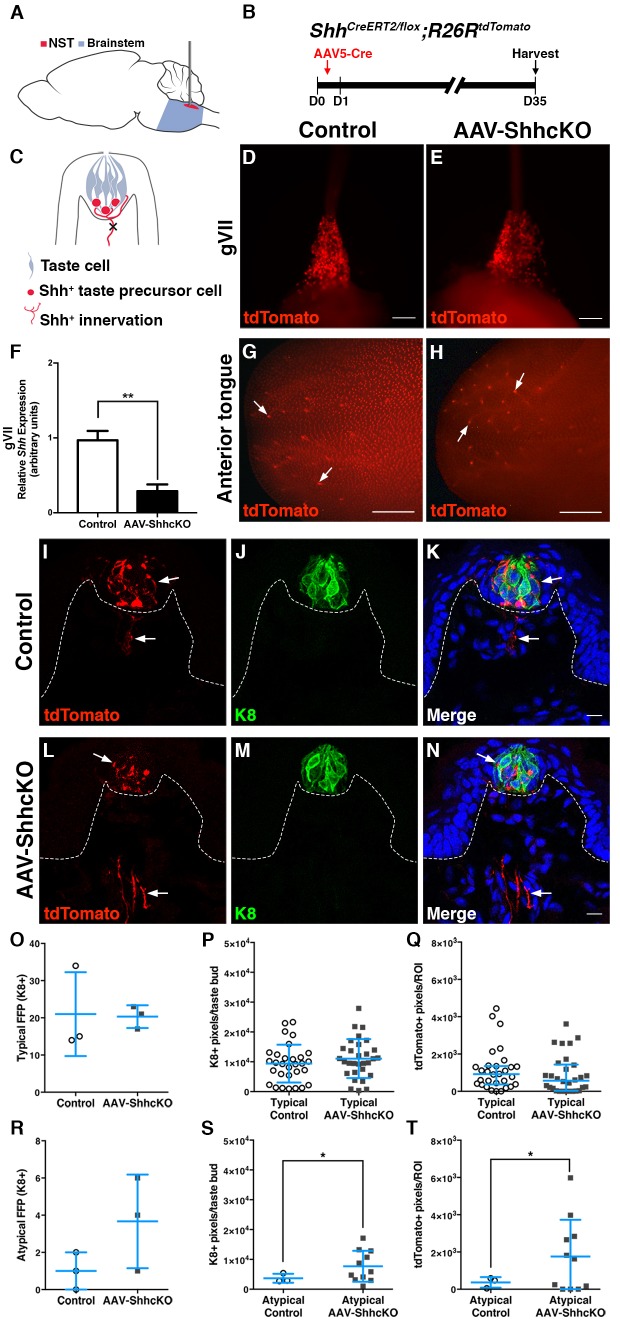
Viral deletion of Shh in gustatory neurons has little effect on taste bud number, size or innervation density. (A) Sagittal schematic of the brain depicting stereotaxic injection of the NST (red) in the brainstem (blue). (B) Experimental design for AAV5-Cre injection of ShhCreERT2/flox;R26RtdTomato (AAV-ShhcKO) mice. (C) AAV5-Cre deletes Shh in gustatory neurons that project to NST and innervate FFP (indicated by the cross). (D-H) AAV5-Cre injection into the NST activates tdTomato+ expression in gVII neurons of control (D) and mutant (E) mice, reduces Shh expression in gVII in mutants (F), and reveals tdTomato+ nerve fibers (arrows) innervating the anterior tongue of controls (G) and mutants (H). (I-N) FFP taste buds (K8+, green) in both control (I-K) and AAV-ShhcKO (L-N) mice are innervated by AAV5-tdTomato+ neurites (arrows). (O,R) Typical FFP number is not affected by AAV5-ShhcKO (O), whereas atypical FFP numbers increase but not significantly (R). (P-T) Taste bud size (P) and density of tdTomato+ neurites (Q) of typical FFP are similar in controls and AAV-ShhcKO mice, whereas taste buds of atypical FFP (S) are larger in mutants, with increased density of tdTomato+ neurites (T). Nuclei are counterstained with Draq5 (blue); white dashed lines delimit basement membrane. (D,E,G,H) Images of whole ganglia and tongues. Scale bars: 150 μm in D,E; 1 mm in G,H. n=3 mice per condition. Data are mean±s.d., except Q, which is the median with interquartile range. Results were analyzed using Student's t-test (F,O,P,R-T) or Mann–Whitney U-test (Q). *P≤0.05, **P<0.01.
Fig. 7.
Fig. 7.
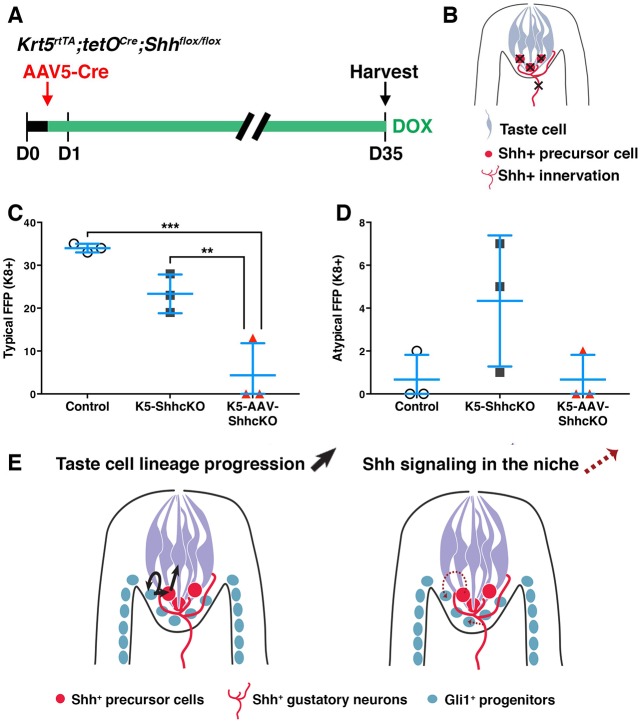
Simultaneous deletion of Shh from tongue epithelium and sensory neurons abolishes taste buds. (A) Experimental design for concurrent neural and epithelial deletion of Shh. The NST of Krt5rtTA;tetOCre;Shhflox/flox (K5-ShhcKO) mice is injected with AAV5-Cre on day 0, and mice are fed dox for 35 days. (B) In K5-AAV-ShhcKO mice, Shh is deleted in both lingual epithelium and gustatory neurons (marked by crosses). (C) Typical FFP number is significantly decreased in K5-AAV-ShhcKOs compared with control and K5-ShhcKO mice. (D) Atypical FFP number does not vary significantly across conditions, although more are evident in K5-ShhcKO mice. n=3 mice per condition. Data are mean±s.d. One-way ANOVA (C,D); **P<0.01, ***P<0.001. (E) Model for the role of Shh in taste cell renewal. Taste cell lineage progression (black arrows, left panel): New taste cells are generated from self-renewing Gli1+ progenitors (blue), which exit the cell cycle, enter buds as Shh+ precursor cells (red) and differentiate as taste cells (gray). Shh signaling in the taste progenitor niche (red dashed arrows, right panel). The niche for Gli1+ progenitors comprise both gustatory neurons and taste precursor cells expressing Shh (red). Shh ligand promotes taste cell differentiation from these Shh-responsive progenitors.

References

    1. Barlow L. A. and Klein O. D. (2015). Developing and regenerating a sense of taste. Curr. Top. Dev. Biol. 111, 401-419. 10.1016/bs.ctdb.2014.11.012 - DOI - PMC - PubMed
    1. Basset-Seguin N., Hauschild A., Grob J.-J., Kunstfeld R., Dréno B., Mortier L., Ascierto P. A., Licitra L., Dutriaux C., Thomas L. et al. (2015). Vismodegib in patients with advanced basal cell carcinoma (STEVIE): a pre-planned interim analysis of an international, open-label trial. Lancet Oncol. 16, 729-736. 10.1016/S1470-2045(15)70198-1 - DOI - PubMed
    1. Beidler L. M. and Smallman R. L. (1965). Renewal of cells within taste buds. J. Cell Biol. 27, 263-272. 10.1083/jcb.27.2.263 - DOI - PMC - PubMed
    1. Brake R. L., Simmons P. J. and Begley C. G. (2004). Cross-contamination with tamoxifen induces transgene expression in non-exposed inducible transgenic mice. Genet. Mol. Res. 3, 456-462. - PubMed
    1. Brownell I., Guevara E., Bai C. B., Loomis C. A. and Joyner A. L. (2011). Nerve-derived sonic hedgehog defines a niche for hair follicle stem cells capable of becoming epidermal stem cells. Stem Cell 8, 552-565. 10.1016/j.stem.2011.02.021 - DOI - PMC - PubMed

Publication types

LinkOut - more resources