. 2017 Jul 25;8(4):e00500-17.
doi: 10.1128/mBio.00500-17.

Metabolic Compensation of Fitness Costs Is a General Outcome for Antibiotic-Resistant Pseudomonas aeruginosa Mutants Overexpressing Efflux Pumps

Affiliations

Metabolic Compensation of Fitness Costs Is a General Outcome for Antibiotic-Resistant Pseudomonas aeruginosa Mutants Overexpressing Efflux Pumps

Jorge Olivares Pacheco et al. mBio. .

Abstract

It is generally assumed that the acquisition of antibiotic resistance is associated with a fitness cost. We have shown that overexpression of the MexEF-OprN efflux pump does not decrease the fitness of a resistant Pseudomonas aeruginosa strain compared to its wild-type counterpart. This lack of fitness cost was associated with a metabolic rewiring that includes increased expression of the anaerobic nitrate respiratory chain when cells are growing under fully aerobic conditions. It was not clear whether this metabolic compensation was exclusive to strains overexpressing MexEF-OprN or if it extended to other resistant strains that overexpress similar systems. To answer this question, we studied a set of P. aeruginosa mutants that independently overexpress the MexAB-OprM, MexCD-OprJ, or MexXY efflux pumps. We observed increased expression of the anaerobic nitrate respiratory chain in all cases, with a concomitant increase in NO3 consumption and NO production. These efflux pumps are proton/substrate antiporters, and their overexpression may lead to intracellular H+ accumulation, which may in turn offset the pH homeostasis. Indeed, all studied mutants showed a decrease in intracellular pH under anaerobic conditions. The fastest way to eliminate the excess of protons is by increasing oxygen consumption, a feature also displayed by all analyzed mutants. Taken together, our results support metabolic rewiring as a general mechanism to avoid the fitness costs derived from overexpression of P. aeruginosa multidrug efflux pumps. The development of drugs that block this metabolic "reaccommodation" might help in reducing the persistence and spread of antibiotic resistance elements among bacterial populations.IMPORTANCE It is widely accepted that the acquisition of resistance confers a fitness cost in such a way that in the absence of antibiotics, resistant populations will be outcompeted by susceptible ones. Based on this assumption, antibiotic cycling regimes have been proposed in the belief that they will reduce the persistence and spread of resistance among bacterial pathogens. Unfortunately, trials testing this possibility have frequently failed, indicating that resistant microorganisms are not always outcompeted by susceptible ones. Indeed, some mutations do not result in a fitness cost, and in case they do, the cost may be compensated for by a secondary mutation. Here we describe an alternative nonmutational mechanism for compensating for fitness costs, which consists of the metabolic rewiring of resistant mutants. Deciphering the mechanisms involved in the compensation of fitness costs of antibiotic-resistant mutants may help in the development of drugs that will reduce the persistence of resistance by increasing said costs.

Keywords: Pseudomonas aeruginosa; antibiotic resistance; efflux pumps; fitness costs.


Figures

FIG 1
FIG 1
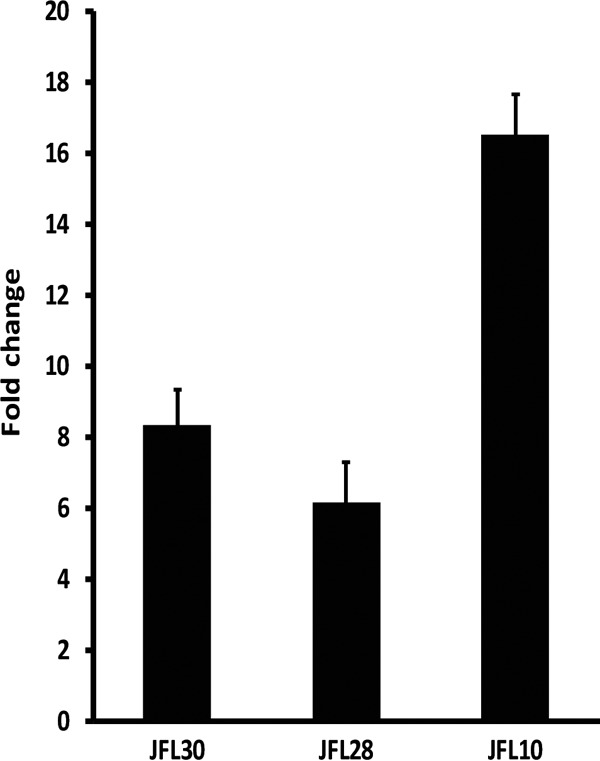
Relative expression levels of mutants overexpressing efflux pumps. The relative expression level of the studied efflux pumps in the overexpressing mutants in comparison with the wild-type strain was measured by real-time RT-PCR. JFL30 indicates relative expression of MexAB-OprM, JFL28 indicates relative expression of MexCD-OprJ, and JFL10 indicates relative expression of MexXY. The figure shows the means and standard deviations from three different experiments. In all cases, the differences between the wild type and the overexpressing strains were statistically significant (P < 0.05).
FIG 2
FIG 2
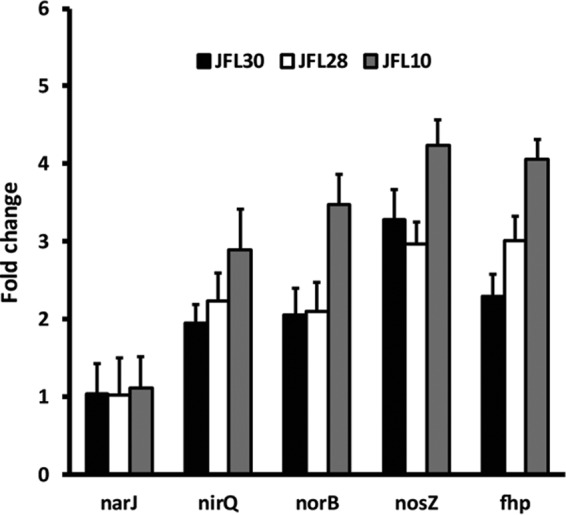
Expression of the nitrate respiratory chain in different P. aeruginosa mutants overexpressing RND pumps. The expression levels were obtained by real-time RT-PCR. As shown, the levels of expression are highest in the mutant JFL10 (gray bars), followed by JFL28 (white bars), and JFL30 (black bars). These results show that all mutants that overexpress RND pumps show increased expression of the nitrate respiratory chain under aerobic conditions. The figure shows the means and standard deviations from three different experiments. In all cases except for narJ, the differences between the wild type and the overexpressing strains were statistically significant (P < 0.05).
FIG 3
FIG 3
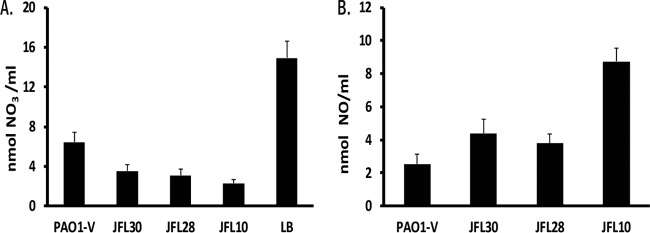
NO3 consumption and NO production in mutants that overexpress RND pumps. The NO3 (A) and NO (B) concentrations were measured using a nitric oxide colorimetric assay kit (Abcam, Inc., Cambridge, United Kingdom). After 24 h of culture, all strains had consumed the nitrate present in the LB medium (A). JFL10 consumes the largest amount of nitrate. These results correlate with the levels of nitric oxide production (B) as JFL10 also produces the largest amount of nitric oxide. These results indicate that the nitrate respiratory chain is active in all the mutants analyzed in this study. The figure shows the means and standard deviations from three different experiments. In all cases, the differences between the wild type and the overexpressing strains were statistically significant (P < 0.05).
FIG 4
FIG 4
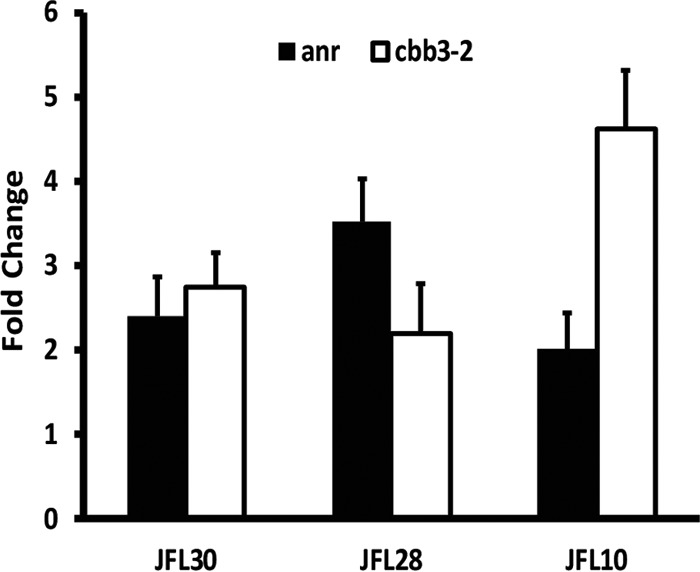
Effect of overexpression of RND efflux pumps on the expression of genes involved in microaerobic growth. The relative expression of anr (black bars) and cbb3-2 (white bars) was analyzed under nonaerated conditions in a fermenter. The figure shows the ratio of expression between nonaerated and fully aerated conditions. For all mutants, increased expression of both genes can be seen under nonaerated conditions in the exponential phase. This phenomenon may be the result of a decrease in internal oxygen concentration in the bacterium due to overexpression of RND pumps. The figure shows the means and standard deviations from three different experiments. In all cases, the differences between the wild type and the overexpressing strains were statistically significant (P < 0.05).
FIG 5
FIG 5
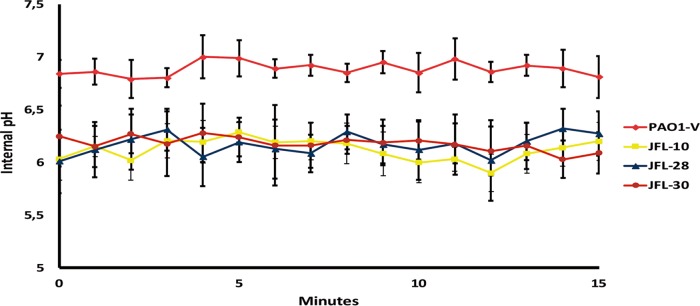
Overexpression of RND efflux pumps decreases P. aeruginosa intracellular pH under anaerobic conditions. Variations in internal pH under anaerobic conditions were measured for the wild-type strain PAO1-V and for the RND efflux pump-overexpressing mutants JFL30, JFL28, and JFL10 as described in Materials and Methods. For all mutants, a decrease in pH can be seen under anaerobic conditions compared to the wild-type strain. This result further supports the importance of oxygen availability for the elimination of the excess of protons generated by overexpression of RND pumps. The figure shows the means and standard deviations from three different experiments.
FIG 6
FIG 6
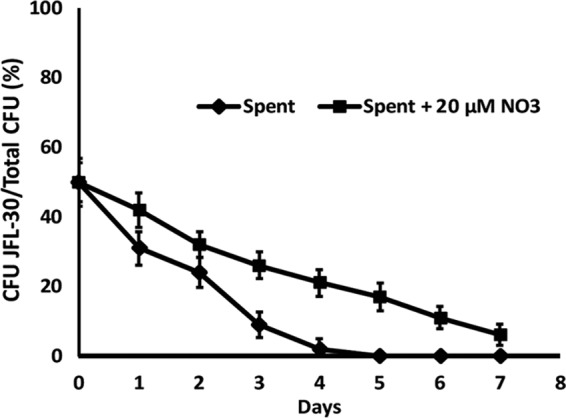
Growth competition between the wild-type strain and a mutant overexpressing MexAB-OprM in nitrate-free medium. The relative fitness between JFL30 and the wild-type strain was estimated by coculturing both strains and is represented as the percentage of mutant cells present at each time point (days). The absence of nitrate in the spent medium (solid line) produces a fitness cost in JFL30. However, the addition of nitrate to the medium partly reverts this cost. This result confirms the need for nitrate availability to avoid the fitness cost caused by overexpression of RND pumps. The figure shows the means and standard deviations from three different experiments.
FIG 7
FIG 7
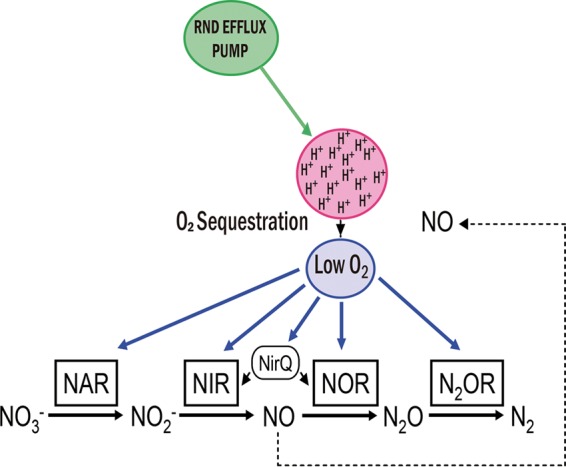
Model of the metabolic compensation associated with overexpression of RND efflux pumps. RND efflux pumps are proton antiporters. Overexpression of these elements could result in the accumulation of protons in the cytoplasm with a concomitant deleterious intracellular acidification. To cope with this problem, P. aeruginosa could make use of the intracellular oxygen to get rid of excess protons. Nevertheless, this oxygen sequestration might decrease intracellular oxygen tension in such way that bacteria sense the situation as a switch to oxygen-limited conditions. As a consequence, the expression of typical pathways of the anaerobic metabolism, such as the nitrate respiratory chain, is triggered. (This figure was inspired by reference .)

Comment in

References

    1. Andersson DI, Levin BR. 1999. The biological cost of antibiotic resistance. Curr Opin Microbiol 2:489–493. doi: 10.1016/S1369-5274(99)00005-3. - DOI - PubMed
    1. Andersson DI. 2006. The biological cost of mutational antibiotic resistance: any practical conclusions? Curr Opin Microbiol 9:461–465. doi: 10.1016/j.mib.2006.07.002. - DOI - PubMed
    1. Sundqvist M, Geli P, Andersson DI, Sjölund-Karlsson M, Runehagen A, Cars H, Abelson-Storby K, Cars O, Kahlmeter G. 2010. Little evidence for reversibility of trimethoprim resistance after a drastic reduction in trimethoprim use. J Antimicrob Chemother 65:350–360. doi: 10.1093/jac/dkp387. - DOI - PubMed
    1. Kollef MH. 2006. Is antibiotic cycling the answer to preventing the emergence of bacterial resistance in the intensive care unit? Clin Infect Dis 43(Suppl 2):S82–S88. doi: 10.1086/504484. - DOI - PubMed
    1. Kollef MH. 2001. Is there a role for antibiotic cycling in the intensive care unit? Crit Care Med 29:N135–N142. doi: 10.1097/00003246-200104001-00014. - DOI - PubMed

MeSH terms

Substances

LinkOut - more resources