


Mechanisms regulating immune surveillance of cellular stress in cancer
- PMID: 28744671
- PMCID: PMC11105730
- DOI: 10.1007/s00018-017-2597-7
Mechanisms regulating immune surveillance of cellular stress in cancer
Abstract
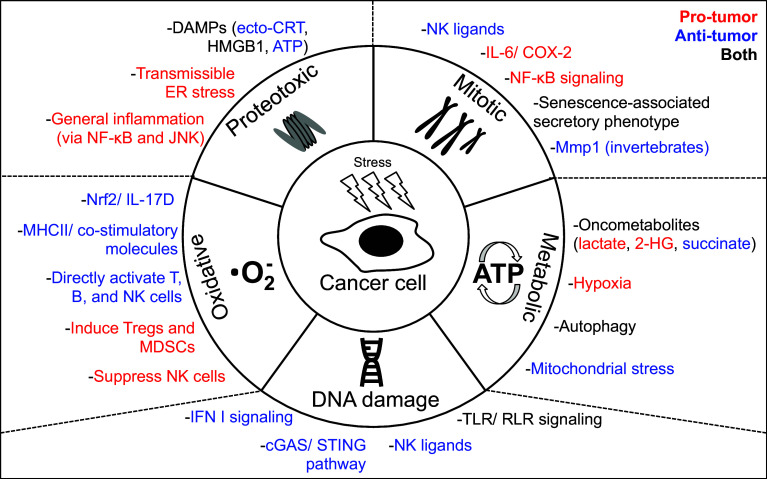
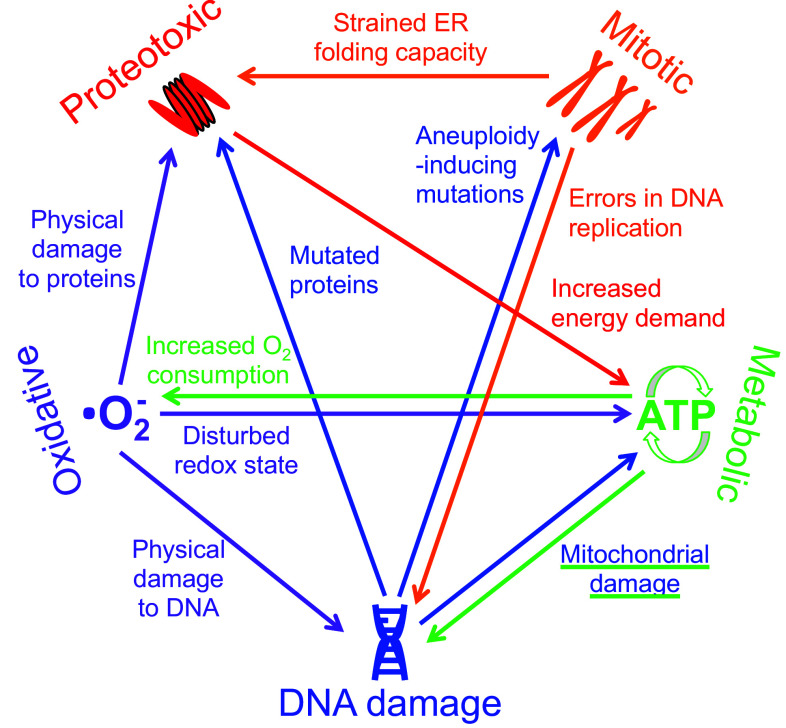
The purpose of this review is to explore immune-mediated mechanisms of stress surveillance in cancer, with particular emphasis on the idea that all cancers have classical hallmarks (Hanahan and Weinberg in Cell 100:57-70, 67; Cell 144:646-674, 68) that could be interrelated. We postulate that hallmarks of cancer associated with cellular stress pathways (Luo et al. in Cell 136:823-837, 101) including oxidative stress, proteotoxic stress, mitotic stress, DNA damage, and metabolic stress could define and modulate the inflammatory component of cancer. As such, the overarching goal of this review is to define the types of cellular stress that cancer cells undergo, and then to explore mechanisms by which immune cells recognize, respond to, and are affected by each stress response.
Keywords: Cancer immune surveillance; Cancer immunity; Cancer inflammation; Cancer-associated stress; Chromosome instability (CIN); DNA damage response (DDR); Danger-associated molecular patterns (DAMPs); ER stress; Hyperploidy; Immunogenic cell death; Mitochondrial stress; Oncometabolites; Senescence-associated secretory phenotype (SASP); Tumor microenvironment; Unfolded protein response.
Figures
References
-
- Acebes-Huerta A, Lorenzo-Herrero S, Folgueras AR, Huergo-Zapico L, Lopez-Larrea C, Lopez-Soto A, Gonzalez S. Drug-induced hyperploidy stimulates an antitumor NK cell response mediated by NKG2D and DNAM-1 receptors. Oncoimmunology. 2016;5:e1074378. doi: 10.1080/2162402X.2015.1074378. - DOI - PMC - PubMed
-
- Akazawa T, Ebihara T, Okuno M, Okuda Y, Shingai M, Tsujimura K, Takahashi T, Ikawa M, Okabe M, Inoue N, et al. Antitumor NK activation induced by the Toll-like receptor 3-TICAM-1 (TRIF) pathway in myeloid dendritic cells. Proc Natl Acad Sci USA. 2007;104:252–257. doi: 10.1073/pnas.0605978104. - DOI - PMC - PubMed
-
- Angelini G, Gardella S, Ardy M, Ciriolo MR, Filomeni G, Di Trapani G, Clarke F, Sitia R, Rubartelli A. Antigen-presenting dendritic cells provide the reducing extracellular microenvironment required for T lymphocyte activation. Proc Natl Acad Sci USA. 2002;99:1491–1496. doi: 10.1073/pnas.022630299. - DOI - PMC - PubMed
Publication types
MeSH terms
LinkOut - more resources
Full Text Sources
Other Literature Sources
Research Materials
