. 2017 Aug;85(1-2):14-25.
doi: 10.1007/s00239-017-9801-0. Epub 2017 Jul 25.

The Distribution of Miniature Impala Elements and SIX Genes in the Fusarium Genus is Suggestive of Horizontal Gene Transfer

Affiliations

The Distribution of Miniature Impala Elements and SIX Genes in the Fusarium Genus is Suggestive of Horizontal Gene Transfer

Peter van Dam et al. J Mol Evol. 2017 Aug.

Abstract

The mimp family of miniature inverted-repeat transposable elements was previously found only in genomes of Fusarium oxysporum and is contextually associated with virulence genes in this species. Through extensive comparative analysis of 83 F. oxysporum and 52 other Fusarium genomes, we uncovered the distribution of different mimp families throughout the genus. We show that (i) mimps are not exclusive to F. oxysporum; (ii) pathogenic isolates generally possess more mimps than non-pathogenic strains and (iii) two isolates of F. hostae and one F. proliferatum isolate display evidence for horizontal transfer of genetic material to or from F. oxysporum. Multiple instances of mimp elements identical to F. oxysporum mimps were encountered in the genomes of these isolates. Moreover, homologs of effector genes (SIX1, 2, 6, 7, 11 and FomAVR2) were discovered here, several with very high (97-100%) pairwise nucleotide sequence identity scores. These three strains were isolated from infected flower bulbs (Hyacinthus and Lilium spp.). Their ancestors may thus have lived in close proximity to pathogenic strains of F. oxysporum f. sp. hyacinthi and f. sp. lilii. The Fo f. sp. lycopersici SIX2 effector gene was found to be widely distributed (15/18 isolates) throughout the F. fujikuroi species complex, exhibiting a predominantly vertical inheritance pattern. These findings shed light on the potential evolutionary mechanism underlying plant-pathogenicity in Fusarium and show that interspecies horizontal gene transfer may have occurred.

Keywords: Comparative genomics; Horizontal gene transfer; Inverted repeat; MITE; Transposable elements; mimp.


Conflict of interest statement

The authors declare that they have no conflict of interest.

Figures

Fig. 1
Fig. 1
60% (Fo f. sp. melonis 001) and 65% (Fo f. sp. radicis-cucumerinum 016) more intact mimps were found in PacBio assemblies compared to Illumina assemblies
Fig. 2
Fig. 2
Most Fusarium species outside the FOSC lack mimps in their genome, but a relatively high number of mimps was found in bulb-infecting isolates of F. hostae and the FFSC. At least one representative genome was selected per Fusarium species. Phylogeny was inferred from a concatenated sequence alignment of three conserved genes: EF1α, RPB1, and RPB2 (partial), using 100 bootstrap replicates. TBLASTN (e value < 1e−100) was performed to identify intact impala open reading frames in the assemblies. Intact mimps were divided into categories and these were plotted next to the phylogenetic tree. In total, the analysis covered six Fusarium species complexes (FOSC, F. oxysporum species complex; FFSC, F. fujikuroi species complex; F. h., F. hostae; FGSC, F. graminearum species complex; FTSC, F. tricinctum species complex; FSSC, F. solani species complex)
Fig. 3
Fig. 3
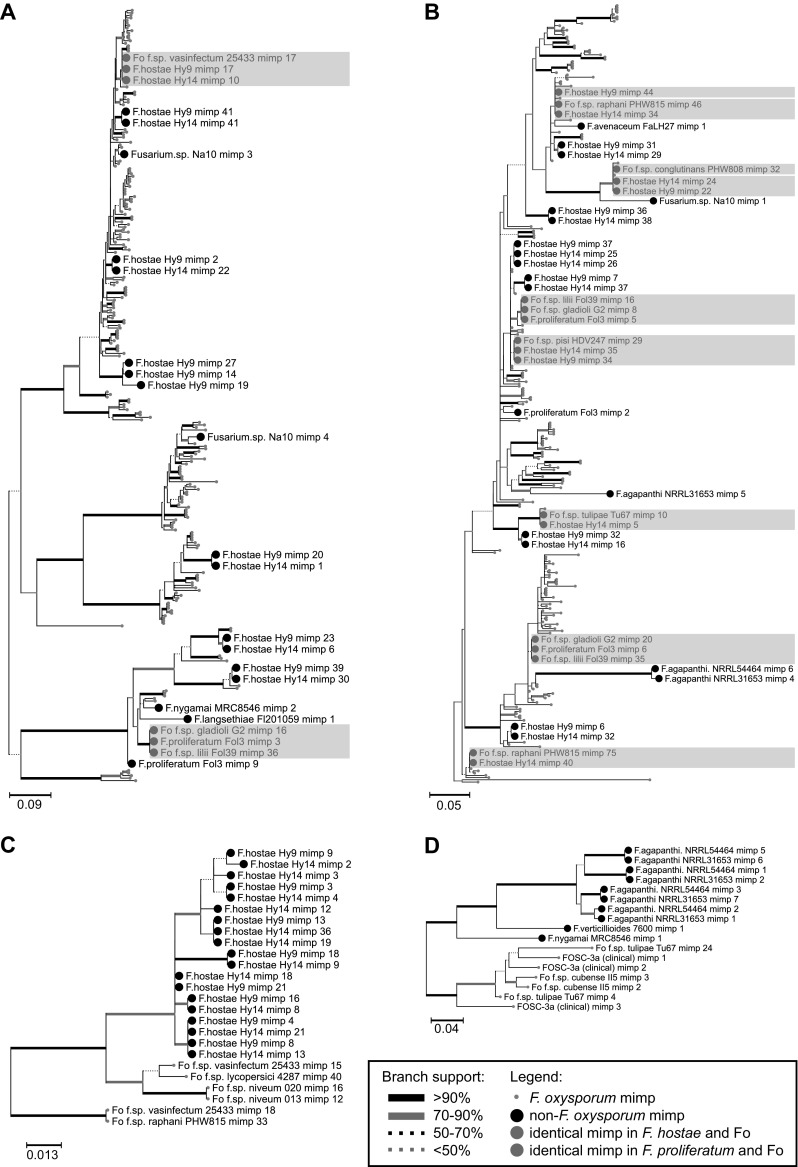
Phylogenies of mimps belonging to four different families show the presence of mimps in F. hostae and F. proliferatum Fol3 that are identical to elements found in pathogenic F. oxysporum isolates. Sequence alignment was performed on mimp sequences extracted from 49 Fusarium genomes belonging to a mimp family 2/3, b family 4, c family 5, and d category ‘09’ with MAFFT and phylogeny was inferred using PhyML with 100 bootstraps. Mimps extracted from F. hostae and F. proliferatum genomes having a 100% identity match in a F. oxysporum genome are highlighted in red and blue, respectively. Node annotations of other F. oxysporum mimps have been omitted for clarity
Fig. 4
Fig. 4
a F. proliferatum Fol3 has a (pseudogenized) SIX1 homolog that is identical to Fo f. sp. nicotianae SIX1 and b F.hostae SIX6 clusters within the F. oxysporum clade, close the SIX6 gene of Fo f. sp. niveum 015 and 019. Clustering of the non-oxysporum SIX genes among copies of F. oxysporum SIX genes supports the hypothesis of horizontal transfer. Nucleotide sequences were aligned with ClustalO and phylogeny was inferred using PhyML with 100 bootstraps (Fonic: Fo f. sp. nicotianae, Focub: Fo f. sp. cubense, Foniv: Fo f. sp. niveum, Fomln: Fo f. sp. melonis, Fopis: Fo f. sp. pisi, Folag: Fo f. sp. lagenariae; Fomom: Fo f. sp. momordicae, Fophy: Fo f. sp. physali, Fomel: Fo f. sp. melongenae, Focon: Fo f. sp. conglutinans, Forcu: Fo f. sp. radicis-cucumerinum, Focuc: Fo f. sp. cucumerinum)
Fig. 5
Fig. 5
a SIX1 (pseudogenized) and b FomAVR2 are located within regions of 100% nucleotide sequence identity between Fol3 and Fonic003. Alignments were made with nucmer (with ‘-breaklen’ 100 to break alignments separated by N-gaps resulting from contig scaffolding). An asterisk positioned above the diagonal indicates an N-gap in Fol3 and an asterisk below the diagonal indicates an N-gap in Fonic003. The position of the SIX1 and FomAVR2 ORFs is indicated on the axes with a black arrow. For visualization reasons, the x-axis is only partially displayed; Fonic scaffold 184 is 11,173 bp and scaffold 299 is 20,768 bp long
Fig. 6
Fig. 6
A tanglegram showing that the phylogeny of SIX2 is largely congruent with the core phylogeny of Fusarium species that have a SIX2 homolog. SIX2 occurs in Fo f. sp. lycopersici, Fo f. sp. cubense, F. hostae, and numerous Fusarium species belonging to the FFSC. Nucleotide sequences were aligned with ClustalO and phylogeny was inferred using PhyML with 100 bootstraps (Focub: Fo f. sp. cubense; Folyc: Fo f. sp. lycopersici)

References

    1. Baayen RP, Förch MG, Waalwijk C, et al. Pathogenic, genetic and molecular characterisation of Fusarium oxysporum f. sp. lilii. Eur J Plant Pathol. 1998;104:887–894. doi: 10.1023/A:1008676729143. - DOI
    1. Bergemann M, Lespinet O, M’Barek SB, et al. Genome-wide analysis of the Fusarium oxysporum mimp family of MITEs and mobilization of both native and de novo created mimps. J Mol Evol. 2008;67:631–642. doi: 10.1007/s00239-008-9164-7. - DOI - PubMed
    1. Breeuwsma SJ, De Boer M (2004) Fusarium in bloembolgewassen: detectiemethoden en vruchtwisselingsproblematiek. PPO Bloembollen en Bomen, PPO project 320689 (in Dutch)
    1. Capella-Gutierrez S, Silla-Martinez JM, Gabaldon T. trimAl: a tool for automated alignment trimming in large-scale phylogenetic analyses. Bioinformatics. 2009;25:1972–1973. doi: 10.1093/bioinformatics/btp348. - DOI - PMC - PubMed
    1. de Queiroz MV, Daboussi MJ. Impala, a transposon from Fusarium oxysporum, is active in the genome of Penicillium griseoroseum. FEMS Microbiol Lett. 2003;218:317–321. doi: 10.1111/j.1574-6968.2003.tb11535.x. - DOI - PubMed

Substances

LinkOut - more resources