


Xanthoceraside modulates neurogenesis to ameliorate cognitive impairment in APP/PS1 transgenic mice
- PMID: 28744803
- PMCID: PMC10717762
- DOI: 10.1007/s12576-017-0561-9
Xanthoceraside modulates neurogenesis to ameliorate cognitive impairment in APP/PS1 transgenic mice
Abstract
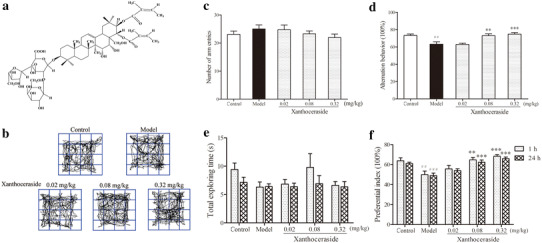
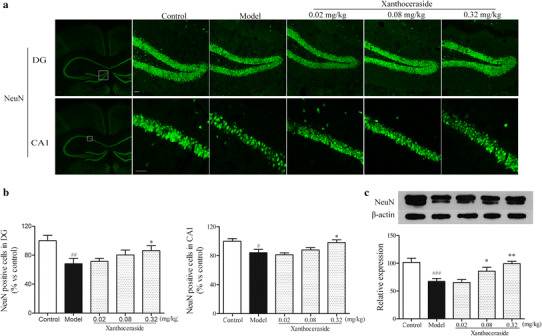
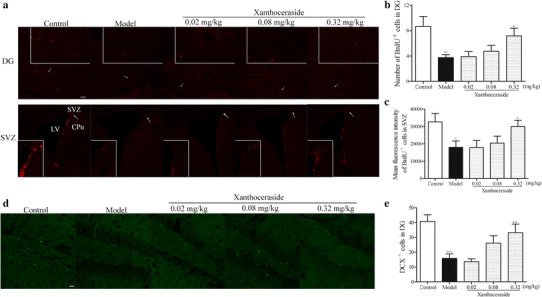
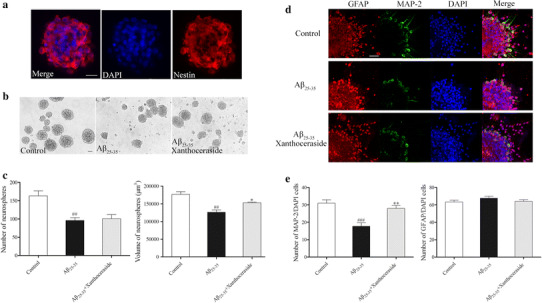
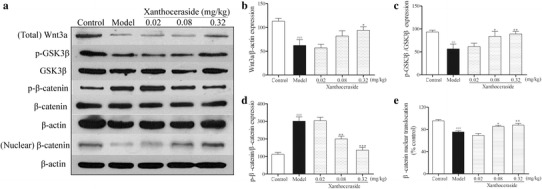
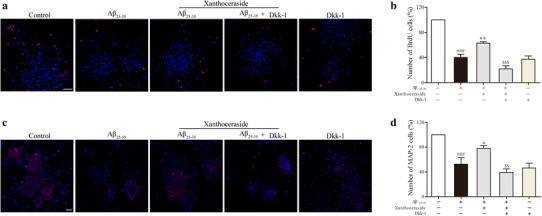
Neuronal loss is reported to be an important pathological process in Alzheimer's disease (AD). Neurogenesis is a process of generation of new neurons to fill the neuronal loss. Xanthoceraside has been shown to attenuate the cognitive deficits in several AD animal models. However, little is known about the effect of xanthoceraside on neurogenesis in APP/PS1 transgenic mice. Thus, in this study, we investigated whether xanthoceraside can ameliorate learning and memory impairment by promoting NSCs proliferation and neuronal differentiation. The results suggested that xanthoceraside significantly ameliorated the cognitive impairment and induced NSCs proliferation and neuronal differentiation in APP/PS1 transgenic mice. Meanwhile, in vitro study revealed that xanthoceraside increased the size of NSCs and induced NSCs differentiation into neurons compared with amyloid beta-peptide (25-35) (Aβ25-35) treatment. Furthermore, we found that xanthoceraside significantly increased the expression of Wnt3a and p-GSK3β, decreased the expression of p-β-catenin, and induced nuclear translocation of β-catenin in APP/PS1 transgenic mice. Furthermore, in vitro study found that the effect of xanthoceraside on inducing NSCs proliferation and neuronal differentiation were inhibited by Wnt pathway inhibitor Dickkopf-1 (Dkk-1). Our data demonstrated that xanthoceraside may promote the proliferation and differentiation of NSCs into neurons by up-regulating the Wnt/β-catenin pathway to fill the neuronal loss, thereby improving learning and memory impairment in APP/PS1 transgenic mice.
Keywords: Alzheimer’s disease; Learning and memory; Neurogenesis; Wnt/β-catenin pathway; Xanthoceraside.
Conflict of interest statement
The authors have no conflicts of interest to declare.
Figures
References
-
- Li XY, Men WW, Zhu H, Lei JF, Zuo FX, Wang ZJ, et al. Age- and brain region-specific changes of glucose metabolic disorder, learning, and memory dysfunction in early Alzheimer’s disease assessed in APP/PS1 transgenic mice using 18F-FDG-PET. Int J Mol Sci. 2016;17(10):1707. doi: 10.3390/ijms17101707. - DOI - PMC - PubMed
-
- Jankowsky JL, Fadale DJ, Anderson J, Xu GM, Gonzales V, Jenkins NA, et al. Mutant presenilins specifically elevate the levels of the 42 residue beta-amyloid peptide in vivo: evidence for augmentation of a 42-specific gamma secretase. Hum Mol Genet. 2004;13(2):159–170. doi: 10.1093/hmg/ddh019. - DOI - PubMed
-
- Parthsarathy V, McClean PL, Holscher C, Taylor M, Tinker C, Jones G, et al. A novel retro-inverso peptide inhibitor reduces amyloid deposition, oxidation and inflammation and stimulates neurogenesis in the APPswe/PS1DeltaE9 mouse model of Alzheimer’s disease. PLoS One. 2013;8(1):e54769. doi: 10.1371/journal.pone.0054769. - DOI - PMC - PubMed
MeSH terms
Substances
Grants and funding
LinkOut - more resources
Full Text Sources
Other Literature Sources
