


Associations between self-reported sleep quality and white matter in community-dwelling older adults: A prospective cohort study
- PMID: 28745016
- PMCID: PMC5655937
- DOI: 10.1002/hbm.23739
Associations between self-reported sleep quality and white matter in community-dwelling older adults: A prospective cohort study
Abstract
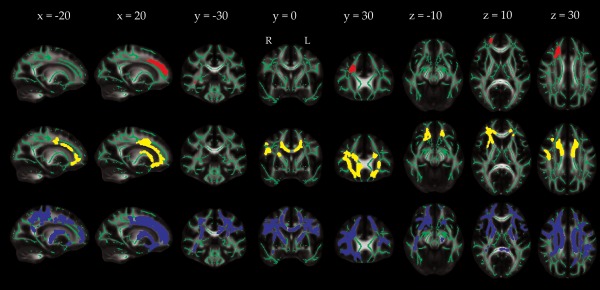
Both sleep disturbances and decline in white matter microstructure are commonly observed in ageing populations, as well as in age-related psychiatric and neurological illnesses. A relationship between sleep and white matter microstructure may underlie such relationships, but few imaging studies have directly examined this hypothesis. In a study of 448 community-dwelling members of the Whitehall II Imaging Sub-Study aged between 60 and 82 years (90 female, mean age 69.2 ± 5.1 years), we used the magnetic resonance imaging technique diffusion tensor imaging to examine the relationship between self-reported sleep quality and white matter microstructure. Poor sleep quality at the time of the diffusion tensor imaging scan was associated with reduced global fractional anisotropy and increased global axial diffusivity and radial diffusivity values, with small effect sizes. Voxel-wise analysis showed that widespread frontal-subcortical tracts, encompassing regions previously reported as altered in insomnia, were affected. Radial diffusivity findings remained significant after additional correction for demographics, general cognition, health, and lifestyle measures. No significant differences in general cognitive function, executive function, memory, or processing speed were detected between good and poor sleep quality groups. The number of times participants reported poor sleep quality over five time-points spanning a 16-year period was not associated with white matter measures. In conclusion, these data demonstrate that current sleep quality is linked to white matter microstructure. Small effect sizes may limit the extent to which poor sleep is a promising modifiable factor that may maintain, or even improve, white matter microstructure in ageing. Hum Brain Mapp 38:5465-5473, 2017. © 2017 Wiley Periodicals, Inc.
Keywords: brain; cognition; diffusion tensor imaging; executive function; insomnia; magnetic resonance imaging; memory; processing speed.
© 2017 The Authors Human Brain Mapping Published by Wiley Periodicals, Inc.
Figures
References
-
- Allan CL, Sexton CE, Filippini N, Topiwala A, Mahmood A, Zsoldos E, Singh‐Manoux A, Shipley MJ, Kivimaki M, Mackay CE, Ebmeier KP (2016): Sub‐threshold depressive symptoms and brain structure: A magnetic resonance imaging study within the Whitehall II cohort. J Affect Disord 204:219–225. - PMC - PubMed
-
- Andersson JLR, Graham MS, Zsoldos E, Sotiropoulos SN (2016): Incorporating outlier detection and replacement into a non‐parametric framework for movement and distortion correction of diffusion MR images. Neuroimage 41:556–572. - PubMed
-
- Andersson JLR, Skare S, Ashburner J (2003): How to correct susceptibility distortions in spin‐echo echo‐planar images: application to diffusion tensor imaging. Neuroimage 20:870–888. - PubMed
-
- Baillet M, Dilharreguy B, Peres K, Dartigues JF, Mayo W, Catheline G (2017): Activity/rest cycle and disturbances of structural backbone of cerebral networks in aging. Neuroimage 146:814–820. - PubMed
Publication types
MeSH terms
Grants and funding
LinkOut - more resources
Full Text Sources
Other Literature Sources
Medical
