


Evaluation of complication rates and vertical bone gain after guided bone regeneration with non-resorbable membranes versus titanium meshes and resorbable membranes. A randomized clinical trial
- PMID: 28745035
- PMCID: PMC5655714
- DOI: 10.1111/cid.12520
Evaluation of complication rates and vertical bone gain after guided bone regeneration with non-resorbable membranes versus titanium meshes and resorbable membranes. A randomized clinical trial
Abstract
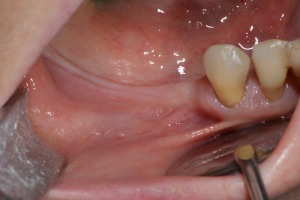
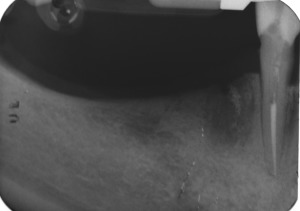
Background: The partial edentulous posterior mandible is often a challenge area that requires a bone reconstructive surgery for implants placement.
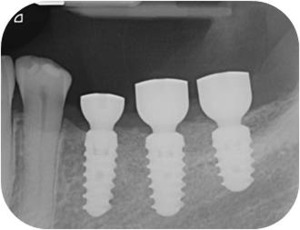
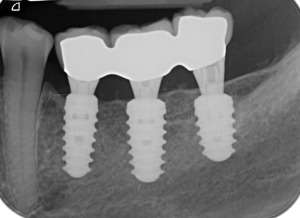
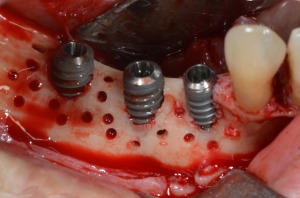
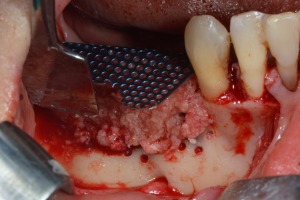
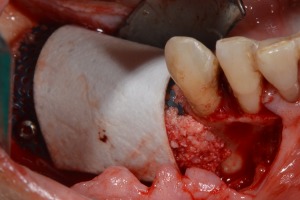
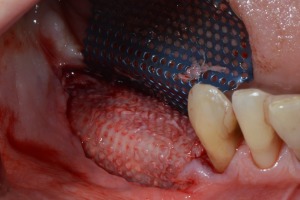
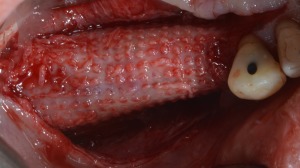
Purpose: This RCT was aimed to evaluate complications rate and vertical bone gain after Guided Bone Regeneration (GBR) with dense non-resorbable d-PTFE titanium-reinforced membranes (Group A) versus titanium meshes covered by cross-linked collagen membranes (Group B).
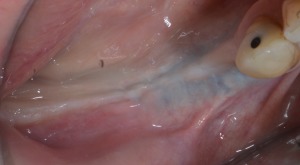
Material and methods: 40 partially edentulous patients with atrophic posterior mandible, were randomly divided into two study group: 20 patients were treated with one stage GBR by means of non-resorbable d-PTFE titanium-reinforced membranes (Group A); and 20 patients, by means of titanium mesh covered by cross-linked collagen membranes (Group B). All complications were recorded, distinguishing between "surgical" and "healing" and between "minor" or "major.". Primary implants stability and vertical bone gain were also evaluated.
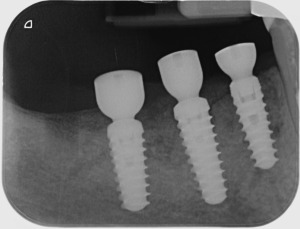
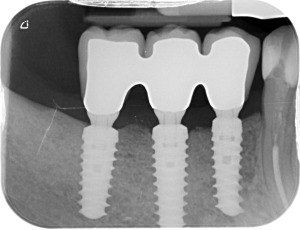
Results: In the group A, surgical and healing complication rates were 5.0% and 15.0%, respectively. In the group B, surgical and healing complication rates were 15.8% and 21.1%, respectively. No significant differences between two study group were observed regarding complications rate implant stability and vertical bone gain.
Conclusions: Both GBR approaches for the restoration of atrophic posterior mandible achieved similar results regarding complications, vertical bone gain and implant stability.
Keywords: alveolar ridge reconstruction; atrophy; bone augmentation; bone defects; bone regeneration; edentulous mandible; guided bone regeneration.
© 2017 The Authors. Clinical Implant Dentistry and Related Research Published by Wiley Periodicals, Inc.
Figures
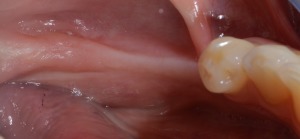
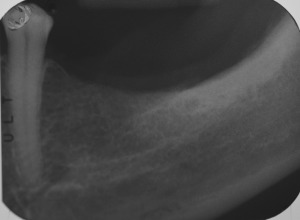
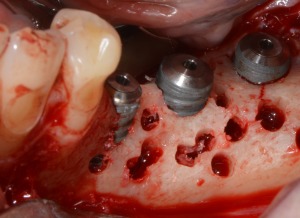
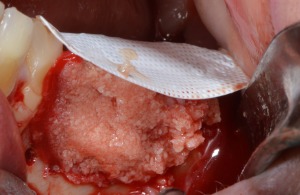
Comment in
-
Guided bone regeneration with nonresorbable and resorbable membranes may not result in different rates of complications or achieve different vertical bone growth.J Am Dent Assoc. 2018 Feb;149(2):e46. doi: 10.1016/j.adaj.2017.10.032. Epub 2017 Dec 12. J Am Dent Assoc. 2018. PMID: 29246410 No abstract available.
References
-
- Atwood DA. Reduction of residual ridges: a major oral disease entità. J Prosthet Dent. 1971;26:266–279. - PubMed
-
- Atwood DA. Bone loss of edentulous alveolar ridges. J Periodontol. 1979;50:11–21. - PubMed
-
- Misch CE, Judy KW. Classification of partially edentulous arches for implant dentistry. Int J Oral Implantol. 1987;4:7–12. - PubMed
-
- Cawood J, Howell RA. classification of the edentulous jaw. Int J Oral Maxillofac Surg. 1988;17:232–236. - PubMed
-
- Rocchietta I, Fontana F, Simion M. Clinical outcomes of vertical bone augmentation to enable dental implant placement: a systematic review. J Clin Periodontol. 2008;35:203–215. - PubMed
Publication types
MeSH terms
Substances
LinkOut - more resources
Full Text Sources
Other Literature Sources
Medical
