Risky Lifestyle Behaviors among Gastric Cancer Survivors Compared with Matched Non-cancer Controls: Results from Baseline Result of Community Based Cohort Study
- PMID: 28745037
- PMCID: PMC6056967
- DOI: 10.4143/crt.2017.129
Risky Lifestyle Behaviors among Gastric Cancer Survivors Compared with Matched Non-cancer Controls: Results from Baseline Result of Community Based Cohort Study
Abstract
Purpose: This study investigated the prevalence of smoking, drinking, and physical inactivity and the associated factors of these behaviors in gastric cancer survivors.
Materials and methods: The baseline data from the nationwide cohort study was used. Four hundred thirty-seven gastric cancer survivors who survived ≥ 2 years from diagnosis and reported completion of treatment were matched with 4,370 controls according to age, sex, education, and household income.
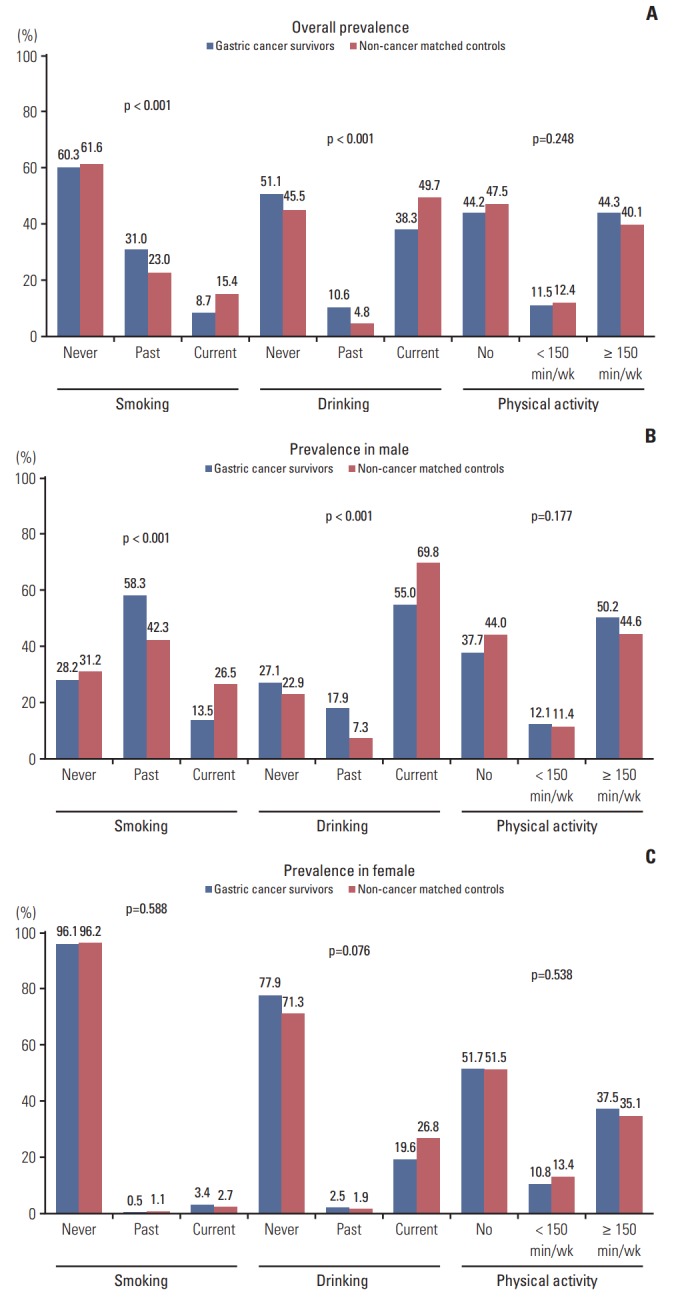
Results: The prevalence rates of current smoking and drinking among gastric cancer survivors were 8.7% and 38.3%, which were significantly lower than those among matched controls (p ≤ 0.001), but the prevalence rates of physical inactivity were not significantly different (55.8% vs. 59.9%, p=0.248). In gastric cancer survivors, ≥ 5 years since cancer diagnosis and current drinking contributed to more current smoking; otherwise, age increment and femalewere associatedwith lower current smoking. Thosewith household income ≥ $2,000 and current smokers were more likely to drink and female showed less drinking. Female, currently employed state, and self-rated health status were associated with more physical inactivity.
Conclusion: Although gastric cancer survivors showed better health behaviors than controls, suggesting that the diagnosis of cancer may motivate individuals towards healthy behaviors, their current prevalence rates of smoking and drinking were still high, and more than 50% of them were physically inactive. Tailored interventions to improve their health behaviors considering associated factors for the gastric cancer survivors are necessary.
Keywords: Cross-sectional studies; Health behavior; Survivors; Stomach neoplasms.
Conflict of interest statement
Conflict of interest relevant to this article was not reported.
Figures
References
-
- Ferlay J, Soerjomataram I, Ervik M, Dikshit R, Eser S, Mathers C, et al. Lyon: International Agency for Research on Cancer; 2013. GLOBOCAN 2012 v1. 0, cancer incidence and mortality worldwide: IARC CancerBase No. 11 [Internet] [cited 2014 Oct 10]. Available from: http://globocan.iarc.fr.
-
- Bray F, Ren JS, Masuyer E, Ferlay J. Global estimates of cancer prevalence for 27 sites in the adult population in 2008. Int J Cancer. 2013;132:1133–45. - PubMed
-
- Haugnes HS, Bosl GJ, Boer H, Gietema JA, Brydoy M, Oldenburg J, et al. Long-term and late effects of germ cell testicular cancer treatment and implications for follow-up. J Clin Oncol. 2012;30:3752–63. - PubMed
-
- Leach CR, Weaver KE, Aziz NM, Alfano CM, Bellizzi KM, Kent EE, et al. The complex health profile of long-term cancer survivors: prevalence and predictors of comorbid conditions. J Cancer Surviv. 2015;9:239–51. - PubMed
MeSH terms
LinkOut - more resources
Full Text Sources
Other Literature Sources
Medical