Review
doi: 10.1056/NEJMra1510092.
Mobile DNA in Health and Disease
Affiliations
- PMID: 28745987
- PMCID: PMC5980640
- DOI: 10.1056/NEJMra1510092
Item in Clipboard
Review
Mobile DNA in Health and Disease
N Engl J Med.
.
No abstract available
Figures
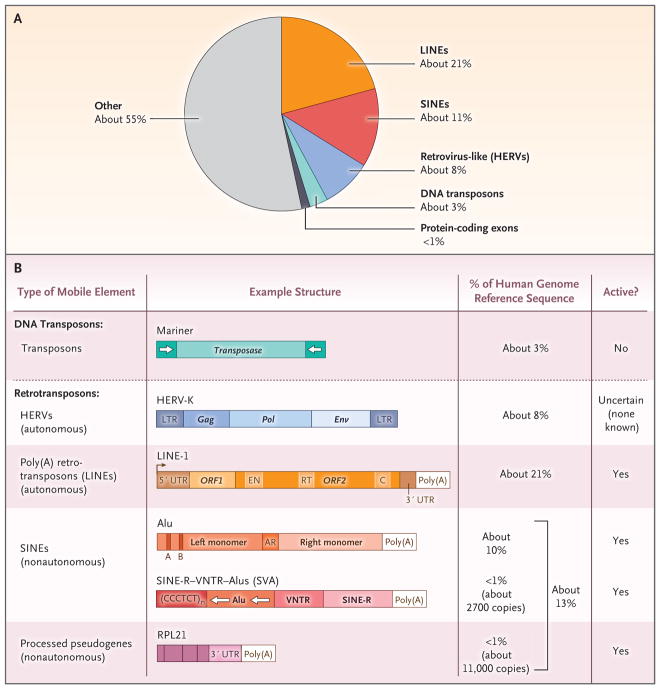
Panel A shows protein-coding exons and classes of human transposable elements as a percentage of the genome. As shown in Panel B, DNA transposons encode transposase, an enzyme that binds at or near inverted repeats flanking the element (white arrows flanking transposase) to promote mobility by means of a cut-and-paste mechanism. Retrotransposons mobilize by means of a copy-and-paste mechanism through an RNA intermediate. Human endogenous retroviruses (HERVs) contain sequences analogous to the gag, pol, and env genes of retroviruses, but most HERVs, if not all of them, are not active in humans. Elements are considered to be autonomous when they encode the protein activities necessary for retrotransposition (e.g., an endonuclease [EN] and a reverse transcriptase [RT]). The arrow at the 5′ end of poly(A) retrotransposons denotes the transcription start site from their internal promoter. Nonautonomous elements do not encode proteins; their retrotransposition depends on the proteins encoded by autonomous elements. Nonautonomous elements include Alu elements and SVAs. Alu elements have a size of approximately 280 bp and consist of two monomers separated by an adenosine-rich (AR) linker; the left Alu monomer has an internal RNA polymerase III promoter (bars labeled A and B). SVAs are composite elements with a portion of a HERV (SINE-R [short interspersed element of HERV origin]), a variable number of tandem repeats (VNTRs), and a backward Alu, as well as a CCCTCT multimer. Processed pseudogenes are copies of cellular messenger RNAs that have been reverse-transcribed into DNA and lack introns. C denotes cysteine-rich domain (encoded by ORF2), HERV-K a HERV of the K type, LINE long interspersed element, LTR long terminal repeat, ORF1 open reading frame 1, ORF2 open reading frame 2, and UTR untranslated region. The diagram in Panel B is adapted from Beck et al.
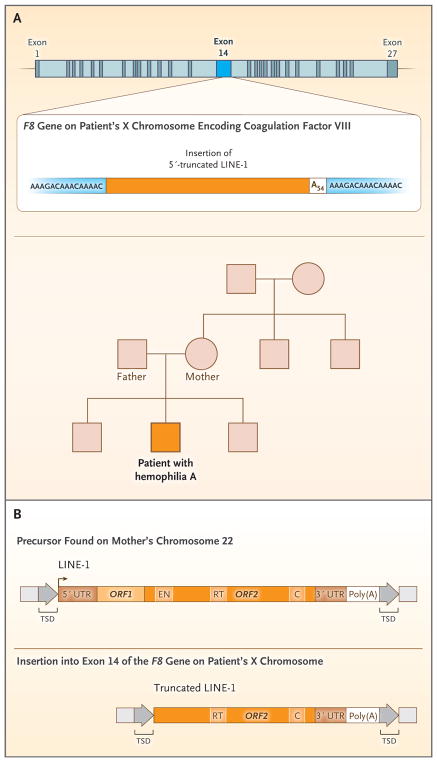
Panel A shows the family pedigree. The solid orange square denotes the affected boy, and the other symbols indicate unaffected family members. The boy’s mother is not a carrier of the insertion in exon 14 of F8 (the gene encoding factor VIII). In Panel B, the precursor LINE-1 element isolated from the mother’s DNA is shown above the insertion. The precursor was a full-length LINE-1 in chromosome 22. The smaller pathogenic insertion was identical in sequence to a portion of the precursor LINE-1. The brown arrow at the 5′ end of the precursor element denotes the transcription start site from the LINE-1 internal promoter. TSD denotes target-site duplication, and the light-gray box next to TSD indicates genomic DNA. The diagram in Panel A is adapted from Kazazian et al., and the diagram in Panel B is adapted from Dombroski et al.
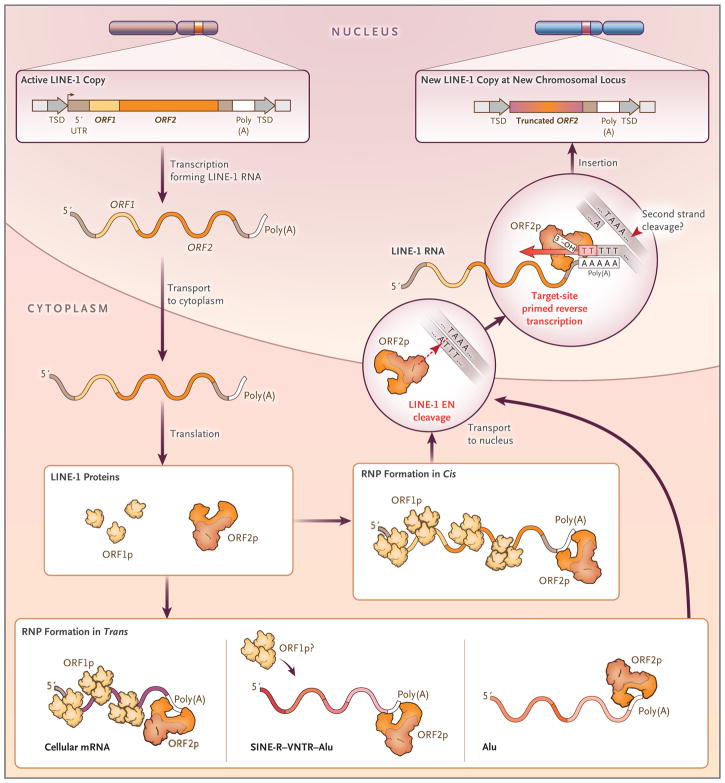
LINE-1 RNA is transcribed from a promoter located within its 5′ UTR. The RNA is exported into the cytoplasm, where it undergoes translation. The LINE-1–encoded proteins ORF1p and ORF2p bind to the LINE-1–encoding RNA by a process known as cis-preference,, leading to the formation of a cytoplasmic complex.– Components of this complex (at least ORF2p and LINE-1 RNA) gain nuclear access, at which point the ORF2p endonuclease (EN) cleaves a single strand of chromosomal DNA at a consensus sequence (i.e., 5′-TTTT/A-3′), liberating a 3′ hydroxyl group that is used by ORF2p reverse transcriptase to copy LINE-1 RNA and integrate the resultant LINE-1 DNA into this new chromosomal location., It is not known how the second DNA strand at the insertion site is cleaved and how second-strand LINE-1 DNA is synthesized, but the ORF2 protein probably mediates these processes. The ORF2 protein is also required for the retrotransposition of nonautonomous RNAs, such as cellular mRNAs (creating processed pseudogenes), SVA RNAs, and Alu RNAs. The ORF1 protein may aid in SVA and Alu retrotransposition. RNP denotes ribonucleoprotein particle. The diagram is adapted from Richardson et al.
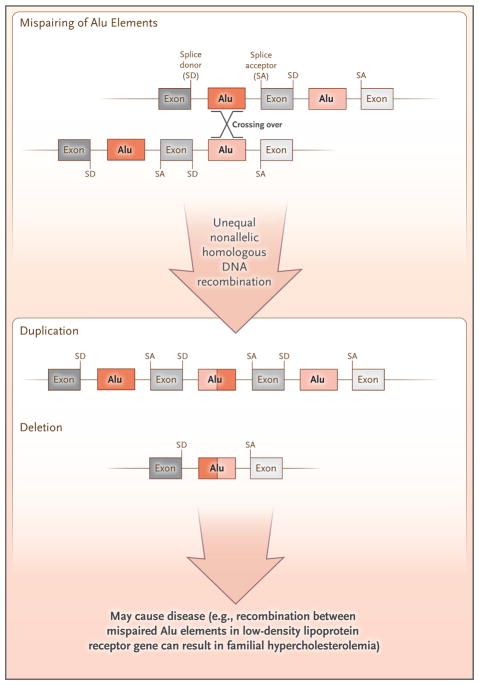
Mispairing of Alu elements or LINE-1 elements, followed by crossing over and unequal nonallelic homologous recombination, leads to the deletion or duplication of the genomic sequence. Exons and introns (black lines) of the hypothetical gene are shown. The diagram is adapted from Hulme et al.
References
-
- Lander ES, Linton LM, Birren B, et al. Initial sequencing and analysis of the human genome. Nature. 2001;409:860–921. - PubMed
-
- McCarthy MI, Abecasis GR, Cardon LR, et al. Genome-wide association studies for complex traits: consensus, uncertainty and challenges. Nat Rev Genet. 2008;9:356–69. - PubMed
-
- National Human Genome Research Institute. A catalog of published genome-wide association studies. 2015 https://www.genome.gov/26525384/catalog-of-published-genomewide-associat...
Publication types
MeSH terms
Substances
Grants and funding
LinkOut - more resources
Full Text Sources
Other Literature Sources