


Optimising decision making on illness absenteeism due to fever and common infections within childcare centres: development of a multicomponent intervention and study protocol of a cluster randomised controlled trial
- PMID: 28747169
- PMCID: PMC5530501
- DOI: 10.1186/s12889-017-4602-3
Optimising decision making on illness absenteeism due to fever and common infections within childcare centres: development of a multicomponent intervention and study protocol of a cluster randomised controlled trial
Erratum in
-
Erratum to: BMC Public Health, Vol. 18.BMC Public Health. 2017 Sep 22;17(1):736. doi: 10.1186/s12889-017-4709-6. BMC Public Health. 2017. PMID: 28938882 Free PMC article. No abstract available.
Abstract
Background: Evidence has shown that children 0-4 year-old attending childcare are prone to acquire infections compared to children cared for at home, with fever being the most common symptom. Illness absenteeism due to fever and common infections is substantial and mostly driven by unrealistic concerns and negative attitude towards fever of both childcare staff and parents, resulting in illness absenteeism from childcare, work absenteeism among parents and healthcare service use. The objective of this study is to optimise decision making among childcare staff on illness absenteeism due to fever and common infections in childcare. Underlying determinants of behavioural change were targeted by means of a multicomponent intervention.
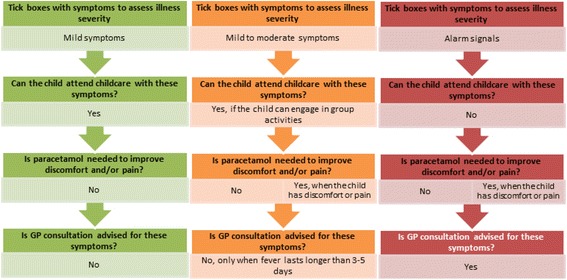
Methods: A multicomponent intervention was developed to improve decision making, using the stepwise approach of Intervention Mapping, and in close collaboration with stakeholders and experts. The intervention consisted of 1) a two-hour educational session on fever among childcare staff; 2) an online video for childcare staff and parents emphasising key information of the educational session; 3) a decision tool for childcare staff and parents in the format of a traffic light system to estimate the severity of illness and corresponding advices for childcare staff and parents; 4) an information booklet regarding childhood fever, common infections, and self-management strategies for childcare staff and parents. The multicomponent intervention will be evaluated in a cluster randomised trial with a 12-week follow-up period and absenteeism due to illness (defined as the percentage of childcare days absent due to illness on the total of childcare days during a 12-week period) as primary outcome measure. Secondary outcome measures are: incidence rate and duration of illness episodes, knowledge, attitude, self-efficacy, and risk perception on fever and common infections of childcare staff and parents, healthcare service use in general and paracetamol use, and work absenteeism of parents.
Discussion: This study aims to develop a multicomponent intervention and to evaluate to what extent illness absenteeism due to fever and common infections can be affected by implementing a multicomponent intervention addressing decision making and underlying determinants among childcare staff and parents of children attending daycare.
Trial registration: NTR6402 (registered on 21-apr-2017).
Keywords: Childcare centres; Common infections; Fever; Illness absenteeism; Intervention mapping.
Conflict of interest statement
Ethics approval and consent to participate
Childcare staff received an informed consent form to obtain their permission to send an electronic survey at T0 and T6 Parents will be asked written informed consent before the start of the study to collect additional data if their child is reported ill during the study period. Parents provide consent to complete a survey to measure knowledge, attitude, self-efficacy and risk perception at the end of the study period (T6). All data will be anonymized and only used for study purposes. This study was approved by the medical ethical committee of Zuyderland, Heerlen, the Netherlands [METC 14-N-171].
Consent for publication
Not applicable.
Competing interests
The authors declare that they have no competing interests.
Publisher’s Note
Springer Nature remains neutral with regard to jurisdictional claims in published maps and institutional affiliations.
Figures
References
-
- Kotch JB, Weigle KA, Weber DJ, Clifford RM, Harms TO. Loda FA, Gallagher PN, Jr, Edwards RW, LaBorde D, McMurray MP, et al. Evaluation of an hygienic intervention in child day-care centers. Pediatrics. 1994;94(6 Pt 2):991–994. - PubMed
Publication types
MeSH terms
LinkOut - more resources
Full Text Sources
Other Literature Sources
Medical
Miscellaneous
