Survival, Persistence, and Isolation of the Emerging Multidrug-Resistant Pathogenic Yeast Candida auris on a Plastic Health Care Surface
- PMID: 28747370
- PMCID: PMC5625385
- DOI: 10.1128/JCM.00921-17
Survival, Persistence, and Isolation of the Emerging Multidrug-Resistant Pathogenic Yeast Candida auris on a Plastic Health Care Surface
Abstract
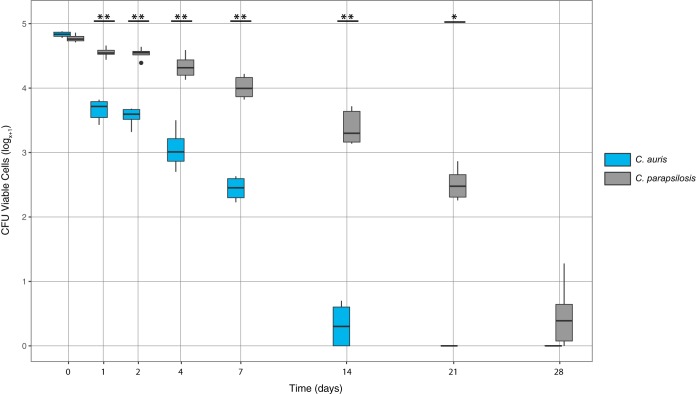
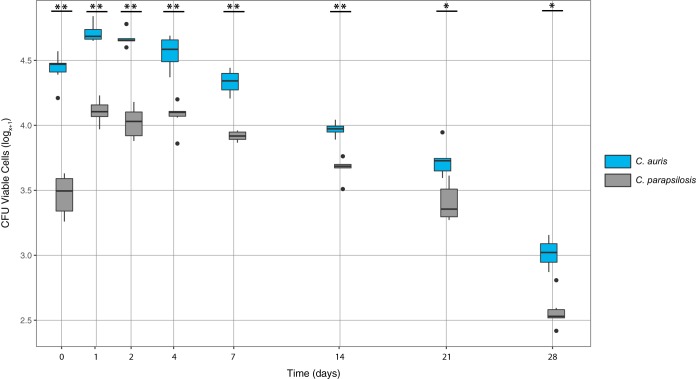
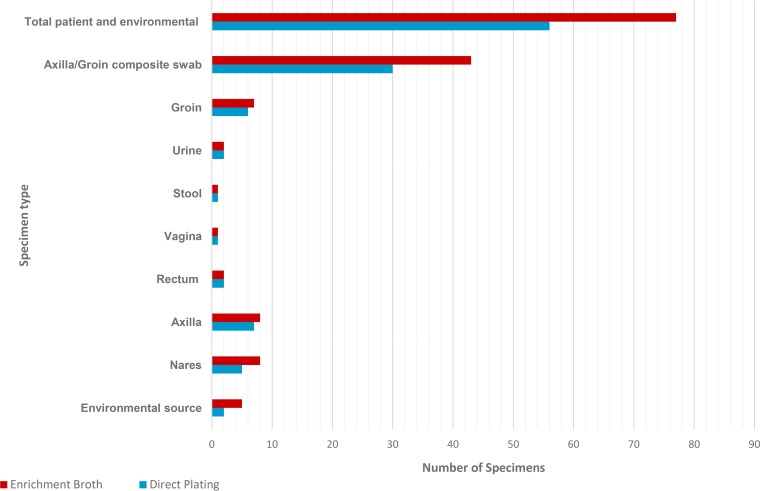
The emerging multidrug-resistant pathogenic yeast Candida auris represents a serious threat to global health. Unlike most other Candida species, this organism appears to be commonly transmitted within health care facilities and causes health care-associated outbreaks. To better understand the epidemiology of this emerging pathogen, we investigated the ability of C. auris to persist on plastic surfaces common in health care settings compared with that of Candida parapsilosis, a species known to colonize the skin and plastics. Specifically, we compiled comparative and quantitative data essential to understanding the vehicles of spread and the ability of both species to survive and persist on plastic surfaces under controlled conditions (25°C and 57% relative humidity), such as those found in health care settings. When a test suspension of 104 cells was applied and dried on plastic surfaces, C. auris remained viable for at least 14 days and C. parapsilosis for at least 28 days, as measured by CFU. However, survival measured by esterase activity was higher for C. auris than C. parapsilosis throughout the 28-day study. Given the notable length of time Candida species survive and persist outside their host, we developed methods to more effectively culture C. auris from patients and their environment. Using our enrichment protocol, public health laboratories and researchers can now readily isolate C. auris from complex microbial communities (such as patient skin, nasopharynx, and stool) as well as environmental biofilms, in order to better understand and prevent C. auris colonization and transmission.
Keywords: Candida; Candida auris; Candida parapsilosis; clinical methods; persistence; public health.
This is a work of the U.S. Government and is not subject to copyright protection in the United States. Foreign copyrights may apply.
Figures
References
-
- Vallabhaneni S, Kallen A, Tsay S, Chow N, Welsh R, Kerins J, Kemble SK, Pacilli M, Black SR, Landon E, Ridgway J, Palmore TN, Zelzany A, Adams EH, Quinn M, Chaturvedi S, Greenko J, Fernandez R, Southwick K, Furuya EY, Calfee DP, Hamula C, Patel G, Barrett P, Lafaro P, Berkow EL, Moulton-Meissner H, Noble-Wang J, Fagan RP, Jackson BR, Lockhart SR, Litvintseva AP, Chiller TM. 2016. Investigation of the first seven reported cases of Candida auris, a globally emerging invasive, multidrug-resistant fungus—United States, May 2013-August 2016. MMWR Morb Mortal Wkly Rep 65:1234–1237. doi: 10.15585/mmwr.mm6544e1. - DOI - PubMed
MeSH terms
Substances
LinkOut - more resources
Full Text Sources
Other Literature Sources
Medical
Molecular Biology Databases