


lncRNAs in development and disease: from functions to mechanisms
- PMID: 28747406
- PMCID: PMC5541349
- DOI: 10.1098/rsob.170121
lncRNAs in development and disease: from functions to mechanisms
Abstract
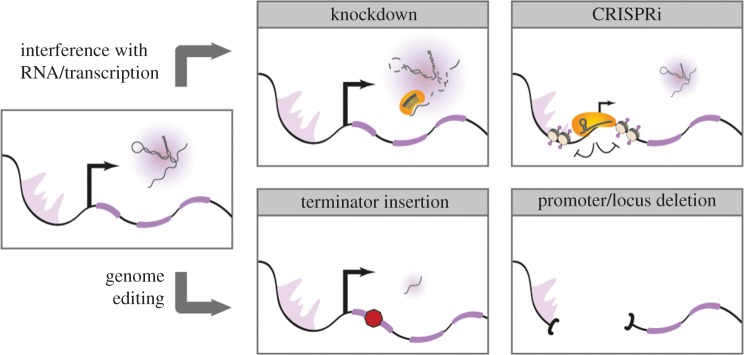
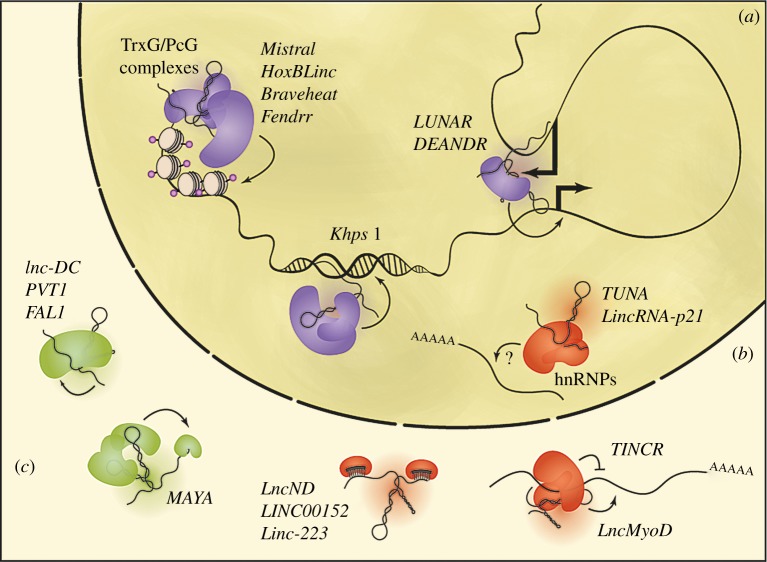
Differential expression of long non-coding RNAs (lncRNAs) during differentiation and their misregulation in cancer highlight their potential as cell fate regulators. While some example lncRNAs have been characterized in great detail, the functional in vivo relevance of others has been called into question. Finding functional lncRNAs will most probably require a combination of complementary approaches that will greatly vary depending on their mode of action. In this review, we discuss the different tools available to dissect genetically lncRNA requirements and how each is best suited to studies in particular contexts. Moreover, we review different strategies used to select candidate lncRNAs and give an overview of lncRNAs described to regulate development and cancer through different mechanisms.
Keywords: cancer; development; long non-coding RNAs.
© 2017 The Authors.
Conflict of interest statement
The authors have no relevant competing interests.
Figures
References
-
- Ponting CP, Oliver PL, Reik W. 2009. Evolution and functions of long noncoding RNAs. Cell 136, 629–641. (doi:10.1016/j.cell.2009.02.006) - DOI - PubMed
-
- Pauli A, et al. 2012. Systematic identification of long noncoding RNAs expressed during zebrafish embryogenesis. Genome Res. 22, 577–591. (doi:10.1101/gr.133009.111) - DOI - PMC - PubMed
-
- Nam J-W, Bartel DP. 2012. Long noncoding RNAs in C. elegans. Genome Res. 22, 2529–2540. (doi:10.1101/gr.140475.112) - DOI - PMC - PubMed
-
- Sebé-Pedrós A, Ballaré C, Parra-Acero H, Chiva C, Tena JJ, Sabidó E, Gómez-Skarmeta JL, Di Croce L, Ruiz-Trillo I. 2016. The dynamic regulatory genome of Capsaspora and the origin of animal multicellularity. Cell 165, 1224–1237. (doi:10.1016/j.cell.2016.03.034) - DOI - PMC - PubMed
-
- ENCODE Project Consortium et al. 2007. Identification and analysis of functional elements in 1% of the human genome by the ENCODE pilot project. Nature 447, 799–816. (doi:10.1038/nature05874) - DOI - PMC - PubMed
Publication types
MeSH terms
Substances
Grants and funding
LinkOut - more resources
Full Text Sources
Other Literature Sources