


Mindfulness-Based Stress Reduction Therapy Improves Patient and Caregiver-Reported Outcomes in Cirrhosis
- PMID: 28749453
- PMCID: PMC5539344
- DOI: 10.1038/ctg.2017.38
Mindfulness-Based Stress Reduction Therapy Improves Patient and Caregiver-Reported Outcomes in Cirrhosis
Abstract
Objectives: Patient-reported outcomes such as health-related quality of life (HRQOL) are impaired in cirrhosis due to under-treated mood and sleep disorders, which can adversely impact their caregivers. Mindfulness-based stress reduction (MBSR) can improve patient-reported outcomes (PRO) in non-cirrhotic patients but their impact in cirrhosis is unclear. To evaluate the effect of MBSR and supportive group therapy on mood, sleep and HRQOL in cirrhotic patients and their caregivers.
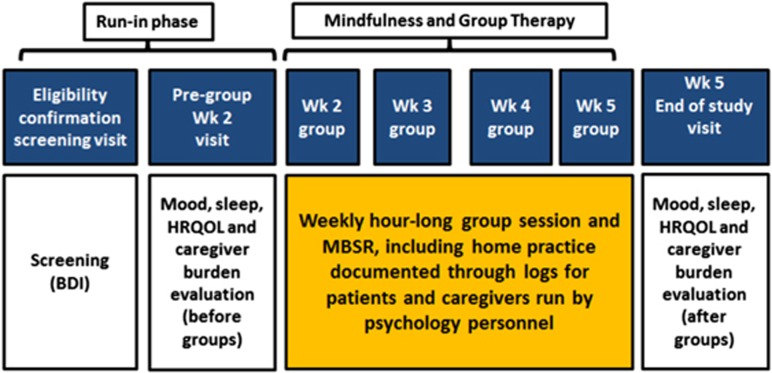
Methods: Cirrhotic outpatients with mild depression (Beck Depression Inventory (BDI)>14) on screening with an adult caregiver were enrolled. At baseline, BDI, sleep (Pittsburgh sleep quality index PSQI, Epworth Sleepiness Scale, ESS), anxiety (Beck Anxiety inventory) and HRQOL (Sickness Impact Profile, SIP) for both patients/caregivers and caregiver burden (Zarit Burden Interview Short-form, ZBI-SF and perceived caregiver burden, PCB) and patient covert HE(CHE) status were measured. Patients who had BDI>14 at baseline, along with their caregivers then underwent a structured MBSR program with four weekly hour-long group sessions interspersed with home practice using CDs. After the last group, all questionnaires were repeated.
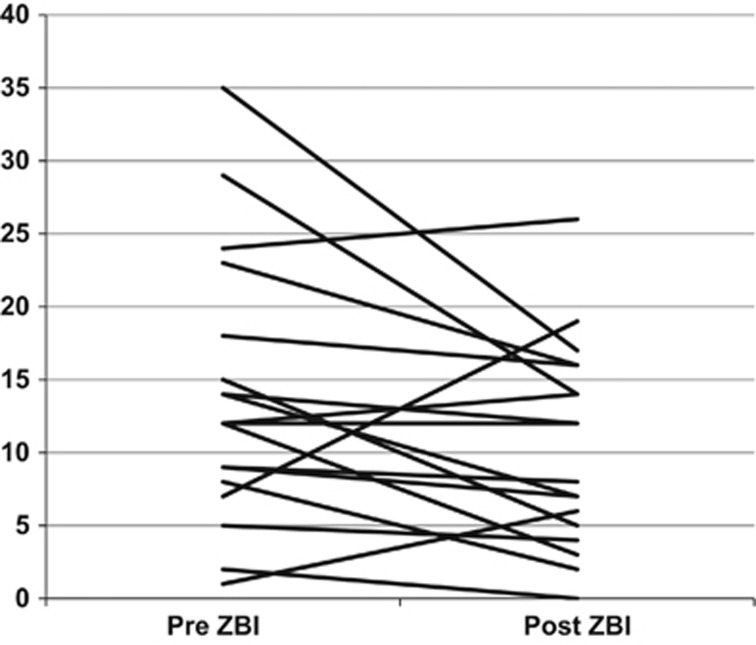
Results: 20 patient/caregiver dyads were included. All patients were men (60±8 years MELD 12.9±5.7, 14 prior hepatic encephalopathy (HE)) while most caregivers (n=15) were women (55±12 years, 23±14 years of relationship, 65% spouses). There was no change in patient BDI between screening and baseline (20.1±11.2 vs. 19.0±10.6, P=0.81). All dyads were able to complete the four MBSR+supportive group therapy sessions. There was a significant improvement in BDI (19.0±10.6 vs.15.6±8.2 P=0.01), PSQI (7.2±3.7 vs. 5.5±3.7, P<0.001) and overall HRQOL (25.0±13.2 vs. 17.7±14.0,P=0.01) but not in anxiety or CHE rates in patients. Similarly caregiver burden (ZBI-SF13.0±9.0 vs. 9.8±6.9,P=0.04, Perceived burden 72.1±29.9 vs. 63.0±14.5,P=0.05) and depression reduced (BDI 9.1±7.8 vs. 5.9±6.0,P=0.03) while caregiver sleep quality (7.2±3.7 vs. 5.5±3.7,P<0.001) improved. Prior HE did not affect PRO change after MBSR+supportive groups but the ZBI-SF of caregivers taking care of HE patients improved to a greater extent (delta -1.1±6.5 vs. 7.4±5.3 HE, P=0.04).
Conclusion: A short program of mindfulness and supportive group therapy significantly improves PRO and caregiver burden in cirrhotic patients with depression. This non-pharmacological method could be a promising approach to alleviate psychosocial stress in patients with end-stage liver disease and their caregivers.
Conflict of interest statement
Figures
References
-
- Nardelli S, Pentassuglio I, Pasquale C et al. Depression, anxiety and alexithymia symptoms are major determinants of health related quality of life (HRQoL) in cirrhotic patients. Metab Brain Dis 2013; 28: 239–243. - PubMed
-
- Kanwal F. Patient-reported outcomes of cirrhosis. Clin Gastroenterol Hepatol 2013; 11: 1043–1045. - PubMed
-
- Vilstrup H, Amodio P, Bajaj J et al. Hepatic encephalopathy in chronic liver disease: 2014 Practice Guideline by the American Association for the Study of Liver Diseases and the European Association for the Study of the Liver. Hepatology 2014; 60: 715–735. - PubMed
LinkOut - more resources
Full Text Sources
Other Literature Sources
Medical
Miscellaneous
