


How does mandibular advancement with or without maxillary procedures affect pharyngeal airways? An overview of systematic reviews
- PMID: 28749983
- PMCID: PMC5531493
- DOI: 10.1371/journal.pone.0181146
How does mandibular advancement with or without maxillary procedures affect pharyngeal airways? An overview of systematic reviews
Abstract
Background: Mandibular advancement surgery may positively affect pharyngeal airways and therefore potentially beneficial to obstructive sleep apnea (OSA).
Objective: To collect evidence from published systematic reviews that have evaluated pharyngeal airway changes related to mandibular advancement with or without maxillary procedures.
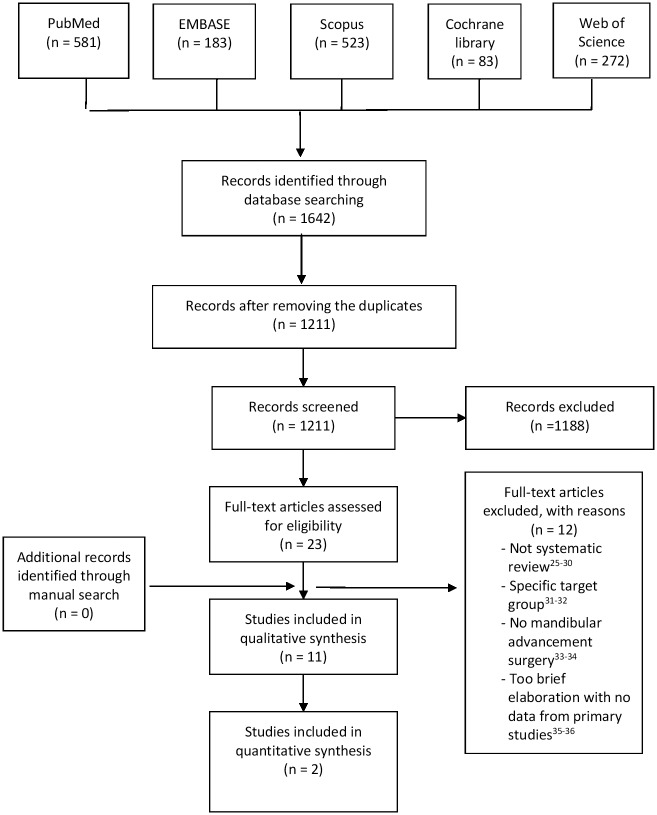
Methodology: PubMed, EMBASE, Web of Science, and Cochrane Library were searched without limiting language or timeline. Eligible systematic reviews evaluating changes in pharyngeal airway dimensions and respiratory parameters after mandibular advancement with or without maxillary surgery were identified and included.
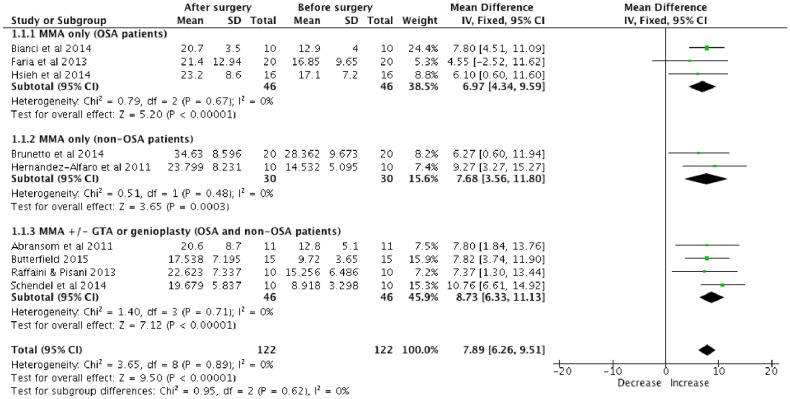
Results: This overview has included eleven systematic reviews. Maxillomandibular advancement (MMA) increases linear, cross-sectional plane and volumetric measurements of pharyngeal airways significantly (p<0.0001), while reducing the apnea-hypopnea index (AHI) and the respiratory disturbance index (RDI) significantly (p<0.0001). Two systematic reviews included primary studies that have evaluated single-jaw mandibular advancement, but did not discuss their effect onto pharyngeal airways. Based on the included primary studies of those systematic reviews, single-jaw mandibular advancement was reported to significantly increase pharyngeal airway dimensions (p<0.05); however, conclusive long-term results were lacking.
Conclusion: MMA increases pharyngeal airway dimensions and is beneficial to patients suffering from OSA. However, more evidence is still needed to draw definite conclusion related to the effect of single-jaw mandibular advancement osteotomies on pharyngeal airways.
Conflict of interest statement
Figures
References
-
- Achilleos S, Krogstad O, Lyberg T. Surgical mandibular advancement and changes in uvuloglossopharyngeal morphology and head posture: a short- and long-term cephalometric study in males. European journal of orthodontics. 2000;22(4):367–81. Epub 2000/10/13. . - PubMed
-
- Hernandez-Alfaro F, Guijarro-Martinez R, Mareque-Bueno J. Effect of mono- and bimaxillary advancement on pharyngeal airway volume: cone-beam computed tomography evaluation. Journal of oral and maxillofacial surgery: official journal of the American Association of Oral and Maxillofacial Surgeons. 2011;69(11):e395–400. Epub 2011/07/30. doi: 10.1016/j.joms.2011.02.138 . - DOI - PubMed
-
- Rosario HD, Oliveira GM, Freires IA, de Souza Matos F, Paranhos LR. Efficiency of bimaxillary advancement surgery in increasing the volume of the upper airways: a systematic review of observational studies and meta-analysis. European archives of oto-rhino-laryngology: official journal of the European Federation of Oto-Rhino-Laryngological Societies (EUFOS): affiliated with the German Society for Oto-Rhino-Laryngology—Head and Neck Surgery. 2016. Epub 2016/03/31. doi: 10.1007/s00405-016-4015-4 . - DOI - PubMed
-
- Eggensperger N, Smolka K, Johner A, Rahal A, Thuer U, Iizuka T. Long-term changes of hyoid bone and pharyngeal airway size following advancement of the mandible. Oral surgery, oral medicine, oral pathology, oral radiology, and endodontics. 2005;99(4):404–10. Epub 2005/03/18. doi: 10.1016/j.tripleo.2004.07.019 . - DOI - PubMed
-
- Turnbull NR, Battagel JM. The effects of orthognathic surgery on pharyngeal airway dimensions and quality of sleep. Journal of orthodontics. 2000;27(3):235–47. Epub 2000/12/02. doi: 10.1179/ortho.27.3.235 . - DOI - PubMed
Publication types
MeSH terms
LinkOut - more resources
Full Text Sources
Other Literature Sources
