Prevalence of Hearing Loss Among Children 9 to 11 Years Old: The Generation R Study
- PMID: 28750130
- PMCID: PMC5710286
- DOI: 10.1001/jamaoto.2017.1068
Prevalence of Hearing Loss Among Children 9 to 11 Years Old: The Generation R Study
Abstract
Importance: Hearing loss (HL), a major cause of disability globally, negatively affects both personal and professional life.
Objective: To describe the prevalence of sensorineural hearing loss (SNHL) among a population-based cohort of 9- to 11-year-old children, and to examine potential associations between purported risk factors and SNHL in early childhood.
Design, setting, and participants: The study was among the general, nonclinical, pediatric community within the city of Rotterdam, the Netherlands, and was conducted between 2012 and 2015 as a cross-sectional assessment within the Generation R Study, a population-based longitudinal cohort study from fetal life until adulthood. Participants are children of included pregnant women in the Generation R Study with an expected delivery date between April 2002 and January 2006. They form a prenatally recruited birth cohort.
Main outcomes and measures: Pure-tone air-conduction hearing thresholds were obtained at 0.5, 1, 2, 3, 4, 6, and 8 kHz, and tympanometry was performed in both ears. Demographic factors and parent-reported questionnaire data, including history of otitis media, were also measured.
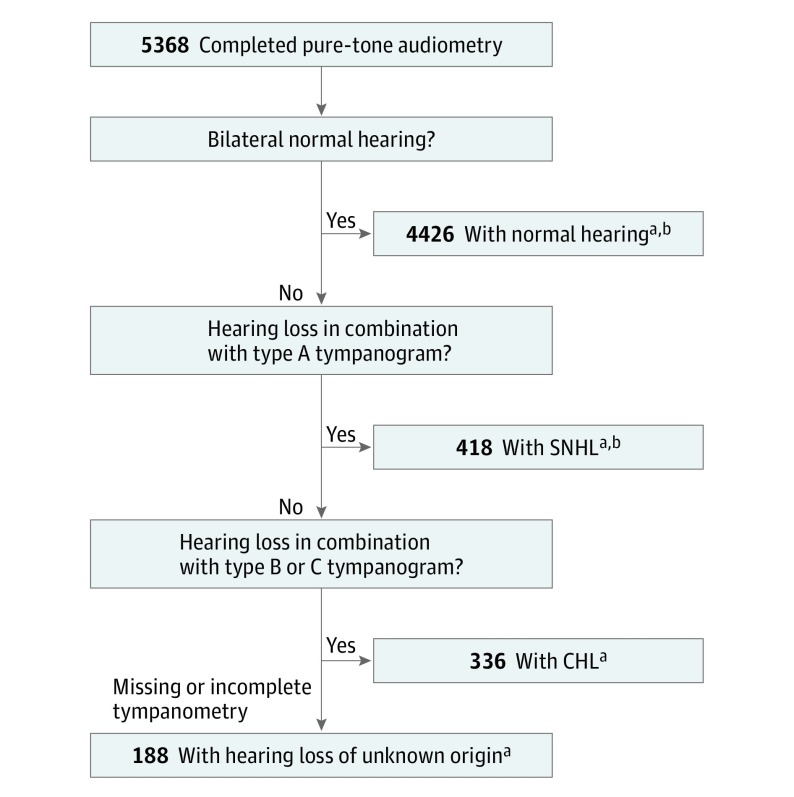
Results: A total of 5368 participants with a mean age of 9 years 9 months (interquartile range, 9 years 7 months-9 years 11 months) completed audiometry and were included in the analyses. A total of 2720 were girls (50.7%), and 3627 (67.6%) were white. Most of the participants (4426 children [82.5%]) showed normal hearing thresholds 15 dB HL or less in both ears. Within the cohort, 418 children (7.8%) were estimated to have SNHL (≥16 dB HL at low-frequency pure-tone average; average at 0.5, 1, and 2 kHz or high-frequency pure-tone average; average at 3, 4, and 6 kHz in combination with a type A tympanogram) in at least 1 ear, most often at higher frequencies. In multivariable analyses, a history of recurrent acute otitis media and lower maternal education were associated with the estimated SNHL at ages 9 to 11 years (odds ratio, 2.0 [95% CI. 1.5-2.8] and 1.4 [95% CI, 1.1-1.7], respectively).
Conclusions and relevance: Within this cohort study in the Netherlands, 7.8% of the children ages 9 to 11 years had low-frequency or high-frequency HL of at least 16 dB HL in 1 or both ears. A history of recurrent acute otitis media and lower maternal education seem to be independent risk factors for presumed SNHL in early childhood.
Conflict of interest statement
Figures
Comment in
References
-
- Arlinger S. Negative consequences of uncorrected hearing loss: a review. Int J Audiol. 2003;42(suppl 2):2S17-20. - PubMed
-
- Bess FH, Dodd-Murphy J, Parker RA. Children with minimal sensorineural hearing loss: prevalence, educational performance, and functional status. Ear Hear. 1998;19(5):339-354. - PubMed
-
- Lieu JE. Speech-language and educational consequences of unilateral hearing loss in children. Arch Otolaryngol Head Neck Surg. 2004;130(5):524-530. - PubMed
-
- Mathers C, Smith A, Concha M Global burden of hearing loss in the year 2000. 2003:1-30. http://www.who.int/healthinfo/statistics/bod_hearingloss.pdf. Accessed August 18, 2017.
-
- Rigters SC, Metselaar M, Wieringa MH, Baatenburg de Jong RJ, Hofman A, Goedegebure A. Contributing determinants to hearing loss in elderly men and women: results from the population-based Rotterdam Study. Audiol Neurootol. 2016;21(suppl 1):10-15. - PubMed
Publication types
MeSH terms
LinkOut - more resources
Full Text Sources
Other Literature Sources
Miscellaneous