


Caregiver-Reported Quality of Life in Youth with Down Syndrome
- PMID: 28751125
- PMCID: PMC5614822
- DOI: 10.1016/j.jpeds.2017.06.073
Caregiver-Reported Quality of Life in Youth with Down Syndrome
Abstract
Objectives: To describe caregiver-reported quality of life (QOL) in youth with Down syndrome (DS) and to examine the role of obesity on QOL.
Study design: Caregivers of youth with and without DS aged 10 through 20 years completed questionnaires examining QOL (Pediatric Quality of Life Questionnaire) and weight-related QOL (Impact of Weight on Quality of Life - Kids). Age- and sex-specific z scores were generated for body mass index. Obesity was defined as a body mass index ≥95th percentile for age and sex.
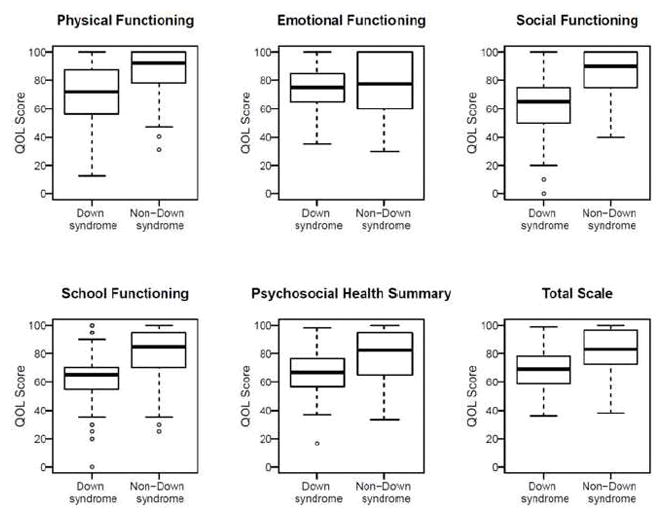
Results: Caregiver-reported Total QOL, Physical Health, and Psychosocial Health summary scores were all lower in the DS group compared with the non-DS controls (P < .001). Social and School Functioning were also lower (P < .001), but Emotional Functioning did not differ between DS and non-DS groups (P = .31). Physical Functioning (P = .003) and Total scores (P = .03) differed between youth without DS with and without obesity, but no differences were reported between youth with DS with and without obesity. On the Impact of Weight on Quality of Life - Kids, caregivers of youth with DS reported greater Body Esteem (P = .020) and Social Life scores (P = .03) than caregivers of non-DS youth. Caregivers of youth with obesity, regardless of DS status, reported significantly lower weight-specific QOL scores than caregivers of youth without obesity.
Conclusion: Caregivers reported lower QOL in youth with DS compared with youth without DS with the exception of emotional functioning. Obesity influences most domains of weight-related QOL in youth with and without DS; therefore, providers should address weight concerns in youth with obesity even in the presence of DS.
Clinical trial registration: NCT01821300.
Keywords: Down syndrome; obesity; quality of life; youth.
Copyright © 2017 Elsevier Inc. All rights reserved.
Figures
References
-
- The WHOQOL Group. The world health organization quality of life assessment (WHOQOL). Development and psychometric properties. Soc Sci Med. 1998;45:1569–85. - PubMed
-
- Parker SE, Mai CT, Canfield MA, Rickard R, Wang Y, Meyer RE, et al. Updated National Birth Prevalence estimates for selected birth defects in the United States, 2004–2006. Birth Defects Res A Clin Mol Teratol. 2010;88:1008–16. - PubMed
-
- de Graaf G, Buckley F, Skotko BG. Estimates of the live births, natural losses, and elective terminations with Down syndrome in the United States. Am J Med Genet A. 2015;167A:756–67. - PubMed
-
- Glasson EJ, Jacques A, Wong K, Bourke J, Leonard H. Improved Survival in Down Syndrome over the Last 60 Years and the Impact of Perinatal Factors in Recent Decades. J Pediatr. 2016;169:214–20. e1. - PubMed
Publication types
MeSH terms
Associated data
Grants and funding
LinkOut - more resources
Full Text Sources
Other Literature Sources
Medical
