Recent Trends in Ovarian Cancer Incidence and Relative Survival in the United States by Race/Ethnicity and Histologic Subtypes
- PMID: 28751475
- PMCID: PMC6859937
- DOI: 10.1158/1055-9965.EPI-17-0290
Recent Trends in Ovarian Cancer Incidence and Relative Survival in the United States by Race/Ethnicity and Histologic Subtypes
Abstract
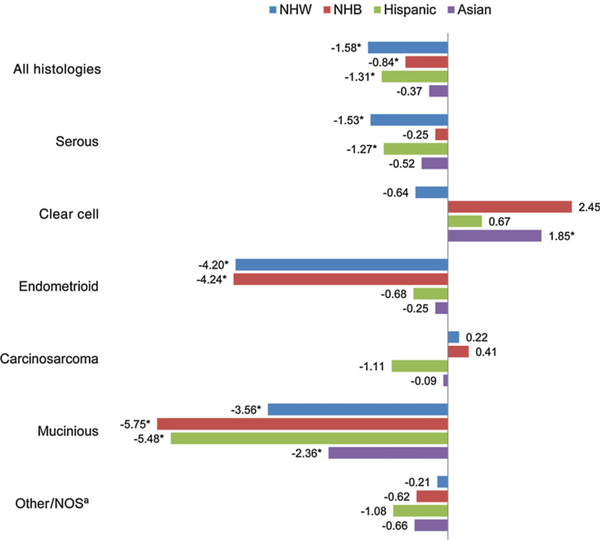
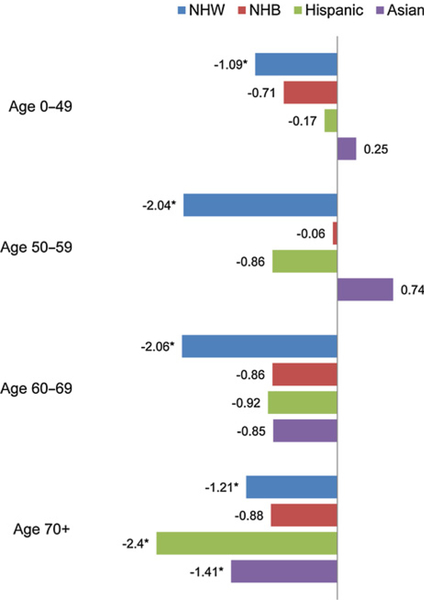
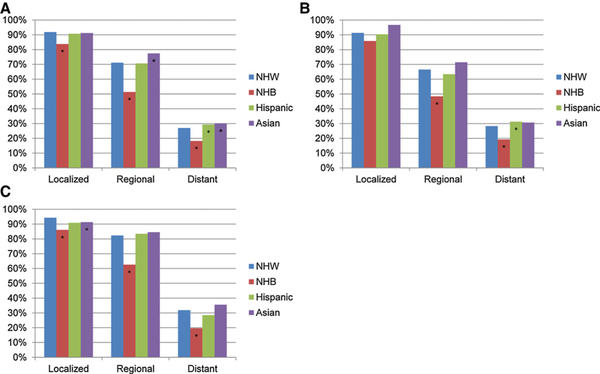
Background: Incidence and survival rates of nonserous epithelial ovarian cancer in racial/ethnic minorities remain relatively unknown in the United States. We examined the trends in incidence and survival rates for epithelial ovarian cancer by histologic subtypes and race/ethnicity.Methods: Ovarian cancer incidence and mortality data from 2000 to 2013 were obtained from the Surveillance, Epidemiology, and End Results database. Age-adjusted incidence rate, incidence rate ratio, and annual percentage changes (APC) were calculated by histology and race/ethnicity subgroups and stratified by age at diagnosis. Five-year relative survival rates were calculated by stage and race/ethnicity.Results: A small but significant decrease in incidence rates was seen in non-Hispanic white (NHW), non-Hispanic black (NHB), and Hispanic women (APC -1.58, -0.84, and -1.31, respectively), while incidence rates remained relatively stable in Asian women (APC -0.37). With exception of significant increase in the incidence rate of clear cell carcinoma among Asian woman (APC 1.85), an overall trend toward decreasing incidence rates was seen across histologic subtypes and age-strata, although not all results were statistically significant. Compared with NHW women, NHB women experienced poorer 5-year survival at every stage across histologic subtypes, while Hispanic and Asian women had equivalent or better survival.Conclusions: Over the last decade, incidence rates of epithelial ovarian cancer in the United States have decreased or remained stable across race/ethnic and histologic subgroups, except for clear cell carcinoma. Survival remains poorest among NHB women.Impact: Comparative histologic subtype distribution and incidence trends do not explain the ovarian cancer survival disparity disproportionately affecting NHB women. Cancer Epidemiol Biomarkers Prev; 26(10); 1511-8. ©2017 AACR.
©2017 American Association for Cancer Research.
Conflict of interest statement
Disclosure of Potential Conflicts of Interest
No potential conflicts of interest were disclosed.
Figures
References
-
- Siegel RL, Miller KD, Jemal A. Cancer statistics, 2016. CA Cancer J Clin 2016;66:7–30. - PubMed
-
- Howlader N, Noone AM, Krapcho M, Miller D, Bishop K, Altekruse SF, et al. SEER Cancer Statistics Review, 1975–2013, National Cancer Institute; Bethesda, MD, http://seer.cancer.gov/csr/1975_2013/, based on November 2015 SEER data submission, posted to the SEER website, April 2016.
-
- Sopik V, Iqbal J, Rosen B, Narod SA. Why have ovarian cancer mortality rates declined? Part I. Incidence. Gynecol Oncol 2015;138:741–9. - PubMed
-
- Gnagy S, Ming EE, Devesa SS, Hartge P, Wittemore AS. Declining ovarian cancer rates in U.S. women in relation to parity and oral contraceptive use. Epidemiology 2000;11:102–5. - PubMed
-
- Beral V, Doll R, Hermon C, Peto R, Reeves G. Ovarian cancer and oral contraceptives: collaborative reanalysis of data from 45 epidemiological studies including 23,257 women with ovarian cancer and 87,303 controls. Lancet 2008;371;303–14. - PubMed
MeSH terms
Grants and funding
LinkOut - more resources
Full Text Sources
Other Literature Sources
Medical