


Gene-based Therapy in a Mouse Model of Blue Cone Monochromacy
- PMID: 28751656
- PMCID: PMC5532293
- DOI: 10.1038/s41598-017-06982-7
Gene-based Therapy in a Mouse Model of Blue Cone Monochromacy
Erratum in
-
Publisher Correction: Gene-based Therapy in a Mouse Model of Blue Cone Monochromacy.Sci Rep. 2018 Mar 14;8(1):4807. doi: 10.1038/s41598-018-23131-w. Sci Rep. 2018. PMID: 29540812 Free PMC article.
Abstract
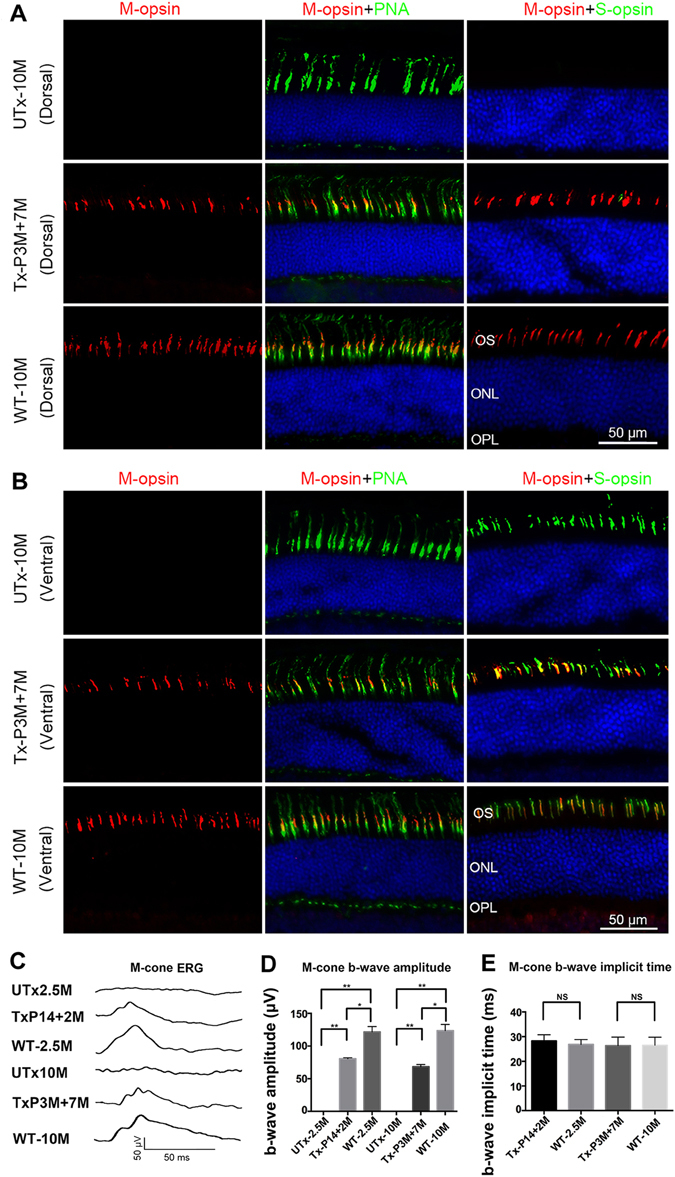
Cones are responsible for daylight, central, high acuity and color vision. Three proteins found in human cones, i.e. long-wavelength (L)-, middle-wavelength (M)-, and short-wavelength sensitive (S)-opsins, are responsible for red, green and blue color recognition, respectively. Human blue cone monochromacy (BCM) is characterized by functional loss of both L- and M-cone opsins due to mutations in the OPN1LW/OPN1MW gene cluster on the X chromosome. BCM patients, who rely on their vision from only S-cones and rods, suffer severely reduced visual acuity and impaired color vision. Recent studies show that there is sufficient cone structure remaining in the central fovea of BCM patients to consider AAV-mediated gene augmentation therapy. In contrast, mouse retina has only two opsins, S-opsin and M-opsin, but no L-opsin. We generated an M-opsin knockout mouse (Opn1mw -/-) expressing only S-opsin as a model for human BCM. We show that recombinant M-opsin delivered by AAV5 vectors rescues M-cone function in Opn1mw -/- mice. We also show that AAV delivered M-opsin localizes in the dorsal cone outer segments, and co-localizes with S-opsin in the ventral retina. Our study demonstrates that cones without M-opsin remain viable and respond to gene augmentation therapy, thereby providing proof-of-concept for cone function restoration in BCM patients.
Conflict of interest statement
WWH and the University of Florida have a financial interest in the use of AAV therapies; WWH owns equity in and is a consultant for AGTC Inc. that might, in the future, commercialize some aspects of this work.
Figures

References
Publication types
MeSH terms
Substances
Supplementary concepts
Grants and funding
LinkOut - more resources
Full Text Sources
Other Literature Sources
Medical
Molecular Biology Databases
Research Materials
