. 2017 Jul 27;7(1):6666.
doi: 10.1038/s41598-017-06411-9.

In silico, in vitro, X-ray crystallography, and integrated strategies for discovering spermidine synthase inhibitors for Chagas disease

Affiliations

In silico, in vitro, X-ray crystallography, and integrated strategies for discovering spermidine synthase inhibitors for Chagas disease

Ryunosuke Yoshino et al. Sci Rep. .

Abstract

Chagas disease results from infection by Trypanosoma cruzi and is a neglected tropical disease (NTD). Although some treatment drugs are available, their use is associated with severe problems, including adverse effects and limited effectiveness during the chronic disease phase. To develop a novel anti-Chagas drug, we virtually screened 4.8 million small molecules against spermidine synthase (SpdSyn) as the target protein using our super computer "TSUBAME2.5" and conducted in vitro enzyme assays to determine the half-maximal inhibitory concentration values. We identified four hit compounds that inhibit T. cruzi SpdSyn (TcSpdSyn) by in silico and in vitro screening. We also determined the TcSpdSyn-hit compound complex structure using X-ray crystallography, which shows that the hit compound binds to the putrescine-binding site and interacts with Asp171 through a salt bridge.


Conflict of interest statement

The authors declare that they have no competing interests.

Figures
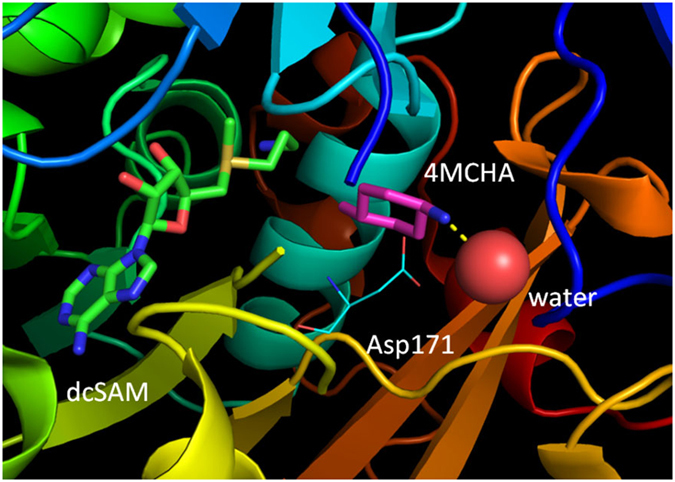
Figure 1
Figure 1
The crystal structure of the TcSpdSyn putrescine-binding site with trans-4-methylcyclohexylamine (4MCHA) (PDB ID code: 4YUW). 4MCHA binds to the putrescine-binding site and interacts with Asp171 through a salt bridge. A water molecule interacts with the 4MCHA amino group.
Figure 2
Figure 2
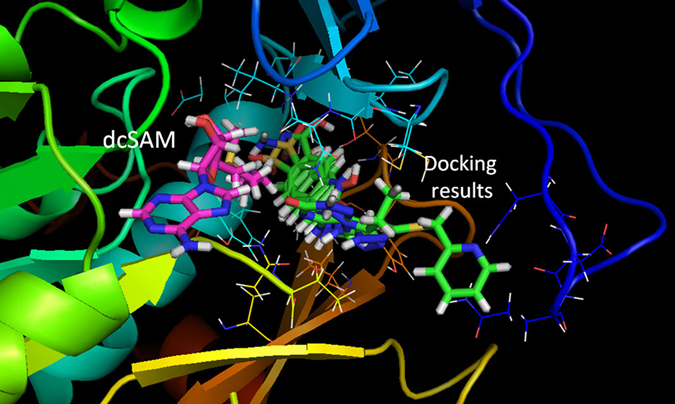
Results of the TcSpdSyn-ligand docking analysis. Docking poses of the top five compounds (green: docking results, pink: dcSAM). This simulation was conducted with the TcSpdSyn X-ray structure (PDB ID code: 3BWC). The docking results show that all compounds bind to the putrescine-binding site and that dcSAM binding in its own site.
Figure 3
Figure 3
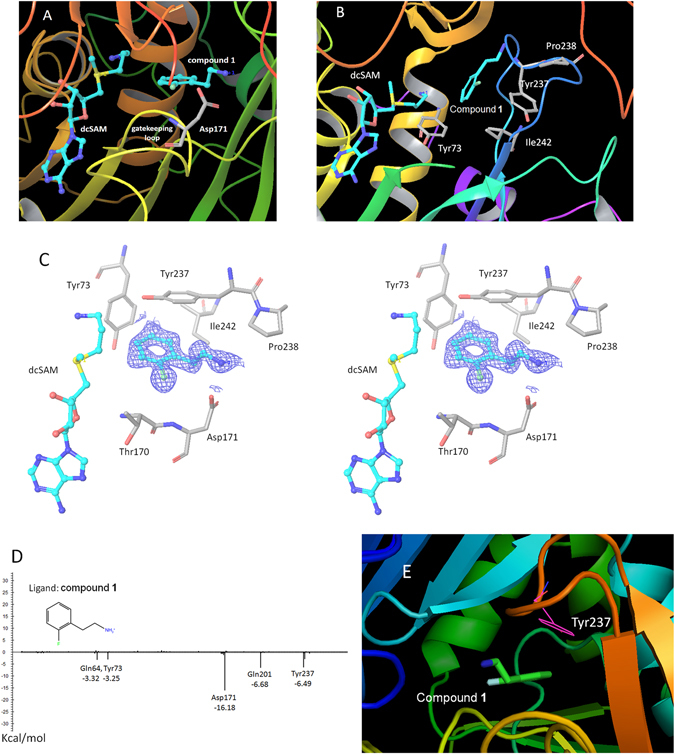
The crystal structure analysis of TcSpdSyn with compound 1. (A) The crystal structure of the TcSpdSyn-compound 1 complex. (B) Binding form of compound 1 predicted by docking simulation. (C) Stereo representation of the TcSpdSyn-compound 1 complex structure. The 2Fo-Fc map around compound 1 is shown as a blue mesh (contoured at 1.5σ). (D) Interaction energy analysis of compound 1. The vertical axis shows the interaction energy (kcal/mol) between the ligand and amino acid, and the horizontal axis shows the amino acid residue number. (E) Interaction between compound 1 and Tyr237.
Figure 4
Figure 4
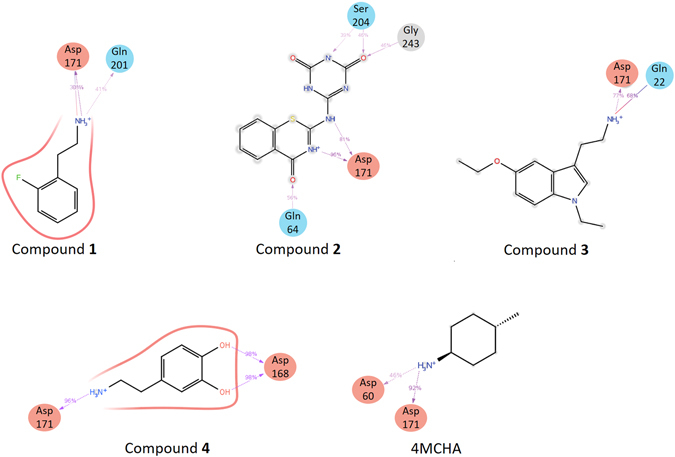
TcSpdSyn-ligand interaction analysis by MD simulation. Schemes of detailed ligand atom interactions with the protein residues are presented. Interactions that occur for more than 30.0% of the simulation time in the selected trajectory (0.00 through 20.00 ns) are shown.

References

    1. Pinto DJC. The treatment of Chagas disease (South American trypanosomiasis) Ann. Intern. Med. 2006;144:772–774. doi: 10.7326/0003-4819-144-10-200605160-00012. - DOI - PubMed
    1. Aufderheide AC, et al. A 9,000-year record of Chagas disease. Proc. Natl. Acad. Sci. 2004;101:2034–2039. doi: 10.1073/pnas.0307312101. - DOI - PMC - PubMed
    1. WHO, Chagas disease (American trypanosomiasis), (2016) (Date of access: 4/5/2016).
    1. Maguire JH. Chagas disease-Can we stop the deaths? N. Engl. J. Med. 2006;355:760–761. doi: 10.1056/NEJMp068130. - DOI - PubMed
    1. WHO, The World Health Report, 2002 (World Health Organization, Geneva, 2002).

Publication types

MeSH terms