


Common Clinical Characteristics and Rare Medical Problems of Fragile X Syndrome in Thai Patients and Review of the Literature
- PMID: 28751920
- PMCID: PMC5511659
- DOI: 10.1155/2017/9318346
Common Clinical Characteristics and Rare Medical Problems of Fragile X Syndrome in Thai Patients and Review of the Literature
Abstract
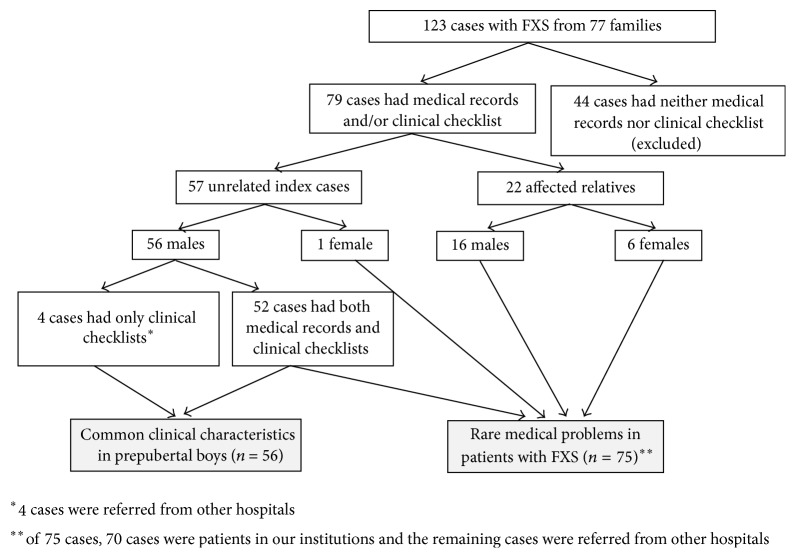
Background. Clinical characteristics of fragile X syndrome (FXS) have been well documented in Caucasians, whereas in Asians they have rarely been described. Those that have been conducted used small cohorts that utilized DNA for diagnosis and larger cohorts that utilized cytogenetics for diagnosis. This study is to describe clinical characteristics of FXS in a large cohort of Thai patients diagnosed by standard molecular methods. Methods. Seventy-seven index cases and 46 affected relatives diagnosed with FXS were recruited into the study. To determine frequencies of common characteristics of FXS in prepubertal boys, we reviewed 56 unrelated cases aged between 18 and 146 months. To list rare medical problems, we reviewed 75 cases aged between 8 months to 71 years old, including 53 index cases and 22 affected relatives. In addition, we selected 16 clinical studies from various ethnicities for comparison with our findings. Results. In prepubertal boys with FXS, attention deficit and/or hyperactivity, prominent ears, macroorchidism, and elongated face were observed in 96%, 80%, 53%, and 48% of patients, respectively, whereas recognizable X-linked inheritance presented in 11% of patients. IQ scores ranged between 30 and 64 (mean ± SD = 43 ± 9, n = 25). We observed clinical findings that rarely or have never been reported, for example, medulloblastoma and tetralogy of Fallot. Conclusion. Attention deficit and/or hyperactivity and prominent ear are the most common behavioral and physical features in prepubertal boys with FXS, respectively. There are differences in frequencies of clinical characteristics observed between ethnicities; however, it is difficult to draw a solid conclusion due to different recruitment criteria and sample sizes within each study.
Figures
References
-
- OMIM. OMIM entry - # 300624 - Fragile X syndrome. 2017, https://www.omim.org/entry/300624.
-
- Saul R. A., Tarleton J. C. FMR1-related disorders. In: Pagon R. A., Adam M. P., Ardinger H. H., et al., editors. GeneReviews(®) Seattle, Wash, USA: University of Washington; 1993.
-
- Hagerman R. J., Hagerman P. J. Fragile X Syndrome: Diagnosis, Treatment, and Research. Baltimore, Md, USA: Johns Hopkins University Press (JHU Press); 2002.
LinkOut - more resources
Full Text Sources
Other Literature Sources
